


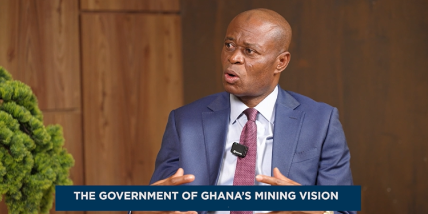
The government plans to station military personnel permanently along selected rivers in a bid to stop illegal miners from returning to sites after enforcement operations, Deputy Minister for Lands and Natural Resources Dr. Yusif Sulemana has announced, with funding for the camps expected in the 2027 national budget.
Speaking on Channel One TV’s The Point of View on the sidelines of the Mining in Motion Summit in Accra, Dr. Sulemana said the decision followed repeated patterns of illegal miners resuming operations once security personnel withdrew from affected river bodies . “Today, as I speak to you, we are putting permanent military men at some riverside to ensure that our young men and women who are on the river bodies mining are not able to do that,” he said. “So, government has now agreed that we put permanent camps there so that we can sustain it. And if you look at next year’s budget, we are going to take care of that” .
A Shift from Raid-and-Withdraw
The announcement signals a strategic shift from periodic enforcement sweeps toward sustained military presence. Under previous arrangements, security operations were largely conducted as short-term exercises, with personnel withdrawn after initial raids, allowing illegal miners to resume activities . The new approach aims to deter re-entry and protect water bodies from further degradation.
The deputy minister rejected suggestions that the government had softened its stance on galamsey because of gold revenue, citing the seizure of excavators and other equipment as evidence of continued enforcement . Beyond enforcement, the government is pursuing cooperative mining arrangements to provide small-scale miners with regulated alternatives, targeting the registration of close to 100 small-scale mining cooperatives by the end of 2026, alongside plans for gold processing centres to improve recovery rates and reduce reliance on mercury and cyanide .
Background: A Long-Running Battle
Illegal small-scale gold mining has been a persistent environmental and economic crisis in Ghana, contributing to the pollution of rivers, destruction of forest reserves, and loss of agricultural land. The practice has strained water treatment plants, with the Ghana Water Company Limited repeatedly warning about rising turbidity levels in major water sources .
The current administration has intensified the anti-galamsey campaign through Operation Halt II and joint task forces involving the military, police, and the Minerals Commission. The ministry has also tightened licensing procedures and increased surveillance through drones and satellite monitoring . In May 2026, the Ministry of Lands and Natural Resources stated that permanent security personnel had already been deployed to critical hotspots, including strategic riverbanks, forest reserves, and mining concessions .
The Mining in Motion Context
Dr. Sulemana’s remarks came on the margins of the second Mining in Motion Summit, held in Accra from October 19 to 21, 2026. The summit brought together government officials, traditional leaders, mining companies, and stakeholders to discuss responsible mining and sustainable development, with a focus on stronger coordination of African mineral policies and greater local value addition . President John Dramani Mahama used the platform to call for African cooperation on mineral royalties and to push for local processing of raw materials before export .
For communities along Ghana’s polluted rivers, the promise of permanent military camps offers a measure of hope that enforcement will no longer be temporary. Whether the 2027 budget delivers the funding—and whether sustained presence translates into cleaner waterways—remains to be seen.