



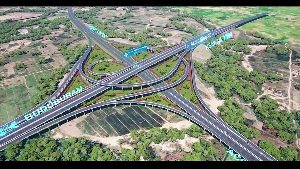
The Government of Ghana is moving forward with the next phase of its flagship infrastructure project, the Accra-Kumasi Expressway, as it begins finalising the detailed design for the ambitious six-lane dual carriageway .
The 198.7-kilometre expressway, a cornerstone of President John Dramani Mahama’s “Big Push” infrastructure agenda, is set to become Ghana’s first dedicated closed toll highway, representing a significant leap forward in the nation’s transport infrastructure .
A New Economic Corridor
The project will follow a completely new alignment, reducing the current travel distance between Accra and Kumasi by more than 50 kilometres. When completed, journey times between the capital and the Ashanti Region’s commercial hub are expected to be slashed to approximately 2.5 hours .
The expressway is being designed for speeds of up to 120 km/h on main sections and will include eight strategic interchanges at locations including Accra Hub, Adeiso, Asamankese, Akyem Oda, Ofoase, and Kumasi. Modern toll plazas featuring 20 lanes each in both Accra and Kumasi, rest stops, filling stations, and pedestrian bridges will enhance convenience and safety for road users .
Funding and Economic Impact
The government plans to raise the estimated $4 billion required for construction from extractive resources, specifically petroleum revenues, following amendments to the Petroleum Revenue Management Law that allow the Annual Budget Funding Amount to be used exclusively for infrastructure projects .
The 2026 national budget has allocated a record GH¢30.8 billion to the broader Big Push road construction initiative—more than double the 2025 allocation—with the expressway expected to create approximately 30,000 direct and indirect jobs during construction .
Regional Transformation
Beyond transport, the expressway is expected to act as a catalyst for economic transformation, sparking the development of new industrial parks, logistics hubs, storage centres, and service economies along its length. The corridor between Accra and Kumasi has been described as the “economic spine of Ghana,” with the project expected to significantly boost trade, tourism, and investment .
The government has also secured a US$12.83 million grant agreement with the African Development Bank to fund feasibility studies, full designs, costings, and environmental and social impact assessments for priority projects under the Big Push initiative .
President Mahama has clarified that the new expressway will complement—not replace—the existing Accra-Kumasi highway, which will continue to serve local traffic and surrounding communities .
With construction expected to commence in early 2026 and completion projected between 2028 and 2029, the Accra-Kumasi Expressway is poised to become one of the most transformative infrastructure projects in Ghana’s history .


