



In one of the most far-reaching institutional overhauls of the executive branch in decades, the government has formally endorsed a constitutional amendment that will sever the Office of the Attorney-General from the Ministry of Justice – ending a 34-year arrangement that has seen the country’s chief legal officer double as a cabinet minister.
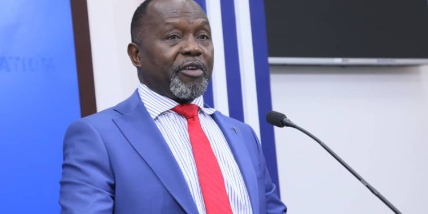
Attorney-General and Minister for Justice, Dr. Dominic Ayine, announced the decision on Thursday while presenting the government’s White Paper on the Constitutional Review Committee (CRC) recommendations. The move, if passed, will fundamentally reshape the legal architecture of the presidency, stripping the Attorney-General of ministerial status while creating a separate portfolio for justice sector oversight.
“The government proposes that Article 88 be amended to remove the requirement that the Attorney-General be a minister of state,” Dr. Ayine stated at the press conference. “A separate portfolio of Minister of Justice will be established to oversee the justice and legal sector. The Attorney-General will remain the principal legal adviser of the Republic and the repository of the prosecutorial authority of the state but will cease to be a minister of state and a member of Cabinet.”
Why the Split? The Case for Independence
The current arrangement, enshrined in Article 88 of the 1992 Constitution, has long drawn criticism from legal scholars and civil society groups. The Attorney-General, as both the state’s chief prosecutor and a political appointee in Cabinet, is often seen as vulnerable to executive influence – particularly in cases involving government officials, ruling party members, or politically sensitive corruption investigations.
By uncoupling the two roles, the government aims to insulate prosecutorial decisions from political pressure. Dr. Ayine described the reform as a “significant restructuring of the legal architecture of the executive” and expressed confidence that “history will judge it kindly.”
The CRC, chaired by Professor H. Kwasi Prempeh, had explicitly recommended the separation in its final report, arguing that the dual role creates an inherent conflict of interest. The committee noted that in several Commonwealth jurisdictions – including the United Kingdom, Canada, and Australia – the Attorney-General is not typically a Cabinet minister, and when they are, strict conventions protect their independence.
Tenure and Removal: A Judicial Shield
To reinforce that independence, the government proposes granting the Attorney-General the same terms and conditions of service as a Justice of the Supreme Court. This includes security of tenure, meaning that future Attorneys-General cannot be removed arbitrarily by the president.
“Whoever is appointed Attorney-General after these amendments come into effect, if you want to remove that person, you have to go through the procedure enumerated under Article 146 of the Constitution,” Dr. Ayine explained.
Article 146 governs the removal of superior court judges through a rigorous process that requires a petition, a determination of a prima facie case by the Chief Justice, and a full judicial tribunal if warranted. This procedural safeguard is designed to ensure that the Attorney-General can act without fear of dismissal for pursuing unpopular prosecutions.
A New Minister of Justice: What Will They Do?
While the Attorney-General retains prosecutorial powers and legal advisory duties, the new Minister of Justice will take over the administrative and policy-making functions of the former combined portfolio. That minister will:
· Oversee the administration of the courts and the judicial service;
· Drive legislative reform and justice sector policy;
· Manage the Ministry of Justice’s budget and staffing;
· Represent the government in parliamentary debates on legal matters.
The minister will be a political appointee and a member of Cabinet, but will have no authority over individual prosecutions – a clear demarcation intended to prevent executive interference in criminal cases.
Broader Anti-Corruption Reforms
The Attorney-General also disclosed that the government has accepted, in principle, the CRC’s recommendation for an independent anti-corruption body. However, rather than enshrining it in the Constitution, the administration intends to establish a Public Ethics Commission through the Conduct of Public Officers Bill currently before Parliament.
Dr. Ayine said the commission would have powers to:
· Investigate corruption and conflicts of interest involving public office holders;
· Prosecute certain offences independently of executive control;
· Recommend sanctions and asset recovery measures.
This approach, he argued, would allow for more flexibility and speed than a constitutional amendment, while still delivering a robust watchdog with prosecutorial teeth.
Reactions from the Legal Community
The announcement has drawn cautious praise from legal practitioners and anti-corruption advocates. Professor Kwame Adu-Amankwah, a constitutional law expert at the University of Ghana, called the separation “long overdue” but warned that the success of the reform hinges on the independence of the appointment process.
“If the president still appoints the Attorney-General unilaterally, even with secure tenure, there remains a risk of patronage,” he said. “We need to see whether the government will also support a more consultative appointment mechanism, such as parliamentary confirmation.”
The Ghana Bar Association (GBA) issued a statement welcoming the move, but urged the government to ensure that the new Minister of Justice does not encroach on the Attorney-General’s prosecutorial discretion. The GBA also called for transparent funding for the Attorney-General’s office to prevent budgetary leverage from the executive.
Political Implications
Opposition parties have reacted with a mix of skepticism and support. The New Patriotic Party (NPP) acknowledged the reform as “a step in the right direction” but questioned the timing, noting that the current Attorney-General is also a government appointee. Some backbenchers have privately expressed concern that the separation could weaken the government’s ability to coordinate legal strategy on major national issues.
However, government insiders argue that the Ministry of Justice will continue to serve as the political face of legal policy, while the Attorney-General becomes a purely technical and quasi-judicial officer – akin to the Director of Public Prosecutions in other jurisdictions.
Next Steps
The proposed constitutional amendments – including the split of the Attorney-General and Justice Ministry, the 60-minister cap, the November election date, and the five-year presidential term – will now be submitted to Parliament. They require a two-thirds majority vote before being put to a national referendum.
If approved by the people, the changes would take effect from the next presidential term, with the first separate Minister of Justice likely to be appointed after the 2028 election.
As Dr. Ayine put it, “This is not about diminishing the Attorney-General’s role; it is about liberating it. We are building a legal system where justice is seen to be done, and done without fear or favour.”


