



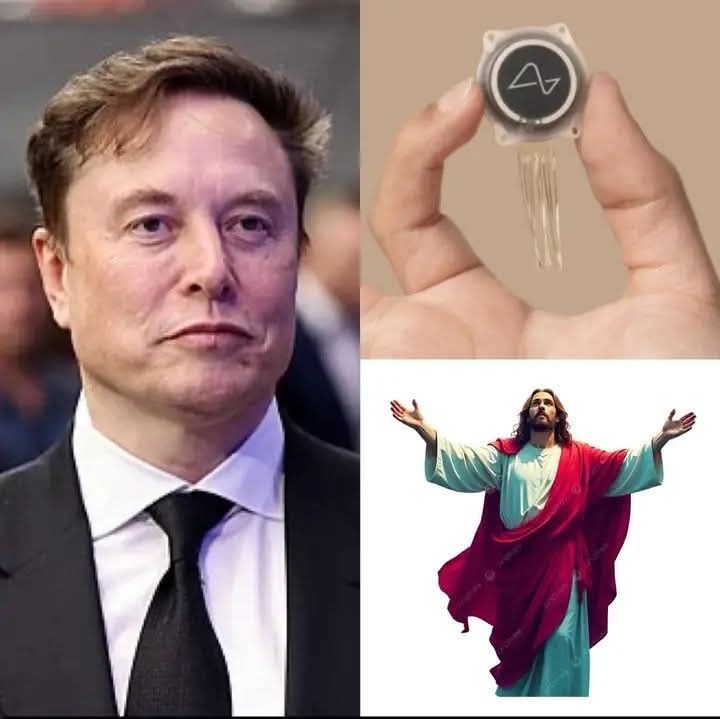
In a stunning announcement that blurs the line between science fiction and scripture, Elon Musk has declared that his brain-computer interface company, Neuralink, is on the verge of granting humanity “God-like powers.” The tech billionaire claimed that the implant will soon allow users to perform “Jesus-level miracles,” including restoring sight to the blind and enabling the paralyzed to walk .
In a series of dramatic statements on social media, Musk outlined a future where neurological disabilities are not just treated, but obliterated by technology.
“You will have God-like powers,” Musk stated, describing the upcoming capabilities of the Neuralink chip. He specifically referenced the ability to perform “miracles like Jesus,” specifically highlighting the restoration of vision and mobility .
The ‘Blindsight’ Breakthrough
While the rhetoric was messianic, the technology behind the claim is already in motion. The primary vehicle for these “miracles” appears to be Neuralink’s Blindsight device, which has already received the FDA’s “Breakthrough Device” designation .
According to documentation and Musk’s previous statements, the Blindsight implant works by bypassing damaged optic nerves entirely. It uses an electrode array implanted in the visual cortex to convert video feed from an external camera into electrical signals, effectively creating a digital version of sight .
Musk has elaborated on how this will work for those who have never experienced vision:
“It will enable even those who have lost both eyes and their optic nerve to see. Provided the visual cortex is intact, it will even enable those who have been blind from birth to see for the first time.”
He clarified that the initial quality may look like “low resolution” or “Atari graphics,” but the long-term potential is to exceed natural biological vision, potentially allowing humans to see in infrared or ultraviolet wavelengths .
Beyond Vision: Speech and Mobility
The “miracle” claims extend beyond eyesight. Neuralink is also developing a speech restoration system, which has also received FDA breakthrough status. This device is designed to read speech intent directly from brain signals, converting thought into text or synthesized speech for those suffering from severe paralysis or ALS .
Furthermore, Musk’s vision of the future includes “full-body functionality” for those with severed spinal cords, allowing individuals who have never walked—or who have lost the ability—to stand and move again .
The Path to ‘Launch’
Is this technology ready for primetime? Data obtained by this newsroom indicates the hardware is rapidly evolving.
Neuralink is currently in a significant expansion phase. As of early 2026, the company has successfully implanted devices in nine clinical trial participants, achieving data transfer rates of over 9 bits per second—double the previous record . The company is expanding trials to Canada, the UK, and the UAE, aiming to enroll 20-30 new participants by the end of the year .
To support the “launch” of these powers, Neuralink recently unveiled a next-generation surgical robot. This new system is designed to make the implantation process nearly automatic, akin to LASIK eye surgery. It can implant the ultra-fine electrode threads in just 1.5 seconds (down from 17 seconds) and is compatible with 99% of human anatomies .
Musk has directed his team to move toward “mass production” in 2026, with the goal of eventually implanting thousands of patients per year using automated surgery .
Would You Accept the Chip?
The announcement raises profound ethical and existential questions. If Neuralink can restore sight, speak through the mute, and activate paralyzed limbs, does it constitute a “miracle”? Or is it just extremely advanced engineering?
As one commentator recently noted, if Musk succeeds, it could render historical accounts of miracles “irrelevant,” offering verifiable, scientific restoration of abilities that have historically been the domain of faith .
The question remains for the public: To gain these “God-like powers,” are you willing to have a chip planted in your head?
This is a developing story. Neuralink has not yet released a specific commercial launch date for the general public, though clinical trials for the vision device are expected to begin this year .


