



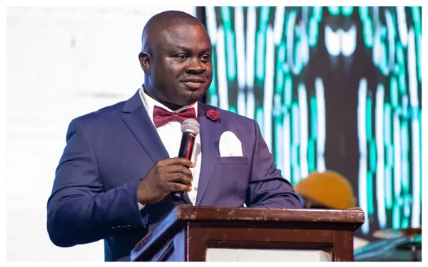
President of the Ghana Journalists Association (GJA), Albert Kwabena Dwumfour, has called on the government to broaden its fight against illegal mining — popularly known as galamsey — by targeting financiers, equipment suppliers, and gold buyers operating within the illegal gold economy, rather than focusing solely on excavator operators at the bottom of the supply chain.
Speaking at the 2026 National Mining Dialogue in Accra on Tuesday, August 18, Mr Dwumfour stressed that the current approach of pursuing small-scale operators would not end the menace, as illegal mining activities are sustained by a wider network of influential actors.
“Our response to illegal mining must also go beyond the person operating the excavator,” Mr Dwumfour said. “The illegal gold economy has financiers, equipment suppliers, buyers, middlemen and other interests behind it. If we target only the person at the bottom, we may remove one excavator today and find another one in the same place tomorrow.”
He urged authorities to deploy what he described as “follow the chain” and “follow the money” tactics, insisting that where evidence implicated powerful interests, those individuals or entities should not be shielded because of their influence. “The law must apply equally,” he emphasised.
The dialogue, presided over by the Ga Mantse, King Tackie Teiko Tsuru II, was organised by Asempa 94.7 FM and its flagship programme Ekosiisen, in partnership with Semmis DS and the Ministry of Lands and Natural Resources. Held under the theme “Mining, Local Content and the Catchment Compact: Rethinking the Social Licence to Operate” , discussions focused on how Ghana can maximise the economic and social value from the extraction of its mineral resources without compromising the health and environmental wellbeing of present and future generations. The event attracted government officials, traditional authorities, mining industry players, regulators, and other stakeholders.
Balancing Economic Gains with Environmental Protection
While acknowledging mining’s significant contribution to the national economy — noting that producing member companies of the Ghana Chamber of Mines paid GHS17.68 billion in fiscal payments to the government in 2024 — Mr Dwumfour cautioned that economic gains should not be the sole measure of mining’s value.
“We must also ask: At what cost? Who benefits? Who bears the consequences? And what are we leaving behind when the minerals are gone?” he stated.
Drawing from his personal background in Tarkwa, a major mining area in the Western Region, Mr Dwumfour said mining had both created opportunities and placed pressure on land, water bodies, and livelihoods. He cautioned against equating small-scale mining with illegal mining, noting that thousands of Ghanaians depend on artisanal and small-scale mining for their livelihoods, and advocated credible pathways to formalise responsible small-scale mining while protecting the environment.
GJA to Conduct Nationwide Assessment of Galamsey Impact
Mr Dwumfour also announced plans by the GJA to hold a one-week dialogue and symposium on the galamsey crisis, followed by a nationwide field exercise involving veteran and experienced journalists to assess the status of the menace.
He said the team would visit affected communities and mining sites, examine rivers and degraded lands, and engage miners, farmers, traditional leaders, regulators, and other stakeholders to obtain a comprehensive picture of the impact of illegal mining and efforts to address it.
“This exercise will be independent of government,” he explained, adding that the GJA would “go there to find the truth” and publish its findings irrespective of whether they pleased the government or the opposition. “We will report what we find. If there has been progress, we will say so. If there are gaps, we will identify them. If there have been failures, we will report them.”
The GJA President urged the media to remain independent while holding government, mining companies, and regulators accountable, and giving affected communities a voice.
Background: Heightened National Focus on Galamsey
The call comes amid intensified national efforts to combat illegal mining, which has devastated forest reserves and water bodies across Ghana. According to government figures, by the first half of 2026, authorities had seized 78 excavators, immobilised 90, destroyed 2,800 changfans (washing plants), and made 207 arrests in anti-galamsey operations. Additionally, 465 suspects were arrested and 112 pump-action guns seized during a six-month crackdown.
The government has also reported losing 8,900 hectares of forest reserves to illegal mining, with the Lands Ministry engaging the Attorney-General’s Department to address prosecution bottlenecks. President John Dramani Mahama has announced a new strategy to prevent illegal miners from returning to cleared forest reserves and has pledged to go after the financiers and masterminds behind the menace.
The National Mining Dialogue forms part of broader efforts to discourage illegal gold mining and promote responsible mining practices across the country.


