

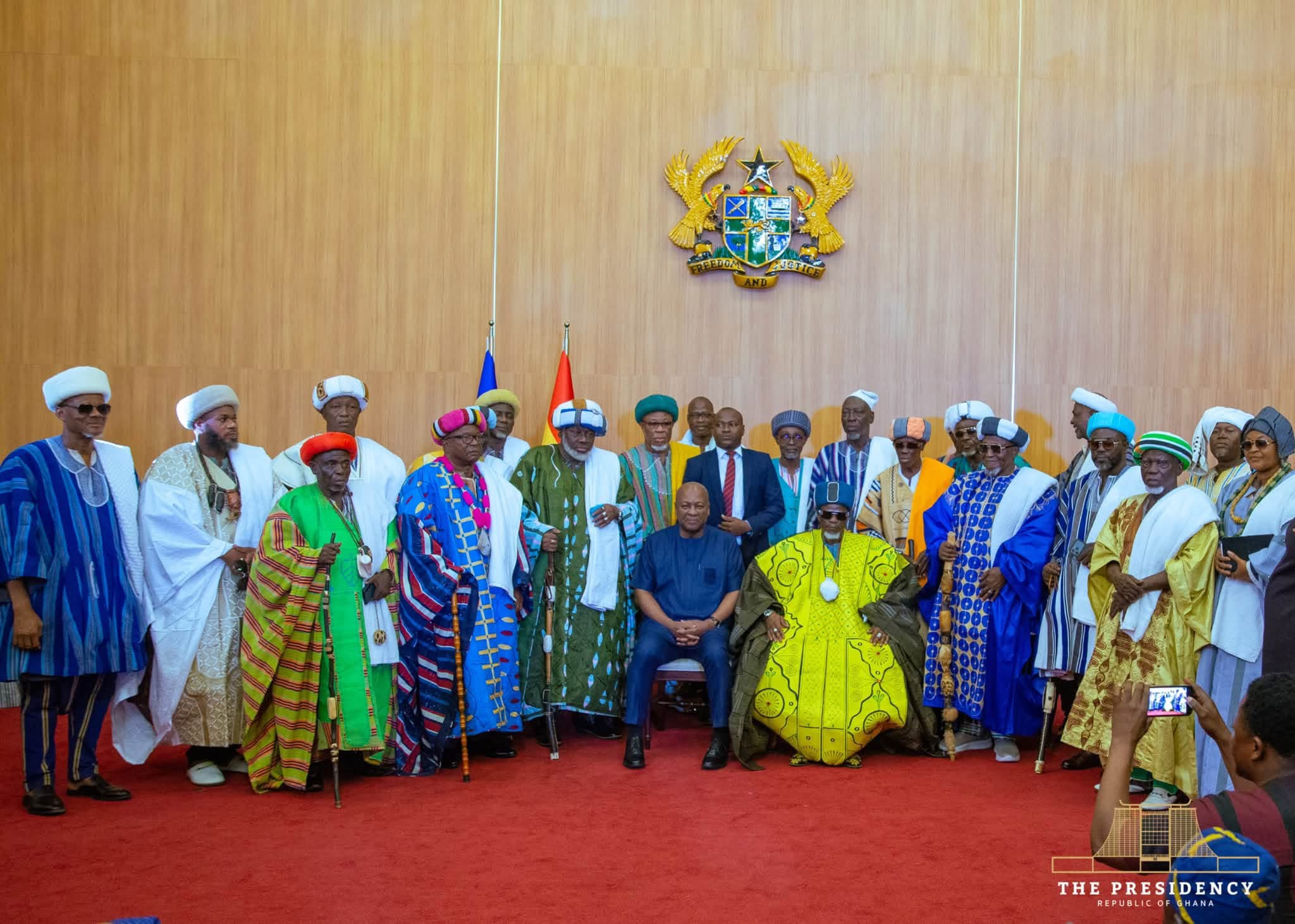
President John Dramani Mahama did something on Monday that was not on the official programme. When the Regent of Dagbon, Kampakuya-Naa Yakubu II, visited Jubilee House for a courtesy call, the President rose, asked for an ordinary chair for himself, and offered his own presidential seat to the Regent for the photographs.
Protocol did not require it. The President’s chair is the President’s chair. But in Dagbon, the skin is not merely a seat—it is the embodiment of the kingdom’s authority, history and identity. To honour the skin is to honour the people. Mahama, according to accounts of the event, understood exactly what that stool meant.
The gesture came during the Regent’s first formal visit to the Presidency since his enskinment in July, following the death of his father, Ya-Na Abukari II, in South Africa . The Regent came with elders and paramount chiefs to present himself formally, as Dagbon custom requires a newly installed leader to call on the head of state .
A Kingdom That Has Seen War and Peace
The symbolism of the moment cannot be separated from Dagbon’s recent history. The kingdom endured a 17-year chieftaincy conflict between the Abudu and Andani royal gates following the assassination of Ya-Na Yakubu Andani II in 2002 . Peace was restored in January 2019 when Ya-Na Abukari II was enskinned as the 41st overlord, a milestone overseen by a committee of eminent chiefs led by the Asantehene, Otumfuo Osei Tutu II .
The late Ya-Na was widely credited with bridging the divide between the two gates. President Mahama described him as “a bridge-builder” during Monday’s meeting, and the Regent pledged to maintain those bridges and build his own . The late overlord’s constitution for the kingdom, drafted by representatives from all traditional areas and approved by the Dagbon Traditional Council, sets the Regent’s tenure at 18 months after the Ya-Na’s passing .
Against that backdrop, the chair carried weight. It was not simply a courtesy to a visiting traditional ruler. It was a sitting President of a constitutional republic signalling that the customs and institutions of Dagbon command respect at the highest level of the state.
A Contrast in Symbolism
The gesture also carries a contrast with recent presidential practice in Ghana. Under the previous administration of Nana Akufo-Addo, the presidential chair became a subject of public debate—a specially designated seat was reportedly transported in a dedicated vehicle to events across the country, and critics argued that the practice symbolised an elevation of the individual over the office . The debate was never about the furniture itself, but about what it communicated in a struggling economy: distance between leadership and the people.
Mahama’s decision to hand his chair to the Regent inverts that symbolism. The Presidency, in this framing, is powerful enough to be humble. The Republic is secure enough to honour the Kingdom.
Substance Beyond Symbolism
The visit was not only ceremonial. President Mahama used the occasion to assure Dagbon of its fair share of development projects, identifying roads, education, healthcare, agricultural livelihoods and water supply as central to the partnership between government and traditional authorities . He disclosed that funding had been secured for major water systems in Tamale, Damongo and Yendi, with interim measures—including the replacement of old pumps—expected to improve supply to Tamale by November .
“I wish to assure you that as long as I remain President, Dagbon shall receive its fair share of any development that my government has undertaken,” Mahama said .
The Regent, for his part, pledged to uphold the constitution developed under his father and to ensure that the transition period leading to the selection of a new Ya-Na proceeds transparently and in accordance with custom . He placed the palace’s systems at the government’s disposal for mobilising youth, land acquisition, traditional arbitration and public education .
The Chair as a Lesson
Ghana’s presidential seat is not an ordinary piece of furniture. Known traditionally as the Asεsεgua, or Seat of State, it is carved from wood overlaid with gold and adorned with adinkra symbols representing the sovereignty and communal principles of the nation . It was designed by the artist Kofi Antubam to blend the ceremonial authority of the colonial governor’s chair with the visual language of Ghanaian traditional rule .
To give that seat away, even for a photograph, is to make a statement about what authority is for. The Presidency is not diminished by humility. The Republic is not weakened by respect for its constituent kingdoms. And leadership, as the moment suggested, is not about who sits highest, but who lifts others higher.
Dagbon has seen war. Dagbon has seen peace. On Monday, it saw a President stand so that the Regent could sit.