



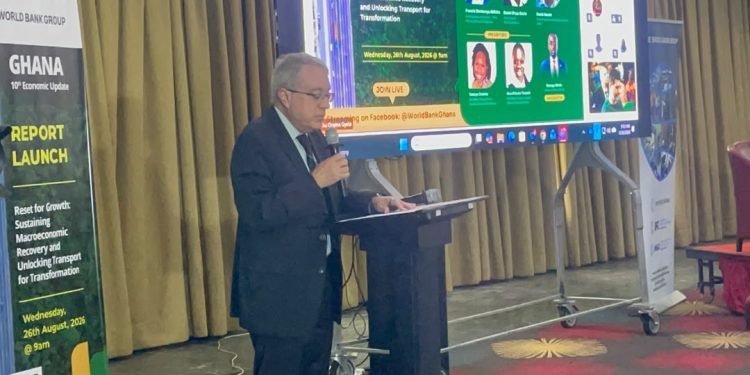
The World Bank has issued a stark warning that Ghana’s recent economic rebound has failed to lift the majority of its citizens out of poverty, revealing a deep structural imbalance between macroeconomic gains and the daily realities of households.
Launching the 10th Ghana Economic Update in Accra on Wednesday, World Bank Division Director for Ghana, Liberia and Sierra Leone, Dr. Robert Taliercio O’Brien, disclosed that 56.4% of Ghanaians remain in poverty, despite the country recording significant growth figures over the past year.
“56.4% of Ghanaians remain in poverty, and spatial disparities are widening,” Dr. Taliercio O’Brien said.
The report comes as Ghana’s economy shows signs of strong recovery, expanding by 6.4% in the first quarter of 2026, following a 6% growth rate in 2025. However, the World Bank noted that this expansion has not translated into broad-based improvements in living standards.
According to Dr. Taliercio O’Brien, the current growth trajectory is being driven primarily by sectors—such as mining and information technology—that have limited capacity to absorb labour. This poses a particular challenge for the country’s rapidly expanding youth population.
“Growth is led by sectors with limited employment absorption relative to its growing young population entering the labour market in the next decade,” he explained.
The warning is underscored by stark labour market data. Nearly 2 million young Ghanaians aged 15 to 35 are currently classified as Not in Education, Employment, or Training (NEET), with youth unemployment standing at approximately 21.9%.
The World Bank further highlighted widening regional inequalities as a critical concern. While poverty rates in the North East and Savannah regions remain alarmingly high at over 50%, the absolute number of poor people is now surging in more populous areas such as the Ashanti and Eastern regions, each of which now hosts more than one million individuals living in poverty.
Dr. Taliercio O’Brien described the situation as a “structural imbalance that also demands urgent attention,” stressing that the disconnect between headline economic performance and household welfare cannot be ignored if Ghana is to achieve sustainable development.
The assessment arrives as the government intensifies efforts to consolidate its post-crisis economic recovery. Stakeholders are now calling for policy interventions that prioritise job creation, particularly in labour-intensive sectors, to ensure that the nation’s growth is inclusive and beneficial to a broader cross-section of the population.


