



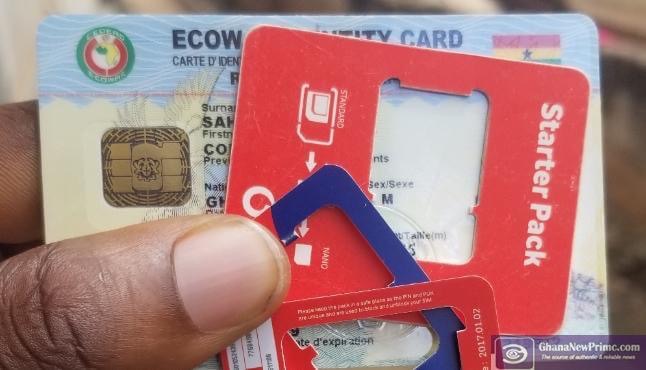
The government will introduce biometric verification as part of Ghana’s SIM registration process before the end of 2026, Communications, Digital Technology and Innovations Minister Samuel Nartey George has announced.
Parliament has passed the Legislative Instrument (LI) on SIM registration, clearing the way for the implementation of the next phase of the exercise . The biometric verification system will require subscribers to provide biometric data such as fingerprints, strengthening subscriber identification and improving the integrity of SIM registration data .
New exercise, not a continuation
The upcoming registration exercise will not be a continuation of the previous one undertaken between 2021 and 2023, but rather a completely new reset exercise . Unlike previous exercises that focused on SIM cards, the new process will register individual phone numbers and link each to a verified identity through real-time biometric verification against the National Identification Authority (NIA) database .
Speaking at the Government Accountability Series at Jubilee House in Accra on Monday, September 7, Mr George said the move forms part of broader efforts to strengthen Ghana’s digital identity and telecommunications systems. He said the government would ensure that the regulatory framework keeps pace with developments in the digital space .
Why a new exercise is needed
The decision follows an audit conducted by the National Communications Authority (NCA) that revealed serious deficiencies in the previous registration exercise. In June 2025, the NCA sampled about 2 million registrations and cross-checked them against the NIA database, finding that some SIM records could not be verified and that there was zero match with biometric capture methods .
NCA Director-General Edmund Yirenkyi Fianko explained that discrepancies arose because the NIA captures fingerprints using contact methods, while SIM registration was done using contactless techniques . The audit also revealed incorrect identity information, unverifiable biometrics, and inconsistencies across systems .
Facial recognition checks fared somewhat better, with 81.1 percent matching out of 2.3 million registrations validated, while 18.9 percent did not match. However, there was no liveness check to verify that the person presenting the SIM card was the rightful owner .
Previous challenges
The earlier SIM registration exercise began on October 1, 2021, and required subscribers to first link their SIM cards to their Ghana Cards, then complete biometric capture at their service provider’s customer care centre or agent .
By October 2022, approximately 28.96 million SIM cards had been linked to Ghana Cards—representing 67.28 percent of all SIM cards issued—while only 18.93 million (44.28 percent) had completed both stages of registration . Nearly 10 million subscribers who had completed the first stage never followed through with the second .
The exercise officially ended on May 31, 2023, after several deadline extensions, leaving over 10 million subscribers only partially registered and exposed to deactivation. MTN Ghana alone blocked approximately 5.4 million unregistered SIM cards at the close .
Enhanced security features
The new biometric verification system will make it more difficult to register SIM cards using fraudulent identities and improve the traceability of subscribers in cases involving fraud or other criminal activity .
Key features of the new system include real-time biometric verification, mandatory audit trails, stricter accountability measures to track registration activities, and a Central Equipment Identity Register (CEIR) to enable cross-network blocking of stolen or fraud-linked devices .
A “primary number system” will also be introduced where a subscriber’s existing primary number receives a one-time password to approve any additional SIM registration linked to the same Ghana Card . The exercise incorporates a “liveliness test” using facial recognition to ensure the person presenting the Ghana Card is physically present and not using a photograph .
Consumer-friendly approach
The government has emphasised that the consumer will not bear any cost for the registration, as services rendered by the NIA will be paid for by the telecommunications companies . The NCA has assured that consumer convenience remains central to both the legal framework and technical implementation of the new process .
The Ministry is working closely with the Bank of Ghana and the Data Protection Commission to align telecommunications operations with financial and data protection regulations, especially in mobile money services . SIM cards will only be activated after successful real-time verification against the NIA database, ensuring every active line is linked to a verified identity .
With Parliament having passed the LI, the Ministry is expected to work with the NCA and telecommunications companies to implement the biometric verification system before the end of the year. Subscribers will be given a timeline to complete the new verification process, with sanctions expected for non-compliance .
“The work is far from finished, and I will not pretend otherwise. But the direction is unmistakable, the results are measurable, and the resolve of this Ministry is unshaken,” Mr George said .


