



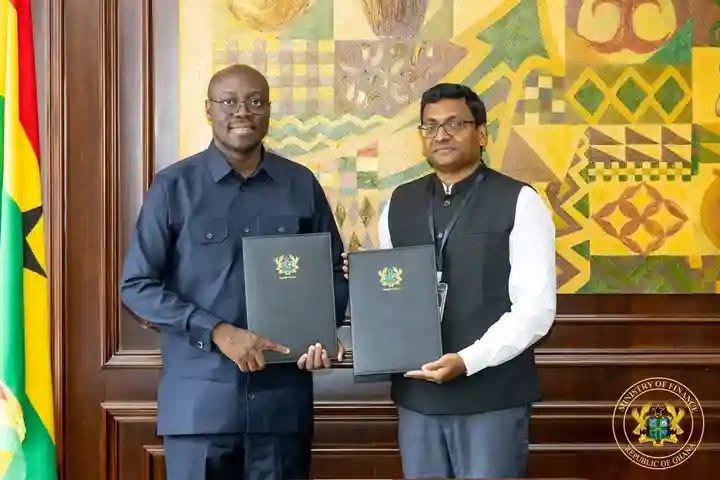
Finance Minister Dr Cassiel Ato Forson has announced the signing of Ghana’s 11th bilateral debt restructuring agreement, this time with the Export-Import Bank of India, as the country accelerates its economic recovery and moves decisively toward a low risk of debt distress.
Accra, Ghana – Ghana has taken another significant step in its debt restructuring programme, signing its 11th bilateral agreement with EXIM India, Finance Minister Dr Cassiel Ato Forson announced on Monday, March 30, 2026.
The agreement marks a critical milestone in the country’s broader efforts to restore debt sustainability and stabilise the economy following years of severe fiscal strain. Dr Forson expressed confidence that Ghana is gradually turning the corner, pointing to improving economic indicators that signal a sustained recovery.
“We are moving steadily towards a low risk of debt distress, with clear indicators that the worst is behind us,” the Finance Minister stated.
The government has reaffirmed its commitment to honouring all restructured obligations on time. “Our commitment is firm: to honour all restructured obligations on time and to keep debt sustainability at the core of every financing decision going forward,” Dr Forson emphasised.
Resident Representative of EXIM India, Rajesh Kumar Gulla, expressed support for Ghana’s recovery efforts, noting that the institution understands the challenges the country faces and is encouraged by its recent progress.
New Loans Act to Enforce Fiscal Discipline
Alongside the debt deal, Dr Forson announced plans to introduce a new Loans Act aimed at tightening controls on public borrowing. The proposed legislation will strictly define how borrowed funds are utilised, ensuring that every loan is tied to high-impact, value-for-money investments.
“As part of this reset, the government will introduce a new Loans Act to strictly define the use of borrowed funds, ensuring that every loan is tied to high-impact, value-for-money investments,” the Finance Minister explained.
The law is expected to eliminate non-essential borrowing and strengthen fiscal discipline across government financing decisions. Dr Forson stressed that the era of excessive borrowing must come to an end.
“Our guiding principle is simple: whatever we borrow must be worth it and must deliver tangible benefits to the Ghanaian people,” he said.
The proposed Loans Act is expected to complement broader public financial management reforms aimed at strengthening accountability, improving investment efficiency, and safeguarding the country’s fiscal stability.
Economic Recovery Gains Momentum
The agreement with EXIM India comes as Ghana’s economy shows increasingly strong signs of recovery. The country has successfully concluded its Extended Credit Facility programme with the International Monetary Fund ahead of schedule, transitioning to a Policy Coordination Instrument (PCI) arrangement.
Gross international reserves have reached an all-time high of approximately US$14.5 billion as of February 2026, equivalent to nearly six months of import cover. Ghana’s sovereign credit rating has climbed from restricted default status to a ‘B’ rating with a positive outlook, representing five distinct rating upgrades.
Inflation has declined sharply from 23.8% in December 2024 to 3.4% in April 2026, while fiscal consolidation has resumed with the government recording a primary surplus without cutting critical social and infrastructure spending. The government is now targeting an investment-grade credit rating within the next three years.
Steady Progress in Debt Restructuring
The EXIM India deal represents the 11th bilateral restructuring agreement Ghana has secured as part of its comprehensive debt resolution strategy. The country has also reached a bilateral debt agreement with the United States to restructure sovereign debt owed to the US EXIM Bank, signed on May 6, 2026.
The IMF has acknowledged significant progress in debt restructuring efforts, noting improvements in Ghana’s debt trajectory. Bilateral agreements have been reached with about half of official creditors under the G20 Common Framework.
Dr Forson stressed that the restructuring programme goes beyond easing the immediate debt burden, serving as a fundamental reset of Ghana’s borrowing strategy. He reiterated that Ghana will not return to a path of unsustainable borrowing.
“Ghana will not return to a path of unsustainable borrowing,” he emphasised, noting that lessons have been learned from the country’s recent financial challenges.


