



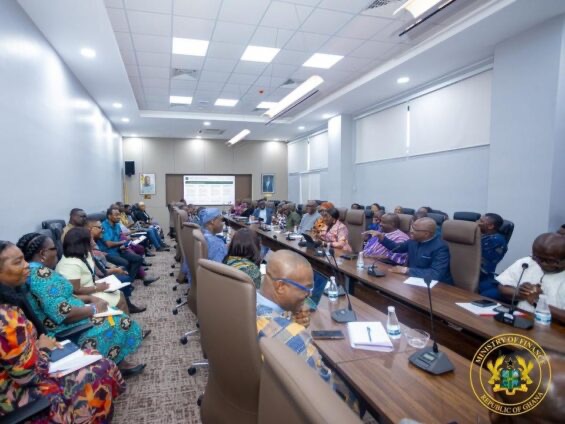
The Minister for Finance, Dr Cassiel Ato Forson, has commenced a series of consultations with key government ministries to shape the details of the government’s ambitious New Economy transformational programme. The initiative, which is backed by a planned US$10 billion investment, is designed to steer Ghana beyond macroeconomic stabilisation towards sustainable job creation and industrial growth.
The first round of engagement saw Dr Forson, accompanied by Deputy Finance Minister Thomas Nyarko Ampem and senior ministry officials, hold a deep-dive session with the Minister for Trade, Agribusiness and Industry, Elizabeth Ofosu-Adjare, and her team in Accra on Wednesday, September 2, 2026 . The meeting was convened to solicit sector-specific inputs and review existing policies to ensure the new programme delivers measurable benefits to the Ghanaian economy.
A Shift from Stabilisation to Transformation
The consultations follow the presentation of the 2026 Mid-Year Fiscal Policy Review, during which Dr Forson outlined the government’s new strategic focus. He emphasised that the administration’s success in restoring fiscal discipline and economic stability was merely the foundation for the next phase of development.
“Through the New Economy agenda that we will unveil, we will build an economy that does not merely withstand shocks but creates jobs, generates wealth and grows on the strength of what Ghana produces,” Dr Forson stated . He stressed, “Stabilisation was never the destination. It was the price of entry. Ghana has paid that price. What comes next is the work that changes lives at scale—the work of transformation” .
Reviewing Policies for Tangible Impact
During the engagement, Dr Forson underscored the importance of reviewing existing policies to ensure they are aligned with current economic realities and deliver concrete results. He cited the Free Zones Act as a critical area for introspection, calling for a thorough assessment of its contribution to job creation and industrial development over the past three decades .
The Finance Minister further advocated for robust systems to monitor the economic contributions of businesses benefiting from government incentives, particularly concerning investment, job creation and the retention of economic value within Ghana . In response, Minister Ofosu-Adjare reaffirmed her Ministry’s commitment to providing sector-specific inputs to ensure the programme achieves its goal of shared prosperity and job creation by 2030 .
The US$10 Billion Investment Plan
This consultative process is set to shape the roll-out of the New Economy initiative, which President John Dramani Mahama has announced will involve a US$10 billion investment across seven strategic sectors over the next four years .
The President has indicated that agriculture and agro-processing will receive the largest share of the investment, accounting for 50 per cent of the allocation, or US$5 billion. This is aimed at boosting food production, rehabilitating irrigation facilities for year-round cultivation, and reducing the nation’s reliance on food imports .
Context of Economic Recovery
The focus on transformation comes on the back of significant economic gains. The Finance Minister has attributed the recovery to three key reforms: fiscal correction, modernisation of the tax regime, and a complementary fiscal policy supporting inflation targeting and exchange rate stability . These measures have resulted in a declining primary expenditure and an improved fiscal balance, creating the fiscal space needed for the upcoming investment .
The full details of the New Economy transformational programme are expected to be unveiled in the 2027 Budget statement scheduled for November .


