



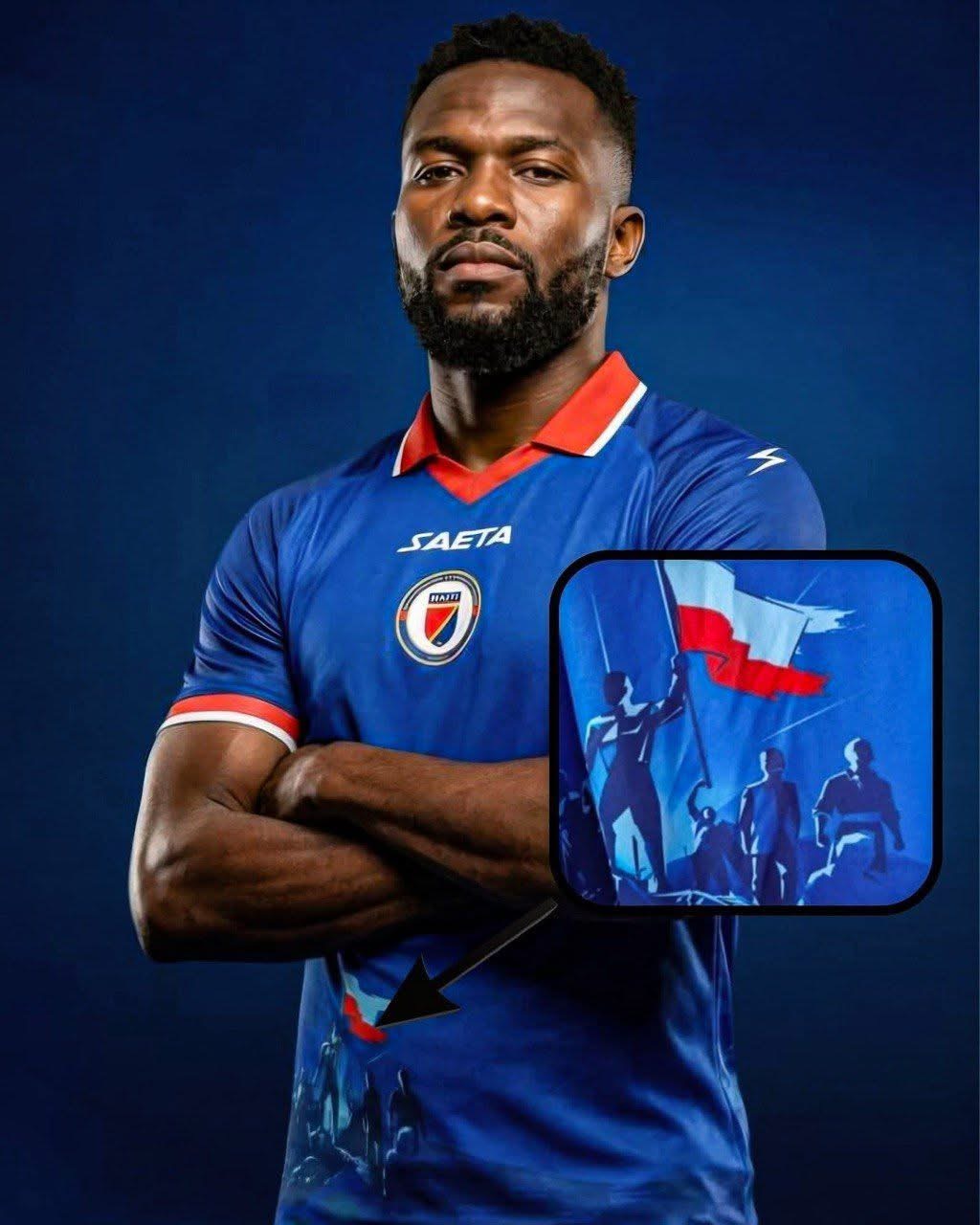
Just three days before their historic return to the FIFA World Cup, Haiti’s national team has been forced into a last‑minute jersey redesign after world football’s governing body ruled that elements of the original kit violated regulations prohibiting political messages.
The decision, confirmed late Tuesday by the Haitian Football Federation’s official sportswear supplier Saeta, has ignited a fierce debate over where national pride ends and political symbolism begins.
Historic battle at the centre of the controversy
At the heart of the dispute is an illustration woven into the blue home jersey depicting the Battle of Vertières — the decisive 1803 clash in which indigenous Haitian forces led by Jean‑Jacques Dessalines defeated Napoleon’s French expeditionary army, paving the way for Haiti’s independence on 1 January 1804. The battle remains one of the most revered episodes in Haitian history, marking the culmination of a thirteen‑year revolution that made Haiti the first nation in the world to permanently abolish slavery.
Yet under FIFA’s Equipment Regulations, players and officials are strictly forbidden from displaying “political, religious or personal messages or slogans of any nature, in any language or format” on match kits. During the standard approval process for World Cup uniforms, FIFA determined that certain visual elements in Saeta’s design “could be interpreted differently under its equipment regulation and ultimately requested modification to the design.”
‘A tribute, not a statement’
Saeta, a Colombia‑based sportswear company that has supplied Haiti’s national teams since the 2010 earthquake, defended its original concept. In an official statement, the firm insisted that the jersey was never intended as a political declaration.
“The final design presented by Saeta was intended as a tribute to the men and women who contribute every day to Haiti’s future and was not intended as a political statement,” the company said.
It added: “Several concepts were developed and refined over a number of months and submitted through FIFA’s standard approval process. While this interpretation differed from our intent, Saeta respected the process and implemented the final requirements communicated by FIFA.”
Neither FIFA nor Saeta has publicly specified exactly which elements of the design triggered the ruling, though sources confirmed to the Miami Herald that the Vertières battlefield imagery was the primary concern.
The Polish flag misunderstanding
Adding to the confusion, social media users in recent days had speculated that the jersey featured the white‑and‑red flag of Poland — leading to claims that Haiti intended to honour Polish soldiers who fought alongside Haitian revolutionaries. In fact, many Polish legionaries sent by Napoleon to crush the slave uprising instead defected and joined the Haitian cause. After independence, Dessalines granted Polish fighters Haitian citizenship and famously referred to them in the constitution as “the Blacks of Europe.”
However, the flag visible on the jersey is not the Polish standard. It is in fact the first flag of independent Haiti: two horizontal bands of blue and red, created in 1803 when Dessalines tore the white centre from the French tricolour and sewed the remaining blue and red stripes together. Because Haiti’s home jersey is predominantly blue, the flag’s blue stripe was digitally lightened for visibility, which in certain photographs created an optical illusion — making the combination of white and red appear reminiscent of Poland’s national colours.
A pattern of scrutiny
This is not the first time Haitian sportswear has drawn objections from international governing bodies. In February 2026, Italian‑Haitian designer Stella Jean was forced to make last‑minute alterations to outfits she created for Haiti’s Winter Olympic delegation after the International Olympic Committee ruled that a portrait of revolutionary hero Toussaint Louverture riding a red horse into battle violated rules against political, religious or racial propaganda.
Months earlier, Saeta itself faced cultural debate when observers questioned whether geometric patterns on the white jerseys Haiti wore during World Cup qualifying were vèvè symbols — sacred Vodou imagery drawn during spiritual ceremonies. The federation and the manufacturer declined to comment on that speculation at the time.
Haiti’s long road back
Despite the administrative upheaval, the Haitian squad has already adopted the revised design. Defender Jean‑Kévin Duverne posted a TikTok video showing a simplified blue jersey with the battle illustration removed from the right side.
Haiti’s return to the World Cup carries profound emotional weight. The nation, still struggling with political instability and the legacy of the 2010 earthquake that killed over 200,000 people, has not appeared on football’s biggest stage since 1974 — a drought spanning 52 years. The team qualified for the 2026 tournament on the 222nd anniversary of the Battle of Vertières, a coincidence that many fans viewed as a powerful omen.
Drawn into Group C alongside Brazil, Morocco and Scotland, the Caribbean side will open their campaign against Scotland on Saturday at Gillette Stadium in Foxborough, Massachusetts. They will then face Brazil on 19 June in Philadelphia and Morocco on 24 June in Atlanta.
For Haitian players and supporters alike, the journey to this World Cup has been one of extraordinary perseverance. The late‑breaking jersey controversy — while frustrating — has only deepened the sense of pride surrounding a nation determined to make its voice heard, even if that voice must now be expressed with a few elements quietly erased.


