



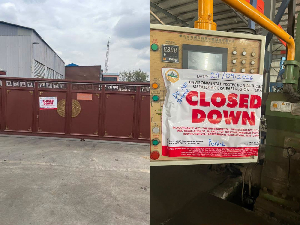
The Environmental Protection Authority (EPA) has ordered Ponlok Company Limited, an aluminium and metal smelting firm at Shai, to cease all operations with immediate effect following a series of environmental violations that the company failed to rectify despite prior warnings.
The enforcement action, announced by the EPA in a Facebook post on Thursday, September 24, 2026, and reported by GhanaWeb, came after inspections uncovered “visible smoke emissions affecting air quality, inadequate pollution-control and monitoring systems, poor housekeeping and sanitation, improper waste disposal, and oil spills within the company’s operational areas”.
The EPA stated that Ponlok had previously been directed to address the identified concerns and was subsequently granted an extension to implement corrective measures. However, following further assessment, the Authority determined that several issues remained unresolved, prompting the shutdown order.
“Protecting the environment is a collective responsibility. Compliance is non-negotiable,” the EPA stated, adding that environmental compliance is a mandatory requirement and not an option.
The company has been ordered to urgently install the necessary pollution-control and monitoring technology before operations can resume, and to take steps to rectify the other environmental deficiencies identified by inspectors.
A Troubled Track Record
Ponlok Company Limited operates as a metallurgical and metal/aluminium smelting enterprise near Shai Hills in the Greater Accra Region. The company had previously been on the radar of Ghanaian authorities. In March 2025, Ponlok Manufacturing Company Limited was named alongside Dangfang Company Limited in connection with a stolen high-tension cable syndicate belonging to the Electricity Company of Ghana (ECG). Fourteen people were arrested in connection with the missing ECG containers, and the two companies were allegedly involved in melting the stolen cables.
The shutdown of Ponlok comes amid a broader crackdown by the EPA on industrial polluters in Ghana. Just ten days earlier, on September 14, 2026, the EPA ordered Empire Cement Ghana Ltd to suspend operations at its Weija plant over alleged air-pollution and environmental-permit breaches. In that case, the EPA cited sustained emissions of visible particulate matter, gases, and other pollutants, as well as the company’s failure to submit quarterly environmental-monitoring returns. Empire Cement must install air-pollution controls compliant with Ghanaian standard GS 1236:2019 before it can resume production.
EPA’s Strengthened Enforcement Regime
The enforcement actions against Ponlok and Empire Cement signal a more aggressive posture from the EPA under Ghana’s new environmental legal framework. In July 2025, the EPA launched the Ghana Online Continuous Emissions Monitoring System (GOCEMS), the first real-time emissions monitoring system of its kind in Africa. The system uses AI-enabled sensors to capture and transmit live emissions data to the EPA’s central monitoring hub, eliminating the need for time-consuming manual inspections.
Speaking at the launch, EPA Chief Executive Officer Professor Nana Ama Browne Klutse warned that non-compliant companies face severe consequences. “Once you are operating on the lands of Ghana, you are bound by our environmental laws. GOCEMS is compulsory for all industrial operators,” she stated, adding that non-compliant companies face “fines, shutdowns, and legal action under Ghana’s broader environmental laws”.
The EPA has also introduced the AKOBEN system, which publicly ranks industries based on their compliance. Companies that meet high environmental standards receive a “green” status, while chronic polluters are marked “red” and could face public scrutiny. The AKOBEN system is already in use across the manufacturing and mining sectors.
The enforcement action against Ponlok was taken under Section 35 of the Environmental Protection Act, 2025 (Act 1124), which grants the EPA broad powers to compel compliance and impose sanctions on businesses that fail to meet environmental standards.
Aluminium Smelting: A High-Risk Industry
Aluminium smelting is among the most environmentally intensive industrial processes. Globally, the aluminium industry accounts for approximately 4% of greenhouse gas emissions, making it the second most carbon-intensive industry after steel. Smelting operations release significant air emissions including particulate matter, fluorides, and sulphur dioxide, while also generating hazardous waste and consuming vast amounts of electricity.
Ghana’s own state-owned aluminium smelter, the Volta Aluminium Company (VALCO) in Tema, has faced its own environmental and financial challenges. The smelter was completely shut down in 2022, with operations halted and workers sent home. By January 2025, VALCO’s debts had ballooned to approximately US600 million investment to revive the facility.
VALCO has announced plans to modernise its operations, including the installation of scrubbers at its cell lines to capture and re-inject fluoride to minimise its environmental footprint, and a transition to natural gas usage.
What Happens Next
For Ponlok, operations will remain suspended until the required corrective measures are implemented, including the installation of appropriate pollution-control and monitoring systems and the resolution of all outstanding environmental issues.
The EPA has reiterated its commitment to protecting public health and the environment while ensuring compliance with Ghana’s environmental laws, reminding businesses and operators that meeting environmental standards is a mandatory requirement for continued operations.
The shutdown of Ponlok Company Limited represents more than an isolated regulatory intervention. It demonstrates the EPA’s growing willingness to use its full enforcement powers—including immediate shutdown orders—when companies fail to address environmental concerns identified through inspections and prior directives. As Ghana pursues its ambitions to build an integrated bauxite-to-aluminium industry, the regulatory environment for smelting operations is set to become increasingly stringent, with real-time monitoring and public compliance rankings leaving little room for operators who prioritise production over environmental responsibility.


