



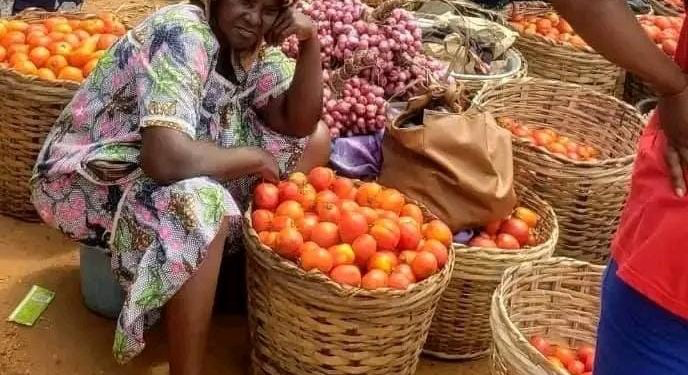
Tomato farmers in the Anloga-Avume area of the Anloga District in the Volta Region have raised the alarm over massive post-harvest losses, with tonnes of ripe tomatoes rotting on farm beds due to an acute shortage of harvesting crates and the absence of buyers, a crisis that threatens to undermine the government’s newly launched push for tomato self-sufficiency.
The farmers said the area had recorded a bumper harvest this season — one they believe is capable of supplying markets in Anloga, Keta, Accra, Kumasi and beyond, and of easing Ghana’s reliance on tomato imports from Burkina Faso. But without crates to harvest the produce and buyers to purchase it, the harvest is being lost by the day.
Daniel Kad, a farmer and Assembly Member for the area, told the Ghana News Agency that the abundant harvest represents far more than income for individual farmers.
He described the situation as a matter of national food security, employment for young people engaged in loading, transporting and selling farm produce, and a lifeline for families who depend on the crop for school fees, medical bills and daily survival.
“The immediate cause of the crisis is an acute shortage of crates needed to harvest the tomatoes, compounded by allegations that the few available crates were being controlled by ‘load boys’ who allegedly demand bribes before releasing them to farmers,” Kad said.
The involvement of “load boys” — intermediaries who negotiate between farmers and buyers — is a long-standing grievance in the Anloga tomato trade. In August 2026, the Southern Sector Vegetable Farmers and Marketers Association (SSVFMA) adopted new standardisation measures ahead of the harvest season, including a requirement that tomato crates measure 2 feet by 2 feet square, with each approved crate designed to contain four normal-sized tomato baskets. The new modalities were partly aimed at addressing disagreements about quantities and the role of loading boys as intermediaries. The association also cautioned farmers against allowing loading boys and middlemen to determine the prices of their produce.
Despite those reforms, the current crisis suggests enforcement remains a challenge on the ground.
Kad explained that many farmers who had borrowed heavily to finance the season — spending on seeds, fertiliser and labour — were now watching helplessly as their produce deteriorated on the farm beds because they could not afford the additional illegal charges being demanded for the crates.
A Week of Rotting Produce
Kad said the crisis had persisted since the previous week, with fresh quantities of tomatoes rotting daily in the absence of buyers, storage facilities or cold rooms to preserve the produce while a market was found.
“We are issuing an urgent appeal to buyers, market women, processing companies and exporters across the country and beyond to visit Avume immediately. Our tomatoes are ready for harvest but risk being completely lost without swift intervention,” he said.
The farmers disclosed that several of them had taken loans in anticipation of proceeds from the harvest and now faced the prospect of defaulting on their debts, losing their farmlands, and being unable to finance subsequent farming seasons.
They called for immediate action from the Ministry of Food and Agriculture, the Anloga District Assembly, the Volta Regional Minister and the Feed Ghana Programme, urging intervention within the week to prevent the total collapse of the Avume tomato economy.
“Failure to act swiftly will result in huge losses in terms of the commodity and to farmers because of debts incurred for the production,” they warned.
The farmers said it was disheartening that Ghana continued to import tomatoes despite having the local capacity to produce enough to meet its demand, and emphasised that the renewed call on buyers, processors and exporters — both within Ghana and abroad — should be prioritised by government, individuals and corporate organisations for a quicker purchase of the produce.
Background: A Perennial Crisis
The Avume crisis is not an isolated incident. Tomato farmers in the Anloga District have repeatedly raised the alarm over the absence of ready markets and storage facilities, warning that the situation is crippling incomes and threatening the survival of farming in the area.
In September 2025, Semabia Agbenyefia, a farmer at Anloga-Avume, told the Ghana News Agency that market prices had drastically dropped. “A box of tomatoes, which is supposed to sell for GH₵1,050, now goes as low as GH₵80 or GH₵70, making profitability an uphill battle,” he lamented, appealing for the establishment of tomato processing factories in the district to preserve produce, cut down losses and create jobs for the youth.
Another farmer, Cecilia Seshie, stressed that urgent interventions were needed to prevent the collapse of tomato farming in Anloga, which she said would worsen hunger and unemployment in the district. She explained that farmers typically invest between GH₵2,000 and GH₵5,000 per season in the hope of earning enough to pay school fees, rent and other essential expenses, but current losses are pushing many into debt.
Anloga, known for large-scale vegetable production, lies below sea level and is susceptible to flooding. In September 2025, floods destroyed about 1,200 acres of vegetable farms in the area, leaving some 600 farmers counting their losses.
The National Picture
The current crisis comes as Ghana’s tomato sector faces a structural deficit. Ghana’s annual tomato demand is estimated at about 800,000 metric tonnes, against peak domestic production of approximately 510,000 tonnes — a baseline deficit of about 290,000 tonnes. When post-harvest losses of between 20 and 30 per cent are factored in, the real gap approaches 400,000 tonnes, according to the Chamber of Agribusiness Ghana.
Ghana is losing an estimated GH₵5.7 billion annually — equivalent to about 1.2 per cent of GDP — due to tomato import dependency, post-harvest losses and limited value addition. An estimated GH₵175 million to GH₵250 million worth of locally grown tomatoes rot each year due to inadequate cold storage facilities, accounting for 30 to 45 per cent of total production losses.
The sector’s fragility was exposed in March 2026 when Burkina Faso — Ghana’s dominant supplier, accounting for 70 to 80 per cent of its tomato supply, with imports valued at around $400 million annually — indefinitely suspended fresh tomato exports to protect its own domestic supply and support newly established processing factories. The ban triggered immediate shortages and sharp price increases across Ghanaian markets, with a large basket of tomatoes that previously sold for GH₵3,000 rising to between GH₵8,000 and GH₵9,000. Fresh tomato prices surged by 158.3 per cent year-on-year in August 2026, making the commodity the biggest price mover recorded by the Ghana Statistical Service during the month.
GHATSI: A Timely Intervention?
The crisis in Avume comes just three days after the government launched the Ghana Tomato Self-Sufficiency Initiative (GHATSI) at the Anloga Anseco Park on September 15, 2026, under the theme “Produce at Home. Feed the Nation.”
The initiative, led by the Ministry of Food and Agriculture in partnership with FarmMate Africa, seeks to establish a reliable, year-round domestic tomato value chain, reduce import dependence, create jobs and eventually generate surplus for export.
GHATSI’s first phase, covering the 2026/2027 production period, targets approximately 100,000 tonnes of tomatoes from more than 10,000 acres across 35 districts in 10 regions and more than 100 communities. The programme is expected to progressively scale up to about 400,000 tonnes of annual tomato supply from more than 40,000 acres, with up to 200,000 tonnes eventually processed into tomato puree and other value-added products.
Food and Agriculture Minister Eric Opoku said the programme would link farmers to land, irrigation, quality inputs, technical support, financing, insurance, aggregation, processing and guaranteed markets. FarmMate Africa, the private-sector implementation partner and committed off-taker, will connect farmers to fresh markets, hotels, restaurants, institutional buyers, processors and eventually export markets.
A farmer enhancement package estimated at about GH₵20,000 per acre covers inputs, land preparation, soil testing, technical assistance, insurance and other production requirements. A packhouse facility is also to be established at Anloga to support the sorting, grading, packaging and marketing of tomatoes.
The initiative is projected to support more than 150,000 direct and indirect employment opportunities in its first phase, including approximately 50,000 year-round jobs.
But Opoku cautioned that the success of the initiative would depend on implementation and accountability beyond the launch. “GHATSI must not become another successful launch followed by silence,” he said, explaining that the programme would be judged by whether farmers produced and were paid, financing and irrigation reached farms, inputs arrived on time, crops were insured, packhouses operated, processing expanded and imports declined.
The Road Ahead
For the farmers of Avume, the immediate priority is survival. Their tomatoes are ripe and ready, but without crates to harvest them and buyers to take them, the harvest will be lost. The debts they incurred to finance the season will come due, and the land they farm may slip away.
The government’s GHATSI initiative, if implemented effectively, could provide the structural solutions the sector has long needed — irrigation, financing, guaranteed markets and processing capacity. But for Avume’s farmers, those solutions cannot come soon enough.
The Volta Regional Minister, James Gunu, has said the Volta Region is ready to drive Ghana’s tomato self-sufficiency agenda, highlighting Anloga, Keta, Akatsi North and Agotime Ziope as key production areas. The Anloga District Assembly, under District Chief Executive Sandra Seyram Kpedor, has previously supported farmers with fertiliser donations and tomato processing equipment.
But the immediate crisis in Avume demands urgent, practical intervention — crates, buyers, storage, and a market — before the region’s tomato economy suffers a blow from which it may not quickly recover.


