



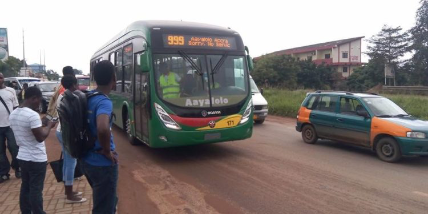
A journey that once consumed more than two hours of a commuter’s morning is now completed in 23 minutes. The Greater Accra Passenger Transport Executive (GAPTE) says its contra-flow traffic management system has dramatically reduced travel times for commuters travelling from Adenta, Kasoa, and Amasaman into Accra Central, easing the daily burden of traffic congestion on some of the capital’s busiest routes
GAPTE Managing Director Daouda Awudu disclosed the figures during an appearance on the Citi Breakfast Show on Thursday, October 15, 2026, describing the results as encouraging and confirming that the contra-flow arrangement is here to stay.
“Adenta to Accra, two and a half hours would have been the ideal time to travel in the morning, but we did 23 minutes under the contra-flow,” Mr Awudu said. “In the evening, we did 28 minutes because of the pressure.”
The gains extend beyond Adenta. The Kasoa-Accra corridor, which previously took up to three hours during peak morning traffic, now takes 50 minutes. The Amasaman route, which once consumed between two and a half and three hours, is now completed in 28 to 32 minutes depending on daily traffic conditions.
A City Choking on Congestion
The contra-flow system, launched on September 29, 2026, is a direct response to one of Accra’s most intractable challenges. According to the World Bank’s 2021 report, 70% of major roads in Accra are congested during rush hours, with vehicle speeds dropping below 20 km/h. The city’s population has grown by 35% over the past two decades, while road infrastructure has remained largely unchanged.
The economic toll is staggering. A 2026 study by Glima Research found that traffic congestion costs Ghana an estimated GH¢4.5 billion annually — GH¢3.2 billion in lost time (71%), GH¢434 million in wasted fuel (10%), and GH¢815 million in stress-related productivity losses (18%). The study warned that congestion-induced stress and fatigue reduce effective productivity by about 30 minutes per commuter per day.
Beyond the economic cost, the environmental and health impacts are severe. Preventable fuel waste from idling vehicles produces approximately 73,000 metric tons of excess carbon dioxide emissions each year, equivalent to wiping out the climate benefit of three million trees annually. The Environmental Protection Agency has reported that vehicle emissions account for 70% of urban air pollution, contributing to respiratory and cardiovascular diseases.
How the Contra-Flow System Works
The contra-flow arrangement allows authorised Aayalolo Bus Rapid Transit (BRT) buses to travel in dedicated lanes against the normal flow of traffic during peak commuting hours — from 6:00 a.m. to 9:00 a.m. and 4:00 p.m. to 8:00 p.m.. The three corridors — Amasaman-Accra, Adenta-Accra, and Kasoa-Accra — were selected because they serve as major gateways for thousands of commuters travelling into and out of the Central Business District each day.
The lanes are reserved exclusively for Aayalolo buses. Private vehicles, taxis, trotros, and commercial vehicles are prohibited from using the designated lanes, with the Motor Traffic and Transport Department (MTTD) of the Ghana Police Service deploying officers to strategic intersections to enforce compliance.
The initiative was developed through a collaboration involving the Ministry of Local Government, Chieftaincy and Religious Affairs, GAPTE, the MTTD, and the Department of Urban Roads. A feasibility study began on September 17, 2026, initially focusing on the Kinbu-Adenta corridor, before expanding to the three major routes.
From Two Hours to 45 Minutes: The Proof of Concept
Before the full rollout, GAPTE conducted an earlier trial along the Kinbu-Adenta route that demonstrated the system’s potential. Travel time on that route, which could take almost two hours under heavy traffic, was reduced to about 45 minutes when Aayalolo buses were given a dedicated movement path through congested areas.
The success of that trial paved the way for the broader contra-flow pilot. On the first day of operation, September 29, GAPTE transported approximately 8,000 passengers from Adenta towards Accra during the morning session alone. Passengers on the Kasoa corridor were so impressed by the speed of the journey that they applauded when the bus reached Weija Junction.
Public Relations Officer Justice Kwaku Safo described the morning’s performance as “wonderful,” adding: “We have a focus. We want to decongest the city and we want to make public transport affordable and accessible. If you are assured that you board an Aayalolo bus and you will not spend the entire time in traffic, we are encouraged that it will benefit the company and the commuters. It’s a win-win for all of us”.
The Aayalolo BRT Story
The Aayalolo Bus Rapid Transit system was introduced as part of efforts to ease traffic congestion in Accra while providing commuters with an affordable and efficient mass transportation option. Operated by GAPTE — an inter-metropolitan body responsible for planning, regulating, and coordinating public passenger transport in the Greater Accra Metropolitan Area — the service was conceptualised under the Ghana Urban Transport Project in 2005 as part of the Accra Modernisation Initiative.
GAPTE was formally established between 2014 and 2016 to improve urban mobility, evolving into a platform for harmonised regulation of formal bus services and a potential base for future BRT expansion.
The Aayalolo system has faced significant challenges in recent years. As of January 2026, only 80 of the 245 buses acquired by the government in 2016 were operational. However, under the current management, 48 grounded buses have been repaired and the fleet expanded to 128 buses to ease Accra’s traffic congestion.
The current contra-flow arrangement supports the deployment of 126 repaired Aayalolo buses, enabling them to make more trips instead of spending long periods trapped in traffic. Each bus carries approximately 85 passengers, translating into 850 passenger journeys over 10 trips per day. With multiple buses operating across the designated corridors, the system moves over 8,000 passengers daily.
Presidential Backing and Permanent Status
President John Dramani Mahama has expressed satisfaction with the initial results of the contra-flow system. Local Government, Chieftaincy and Religious Affairs Minister Mahama Ayariga disclosed that the President was encouraged by the pilot’s performance and scheduled a stakeholder meeting on October 7, 2026, to review the trials and determine how to sustain the exercise permanently.
“He is satisfied with the initial successes achieved and has further scheduled a meeting of stakeholders in his office on Thursday, October 7, to review the trials and give appropriate directives on how to sustain the exercise permanently,” Mr Ayariga said.
Mr Awudu has affirmed that the contra-flow project is permanent. “Aayalolo contraflow has come to stay; it’s not going anywhere,” he stated.
Challenges: Private Motorists and Enforcement
Despite the success, the system faces a significant enforcement challenge. Private vehicle drivers have been joining the contra-flow lanes to bypass traffic congestion, undermining the initiative’s purpose. Mr Awudu warned that motorists who flout the restriction will face arrest and be dealt with in accordance with the law.
“It has come to our attention that private vehicle drivers are joining the buses to use the contra-flow. Those are challenges that were reasonably foreseeable when we started the exercise using motorbike escorts,” he said.
GAPTE is working with the MTTD to deploy additional personnel along the routes to prevent unauthorised vehicles from taking advantage of the system. “We are doing this in collaboration with the MTTD. The police are supposed to handle all these drivers who join the contra flow in the morning,” Mr Awudu added.
The Minister for Local Government has also urged GAPTE to adhere strictly to advertised times for the contra-flow system to maintain public confidence.
A National Model?
The contra-flow system represents the first time such a traffic management principle has been deployed to ease congestion in Greater Accra. While the results are promising, some stakeholders have cautioned that the intervention should not be mistaken for a comprehensive solution to Accra’s mobility crisis.
Kennedy Nyarko Osei, Ranking Member on Parliament’s Roads and Transport Committee, has called for a complete overhaul of the capital’s transport system. “It is not only about getting enough buses to deal with the system, we need a complete overhaul of our transport system within the capital city,” he said, advocating for expanded internal rail systems, trams, and additional arterial roads and interchanges.
For now, however, the contra-flow system is delivering measurable relief to thousands of daily commuters. For workers, traders, and students who have long endured gruelling commutes, the difference is not measured in minutes saved — it is measured in hours reclaimed for family, work, and rest.
As Mr Awudu put it: “Our focus must be how to move people but not to move buses”.


