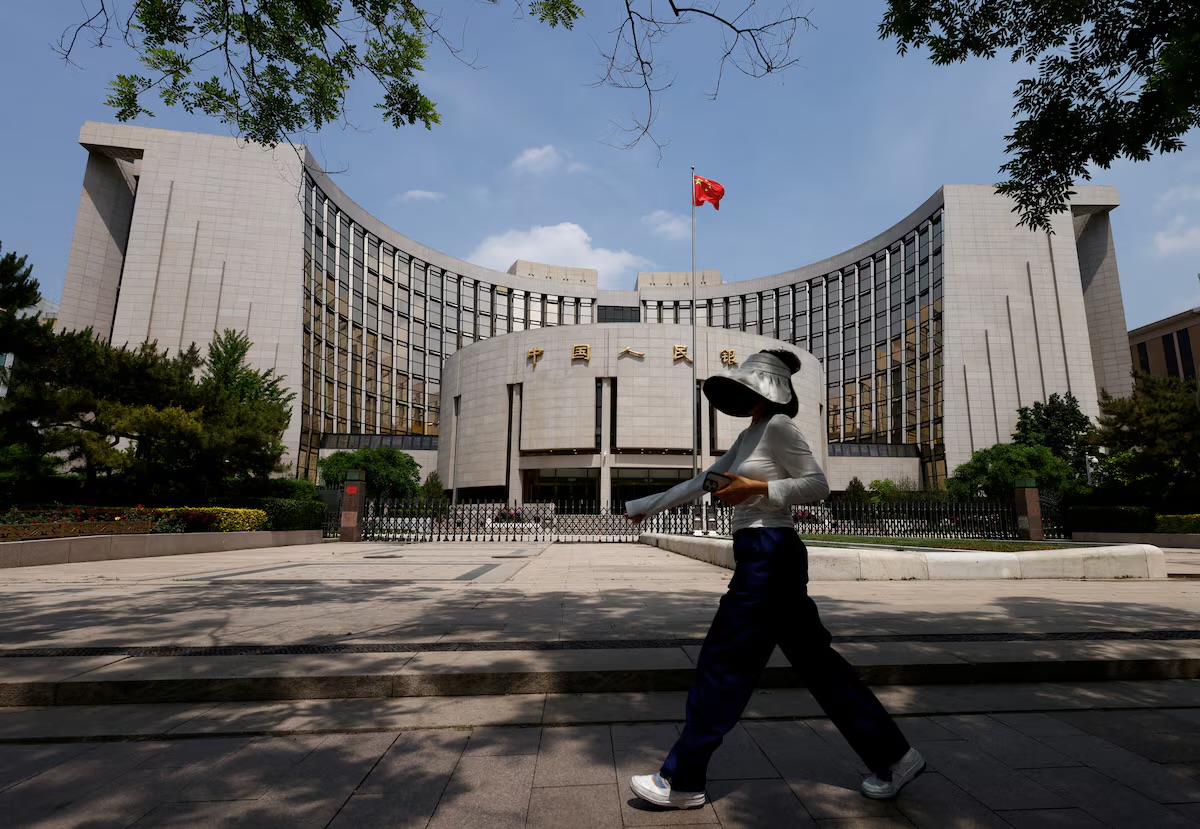
China unveiled a sweeping package of targeted credit and mortgage-support measures on Tuesday, cutting a key policy rate and introducing the country’s first nationwide subsidy for homebuyer mortgages as policymakers confront a slowing economy, entrenched property downturn and widening interest-rate gap with the United States.
The measures came a day after the State Council pledged to step up counter-cyclical policy support, signalling greater urgency to keep the world’s second-largest economy on track to meet its 2026 growth target of 4.5% to 5%.
PSL Rate Cut and Expanded Lending Quotas
The People’s Bank of China said it would cut the interest rate on its pledged supplementary lending (PSL) facility by 25 basis points, bringing the one-year rate to 1.5% from 1.75%. The PSL is a key channel through which the central bank funnels long-term, low-cost funding to policy banks for infrastructure and strategic projects.
The PBOC also broadened the PSL facility’s scope beyond its traditional infrastructure remit to explicitly include water conservancy, power-grid, computing, communications, urban pipeline and logistics networks — collectively described in official statements as the “six networks” of modern infrastructure.
Alongside the rate cut, the central bank raised its relending quota for sci-tech innovation and technological upgrading by 200 billion yuan ($29.8 billion) to 1.4 trillion yuan, and increased the proportion of eligible loans funded by the facility from 60% to 100%. It also lifted the relending quota for small and medium-sized enterprises by 500 billion yuan to 4.85 trillion yuan, and raised the quota for private enterprises by 300 billion yuan to 1.3 trillion yuan.
“China’s latest policy measures suggest a more coordinated effort to support growth by boosting both investment and household demand,” said Hao Zhou, a Hong Kong-based analyst at Guotai Haitong Securities. “While the full impact will depend on implementation and private-sector response, the latest steps send a clear signal that policymakers are prepared to provide stronger support for growth.”
First-Ever Mortgage Interest Subsidy
In a landmark move, the Ministry of Finance, the PBOC and the National Financial Regulatory Administration jointly announced that China would subsidise interest payments on new commercial mortgages for eligible first-time homebuyers starting October 1, 2026. This marks the first time the central government has offered fiscal subsidies on commercial housing loans.
Under the policy, which will be implemented on a one-year trial basis, the government will provide an annualised subsidy of 1 percentage point for up to five years, with the subsidised loan capped at 1 million yuan per household. Eligible homes must have a floor area of no more than 120 square metres and a purchase price of no more than 1.5 million yuan. For a 1-million-yuan mortgage, the subsidy could reduce cumulative interest payments by nearly 50,000 yuan.
Zhaopeng Xing, senior China strategist at ANZ, said he had expected the interest subsidy to cover homes in China’s top-tier cities. “A budget of 1.5 million yuan would probably only be enough to buy a home in a third-tier city,” he noted, suggesting the measure may have limited reach in the most supply-constrained urban markets.
Economic Strains Mount
The policy package comes as China’s economy shows widening cracks. GDP growth slowed to 4.3% year-on-year in the second quarter of 2026 — the weakest pace in three and a half years and below the government’s target range — as weak domestic demand and the fallout from the Iran-linked oil shock outweighed resilient industrial output and exports.
The property sector remains the largest drag. Property investment fell 18.0% year-on-year in the first half of 2026, with new construction starts down 23.4% and property sales by floor area down 11.6%. The real estate and construction sectors now account for just 11.1% of GDP, down sharply from their peak contribution, as the multi-year deleveraging that began with Evergrande’s collapse continues to reshape household consumption and local government finances.
Manufacturing deflation, which had gripped China since late 2022, eased in early 2026 as the Iran conflict pushed energy costs higher, but consumer inflation remains subdued at around 1%, well below the government’s 2% target.
US Rate Constraint
The PBOC’s room for aggressive monetary easing is constrained by a record-wide interest-rate gap with the United States. The yield on 10-year Chinese government bonds stood at 1.68% in September, while the equivalent US Treasury yield reached 4.85% — the widest spread on record — raising the spectre of accelerated capital outflows and pressure on the yuan.
“With US rate hikes creating headwinds, there is limited room for PBOC’s further monetary easing in the new policy measures,” Xing said. The adjustments reflected a balance between an “accommodative monetary-policy stance and a cautious approach,” he added.
The divergence stems from fundamentally different inflation trajectories: the Federal Reserve faces persistent price pressures that have kept it in a hiking cycle, while China continues to grapple with subdued demand and excess industrial capacity. The US federal government’s debt has surpassed $40 trillion, and the resulting term-premium expansion in Treasury yields has driven the spread wider even without a sharp acceleration in US growth.
Analysts See Coordinated but Cautious Approach
Morgan Stanley analysts noted that the mortgage subsidy alone is unlikely to break China’s deleveraging trap, particularly given the modest scale of the subsidised loan cap and the geographic limitations of the 1.5-million-yuan price ceiling. The brokerage said the PSL rate cut and expanded relending quotas would provide supplementary capital-expenditure support at a time when budget execution has been slow.
The measures represent a calibrated response rather than a decisive stimulus shift, consistent with Beijing’s preference for targeted, structural tools over broad-based easing. The PBOC has so far refrained from cutting its main policy rates, mindful of bank margin pressures and the risk of further yuan weakness.
Still, the coordinated nature of Tuesday’s announcements — spanning monetary, fiscal and regulatory authorities — underscores the growing recognition that the property downturn and weak private demand require a multi-pronged policy response.
“The latest steps send a clear signal that policymakers are prepared to provide stronger support for growth,” Zhou said. “Whether they are sufficient to turn the trajectory will depend on how quickly the measures translate into actual lending and home purchases.”