



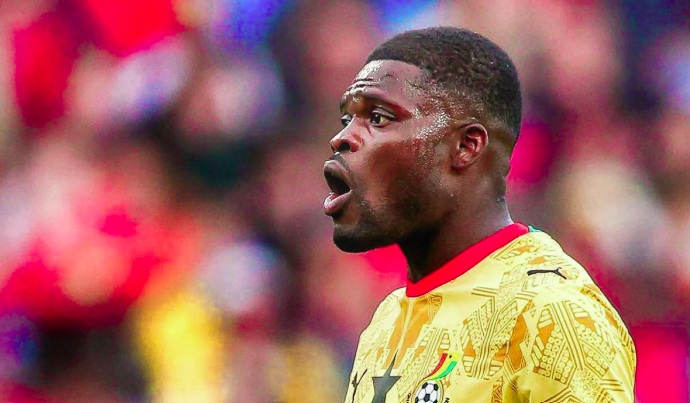
Canada’s Immigration Minister has firmly defended the decision to deny Ghana midfielder Thomas Partey a visa for the 2026 FIFA World Cup, insisting that every traveller is assessed individually and that hosting a global tournament does not override the country’s immigration rules.
Partey, 32, who faces seven counts of rape and one count of sexual assault in the United Kingdom, will miss Ghana’s Group L opener against Panama at BMO Field in Toronto on Wednesday after his visa application was refused by Canadian authorities.
Addressing the decision, Lena Diab, Minister of Immigration, Refugees and Citizenship of Canada, said: “Canada is proud to be a host country for the 2026 FIFA World Cup and is working to facilitate a successful event while maintaining the safety and security of Canadians.”
“Canada has been consistent that hosting major events does not change Canada’s immigration laws. Every person seeking to come to Canada is assessed individually, based on the facts available and the law that applies,” Diab added.
No conviction required for inadmissibility
A spokesperson for Immigration, Refugees and Citizenship Canada (IRCC) told ESPN that the visa denial was justified because the country is consistent in “assessing [every person seeking to come to Canada] individually, based on facts available and the law that applies.”
Under Canadian law, foreign nationals can be found inadmissible even without a foreign conviction. “When there are reasonable grounds to believe an act that would trigger inadmissibility has been committed by an applicant, they can be deemed inadmissible to Canada,” IRCC said in a statement to CBC News.
The legal basis lies in Section 36 of the Immigration and Refugee Protection Act (IRPA), which allows immigration officers to bar entry based on charges or credible allegations alone — without requiring a conviction — if the alleged conduct would constitute a serious crime in Canada punishable by ten years or more in prison. Rape and sexual assault allegations fall squarely within that category.
Ghana vows diplomatic fight
The Ghanaian government has reacted with fury, initiating diplomatic efforts through the Foreign Affairs Ministry to seek a review of the decision.
“If any Ghanaian is touched anywhere, we will not keep quiet over it,” Sports Minister Kofi Adams told local station Channel One TV on Friday.
“Through the appropriate channels, we have communicated to the rightful authorities and are requesting for them to use all processes to review and give opportunity for a review of such a decision that we think frowns on international laws and conventions, which both Ghana and Canada are party to,” Adams said.
Adams described the reasons for the visa refusal as “flimsy,” stressing that Partey has been charged but not convicted.
“I say flimsy because the person has already been charged, he has not been found guilty. Even in the country where they claim he committed the act, for which reason he is in court, which he has denied, he is still living there, as a free citizen, walking about freely and doing anything every free citizen should do,” Adams added.
Ghana’s Foreign Minister Samuel Okudzeto Ablakwa has been tasked with triggering diplomatic engagement to pursue the player’s rights, with Adams expressing hope that Canadian authorities would reconsider the matter.
Partey maintains innocence, trial delayed
Partey, a former Arsenal midfielder who now plays for Spanish side Villarreal, has pleaded not guilty to all charges.
London’s Metropolitan Police initially charged him in July 2025 with five counts of rape and one count of sexual assault relating to three women, with incidents alleged to have occurred between 2021 and 2022. He pleaded not guilty to those charges in September 2025.
In February 2026, Partey was charged with two additional counts of rape relating to a fourth woman following a new investigation, stemming from alleged non-recent offences in 2020. He pleaded not guilty to those charges in April 2026.
His trial at Southwark Crown Court in London, originally scheduled for November, has been delayed and is now expected to begin on June 8, 2027. Under his bail conditions, Partey must notify authorities of any plans to travel outside the United Kingdom.
His lawyer, Jenny Wiltshire of Hickman and Rose, has said in a statement that her client welcomes “the opportunity to finally clear his name.”
US visa approved, but Canada stands firm
While Partey was granted a US visa and is currently training with Ghana at their base camp at Bryant University in Rhode Island, Canada’s refusal stands in stark contrast. IRCC stated it cannot share individual details without a signed consent form but defended its strict border enforcement stance.
“IRCC officers are trained decision makers who assess an individual’s eligibility and admissibility in accordance with Canadian immigration laws,” the agency added. “If they believe that an individual could pose a security risk, they may decide to deny them entry.”
Ghana coach Carlos Queiroz has defended his decision to select Partey, citing the presumption of innocence. “As far as I know — in England and Portugal, wherever we are living in this world — until the court makes a decision, the presumption of innocence is on the side of all court cases,” Queiroz told a press conference earlier this month.
What lies ahead for Ghana
Ghana, drawn in Group L alongside England, Croatia, and Panama, will play their remaining group matches in the United States: against England at Gillette Stadium in Foxborough, Massachusetts, on June 23, and against Croatia in Philadelphia on June 27.
Partey is expected to be available for both fixtures. However, if Ghana finishes second in Group L, they would face a round-of-32 match in Toronto — which would again require entry into Canada. A third-place finish could also lead to a round-of-16 match in Vancouver. Any further games on Canadian soil would likely present the same immigration obstacle. With files from Reuters, AP, ESPN, CBC News, and The Athletic.


