



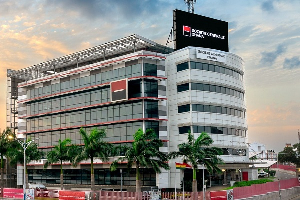
Morocco’s Bank of Africa (BOA) and Nigeria’s Access Bank have emerged as the two final contenders competing to acquire the 60.22 percent controlling interest in Société Générale Ghana, according to reports tracking the transaction .
A Contested Sale Moving Beyond Exploratory Stage
The proposed sale has progressed well beyond the exploratory stage, with negotiations now at an advanced phase involving regulatory due diligence by the Bank of Ghana . However, the transaction remains incomplete—no preferred buyer has been publicly confirmed, nor has a definitive price been announced .
Burkinabe financial group Coris Bank, which had earlier emerged as a key contender, has become reticent about following through on the acquisition . Similarly, the Government of Ghana, which explored a strategic state-backed move through the Social Security and National Insurance Trust (SSNIT)—already a 19 percent minority shareholder—has also reportedly stepped back .
The Two Contenders: Strategic Advantages and Challenges
Bank of Africa (BOA) benefits from its existing presence in Ghana through BOA Ghana, giving it deep insight into the local regulatory and banking environment . Its parent, BMCE/Bank of Africa Group, boasts a substantial pan-African footprint spanning approximately 18 countries .
The key attraction for BOA would be combining two existing Ghanaian operations. Since BOA Ghana is considerably smaller than SG Ghana, an acquisition would rapidly increase its scale and strengthen the Moroccan group’s position in Ghanaian corporate, retail, and trade banking . However, integrating both banks would require significant rationalisation of branches, personnel, technology platforms, and corporate structures, and could attract closer competition scrutiny .
Access Bank, one of Africa’s most aggressive pan-African banking groups, already operates Access Bank Ghana . Its acquisition of SG Ghana would create a much larger Ghanaian franchise with strong potential for integration into the Nigeria-Ghana trade corridor and Access’s wider African network .
The bank could potentially exploit SG Ghana’s corporate relationships, affluent customer base, and established franchise to accelerate its Ghanaian growth . Its main disadvantage mirrors BOA’s—the challenge of integrating two existing Ghanaian banks .
No Public Indication of Parent’s Preference
Instructively, there is no public indication of a definitive preference by Société Générale’s Paris-headquartered parent for either BOA or Access Bank . The reported bidding contest gives Société Générale a significant negotiating advantage as two credible African banking groups compete for the asset .
The parent is likely to place greatest emphasis on certainty of execution, price, regulatory acceptability, and the buyer’s ability to complete the transaction without prolonged negotiations .
Pricing Considerations and Financial Fundamentals
At the current Ghana Stock Exchange price of approximately GH¢5.98 per share, SG Ghana’s 709.1 million shares outstanding imply an equity market capitalisation of roughly GH¢4.24 billion . The French parent’s 427.08 million shares have a quoted market value of approximately GH¢2.55 billion.
However, a controlling stake normally attracts a control premium, particularly with two strategic buyers competing. Investment bankers suggest a reasonable analytical range of 15–30 percent above the prevailing market value, implying approximately GH¢2.9–3.3 billion for the 60.22 percent stake, producing an implied whole-bank valuation of roughly GH¢4.9–5.5 billion .
The bank’s underlying fundamentals provide some justification for a premium. Its 2025 capital adequacy ratio was reported at 23.4 percent, comfortably above the regulatory minimum, while 2025 profit after tax was approximately GH¢397 million . However, SG Ghana’s first-half 2026 profit fell sharply to GH¢128.2 million, down 47.7 percent year-on-year, with earnings per share falling from GH¢0.69 to GH¢0.36—a factor that may temper the buyer’s willingness to pay an aggressive earnings multiple .
Regulatory Timeline and Market Impact
A Bank of Ghana-regulated bank acquisition requires BoG approval, with the regulatory decision to be issued within six months of receiving the application . If a preferred bidder is selected late in 2026, completion could occur by early 2027 . Acquiring more than 50 percent of a listed company also triggers takeover rules that may affect minority shareholders and initiate mandatory offers .
The immediate effect on share prices will likely be positive if an acquisition occurs at a premium above GH¢5.98 per share. SG Ghana’s stock has already risen over 33 percent this year, though it remains below its peak of GH¢11.51 . An analyst predicts that announcing an acquisition at around GH¢7–7.80 per share could significantly boost market prices due to speculative buying driven by competitive bidding expectations .
Context: A Broader Sector Consolidation
The proposed sale comes amid significant consolidation in Ghana’s banking sector. Global banks have been retreating from African markets due to complex risks and regulatory challenges, creating opportunities for African banking giants to expand regionally . The outcome of the BOA-Access Bank battle will determine whether SG Ghana becomes part of a Moroccan-led pan-African group or a Nigerian-led West African powerhouse .
For corporate clients, the immediate advice is to monitor the acquisition closely but not to panic—the bank is exceptionally well-capitalised, and whichever bidder prevails will bring pan-African scale that SG Ghana currently lacks .


