



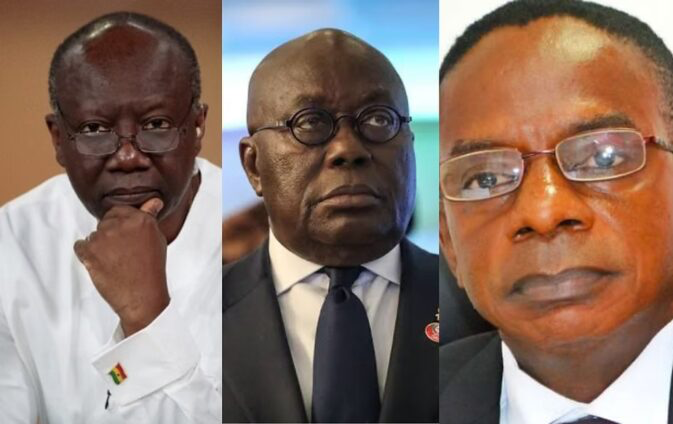
A years-long investigation has revealed that the Auditor-General’s special audit into Ghana’s COVID-19 expenditure significantly understated a major cost incurred across multiple ministries, with evidence pointing to a deliberate omission of hundreds of millions of cedis.
The special audit, carried out in late 2022 at the request of then Finance Minister Ken Ofori-Atta, reported Ghana’s “cost of fumigation” as GH¢96 million. This investigation, covering three ministries—Education, Transport and Local Government—has uncovered that Ghana spent at least GH¢780 million on COVID-19 fumigation, meaning the Auditor-General’s figure represents only about 12% of actual expenditure.
At least GH¢684 million in fumigation expenses were omitted from the reported figure. About GH¢775 million (99.4%) of the uncovered expenditure went to a single company: Zoomlion Ghana Limited.
A Company with a History
Prior to the COVID-19 fumigations, both the activity and Zoomlion had been indicted in major corruption probes. The World Bank blacklisted Zoomlion in 2013 for paying bribes to facilitate contract execution in Liberia. The Auditor-General had described the company in 2019 as a “fraudulent drain on the country” after uncovering malfeasance in a multi-year fumigation contract awarded by the Ministry of Health.
During the pandemic, Zoomlion already held multiple fumigation contracts covering all of Ghana, which the state paid for separately.
A December 2025 report submitted to cabinet by three ministers described Zoomlion’s capture of the sanitation sector as a national “security risk.” The cabinet report, signed by Finance Minister Cassiel Ato Forson, Local Government Minister Ahmed Ibrahim, and Youth Development Minister George Opare-Addo, said Zoomlion’s contracts gave “the impression of an autocratic monopoly that should not be accepted in a democratic state”.
The Understatement
The Auditor-General’s special audit stated GH¢152.5 million under “The cost of quarantine and fumigation,” with GH¢96.3 million attributed to fumigation. This figure, it turns out, represented only the second phase of the Ministry of Education’s fumigation exercise.
Ministry of Education: Between June 2020 and March 2021, the ministry undertook three phases of fumigation for school reopening. Contract documents show the first phase was signed July 24, 2020, for GH¢100.99 million; the second on September 24, 2020, for GH¢96.3 million; and the third on March 1, 2021, for GH¢118.86 million. Total: GH¢316.1 million. The Auditor-General captured only GH¢96 million—the least amount spent across three phases.
Ministry of Local Government: The ministry spent GH¢299 million across three phases of market fumigation contracted to Zoomlion between April and November 2020. The Auditor-General’s special audit did not mention any fumigation expenditure undertaken by this ministry, despite the ministry submitting its expenditure to auditors. The first contract, awarded in April 2020 using single-source procurement without mandatory PPA approval, cost GH¢76.6 million. A second contract on June 9, 2020, cost another GH¢76.6 million. A third on November 27, 2020, cost GH¢145.8 million—nearly double the first two.
Ministry of Transport: This ministry paid Zoomlion GH¢159.9 million for fumigations in 2020, 2021, and 2022. It paid GH¢31.98 million in 2020, another GH¢31.98 million in 2021, then tripled spending to GH¢95.9 million in 2022—when the pandemic’s impact had diminished—to fumigate the same spaces.
The Auditor-General’s Response
The COVID-19 special audit was overseen by Johnson Akuamoah Asiedu, appointed after President Akufo-Addo removed his predecessor in 2020—a removal the Supreme Court later ruled unconstitutional.
The Ghana Audit Service confirmed it audited the Local Government Ministry’s fumigation expenditure and Phases 1 and 2 of the Education Ministry’s spending. It failed to explain why these were omitted from the “cost of fumigation” figure.
When asked about “what appears to be a cover-up and a deliberate understatement,” the Audit Service responded: “The last statement made by you… seems more like an allegation rather than a request for information”.
Former Auditor-General Daniel Domelevo said the audit should have included the full expenditure. He also described Ofori-Atta’s request for the audit as a legal anomaly: “This is not grounded in law. If the auditee tells you to ‘come and audit me,’ it is loaded. It raises red flags”.
Science and the Fumigation Question
Ghana’s fumigation exercises were not backed by science, according to Ghana’s scientific community and WHO guidelines.
Dr. J.H. Kofi Bonney of the Noguchi Memorial Institute said: “If it [a school] was shut for three months, who went in there and introduced the virus? And is the virus going to stay for three months?” Professor Gordon Awandare, Director of the West Africa Centre for Cell Biology of Infectious Pathogens, said if a place has been closed for three months, “the virus is likely dead”.
The WHO’s May 2020 guidance explicitly discouraged both indoor and outdoor mass spraying. On outdoor fumigation, it stated: “Spraying or fumigation of outdoor spaces, such as streets or marketplaces, is also not recommended to kill the COVID-19 virus… disinfectant is inactivated by dirt and debris”.
Deputy Minister for Local Government O.B. Amoah told Kasapa FM at the time that the exercise was not targeted at the coronavirus: “Whoever says this spraying is meant to kill the virus is not being truthful”.
Existing Contracts
Zoomlion already held multiple nationwide fumigation contracts. The company had a standing contract with all metropolitan, municipal and district assemblies for monthly fumigation and disinfection since 2010, paid from the Common Fund. The Ministry of Health had another contract covering all 260 assemblies since 2009, paid by the National Health Insurance Authority. A third annual contract was awarded by the Local Government Ministry.
The Public Accounts Committee ordered cancellation of the MMDA contract in 2022 due to infractions. It was eventually terminated in 2025.
District assemblies that had developed their own fumigation capacity were asked to stop. The Accra Metropolitan Assembly, with UNICEF support, was spraying markets and lorry parks but was told to suspend so Zoomlion could conduct the second phase. The Kwahu North District Chief Executive said his assembly was asked to stop fumigating so Zoomlion could do it for additional pay.
The Wider Context
The special audit found that of GH¢21.8 billion mobilised for COVID-19, only GH¢11.75 billion was spent on pandemic activities, with the rest going to budget support.
The investigation’s findings add to a pattern documented across multiple state reports. As the three ministers’ cabinet memo noted: “It must be pointed out that ZL could not have entered into these Agreements without the concurrence or acquiescence of officers of the Ministries, Departments and Agencies… Some of the terms of the Agreements in question are not acceptable to the officials in these MDAs and MMDAs”.


