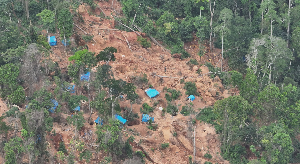
The Atewa Range Forest Reserve is “at the edge of extinction” due to escalating illegal mining activities, weak enforcement, and delays in prosecuting alleged offenders, environmental advocacy groups warned on Monday.
In a press statement issued on September 14, A Rocha Ghana, Eco Conscious Citizens, and the Concerned Citizens of Atewa Landscape said the forest faces an unprecedented threat following increasing illegal mining operations and mounting pressure on institutions responsible for its protection. The groups said their assessment was based on court records, operational reports, Forestry Commission correspondence, and documentation from the forest .
A Century of Protection Under Siege
The Atewa Forest was gazetted as a protected reserve on January 5, 1926, by the Okyeman State Council under the leadership of Nana Sir Ofori Atta I. A century later, the groups say, the forest’s survival is being threatened by illegal mining, weak enforcement, and delays in prosecuting alleged offenders .
Covering approximately 26,300 hectares and rising to more than 800 metres above sea level, Atewa forms the headwaters of the Ayensu, Densu, and Birim rivers, as well as more than 99 streams, making it a critical source of water for millions of Ghanaians. The groups estimate that more than five million people depend on water systems connected to the forest .
The reserve is internationally recognised as one of the highest-priority ecosystems in West Africa. It is home to 239 bird species, 69 mammals, 40 amphibians, and 14 reptiles, with at least 78 species threatened with global extinction. The forest contains 969 vascular plant species and an estimated 711 butterfly species, representing about 77 per cent of butterfly species recorded in Ghana .
It was designated a Special Biological Protection Area in 1994, a Hill Sanctuary in 1995, and included as one of Ghana’s 30 Globally Significant Biodiversity Areas in 1999 .
Evidence of Destruction
The statement said illegal mining has expanded into parts of the protected reserve, citing the Wankobi Stream headwaters as one of the affected areas. It described evidence of excavated pits, stripped forest cover, polluted streams, makeshift mining camps, and abandoned equipment .
Forestry Commission records indicate that dozens of people have been arrested in connection with illegal mining operations, yet the activities continue. A letter dated March 2, 2026, from the District Manager of the Kyebi Forest District, Owusu Ameyaw, to the Abuakwa South Municipal Chief Executive reportedly stated that 60 people had been arrested in the Sagyimase/Asikam portion of the reserve, yet illegal mining persisted .
The statement also alleged that an operation involving 55 police officers on February 20, 2026, was compromised by an apparent information leak, resulting in only five arrests. Two forest guards were allegedly held hostage by illegal miners and later rescued by police reinforcements .
In April 2026, a joint enforcement operation by the Forestry Commission, A Rocha Ghana, and the Coalition Against Galamsey led to the arrest of a 20-year-old suspect and the destruction of ten water pumping machines and about 30 makeshift structures . A subsequent dawn swoop on April 26, 2026, resulted in 24 arrests at the Sagyimase portion of the reserve, with 16 water pumping machines destroyed and 52 makeshift tent structures dismantled. Five of those arrested were identified as minors .
Prosecution Challenges
The environmental groups expressed concern about repeated adjournments and bail granted in cases involving alleged illegal miners. They cited several cases between 2021 and 2026 in which suspects were arrested but proceedings were repeatedly adjourned .
However, the statement acknowledged that convictions had been secured in some cases, including one in which a suspect was sentenced to 20 years and another involving three suspects who pleaded guilty and received 15-year sentences with hard labour. The groups said such convictions demonstrate that effective prosecution is possible, although they described them as exceptions rather than the norm .
The Bauxite Question
The forest has faced a parallel threat from bauxite mining proposals. In 2018, Ghana entered a $2 billion barter agreement with the Chinese government, known as the Sinohydro deal, which earmarked the Atewa forest reserve for bauxite mining to repay infrastructure loans. In 2019, the Ghana Integrated Aluminium Development Corporation began prospecting for bauxite in the forest, drilling 53 exploration boreholes without an Environmental Impact Assessment as required by Ghana’s laws .
The exploration process affected around nine tributaries of rivers in the forest and resulted in the loss of centuries-old trees and the destruction of over 100 hectares of land. Bauxite mining has not yet commenced due to a lawsuit against the Ghanaian government, with the case currently pending in court .
The Okyenhene, Osagyefuo Amoatia Ofori Panin, has consistently opposed bauxite mining in the Atewa Forest. At the centenary celebration of the forest’s gazetting on January 5, 2026, he reaffirmed his commitment to protecting the reserve and questioned how mining could be undertaken without destroying its flora and fauna .
Escalating Threat Since 2025
Daryl Bosu, Deputy National Director of A Rocha Ghana, warned separately on TV3’s KeyPoints programme that the forest could be lost before the end of the current government’s term. He said the forest had come under an “unprecedented attack” since 2025, with illegal miners encroaching from several directions, including groups moving in from Burkina Faso .
“The Forestry Commission is struggling, even NAIMOS cannot contain the pressure,” Bosu said, referring to the National Anti-Illegal Mining Operations Secretariat. “If government does not really prioritise action to protect the forest as they said, this forest, I am afraid we are going to lose it” .
A Path Forward: National Park Proposal
Rather than mining, the environmental groups are advocating the development of Atewa as a National Park and the implementation of what they describe as a “Transformational Development Agenda.” The proposed agenda would focus on eco-tourism, agroforestry, climate finance, green value chains, land restoration, and sustainable livelihoods for communities surrounding the forest .
According to the statement, effective protection and restoration of Atewa could generate significant economic benefits, including more than $5 million annually in tourism revenue .
The Concerned Citizens of Atewa Landscape, a community-based organisation of 500 members from the 53 communities surrounding Atewa, has long advocated for national park status. The group has argued that this option “enjoys significant public support among the forest-edge communities and would honour Ghana’s commitment to the international Convention on Biological Diversity and the Sustainable Development Goals” .
In a related development, the World Bank has expressed satisfaction with the REDD+ programme being implemented in the Atewa Hotspot Intervention Area. The Ghana Cocoa Forest REDD+ Programme has provided carbon finance credits to communities in the Atewa landscape, with funds invested in boreholes, school desks, agricultural inputs, and capacity-building initiatives .
Mr Guangzhe Chen, World Bank Vice President for Planet, said during a field visit in June 2026: “We are modestly satisfied with the progress being made, but of course, we can always improve. We want to accelerate the payments, but that requires everybody to work together” .
Call for Urgent Action
The environmental groups called on the government to translate its environmental rhetoric into verifiable operational outcomes. They demanded an immediate and absolute cessation of all active illegal mining operations inside the Atewa Forest and along the banks of the Birim, Densu, and Ayensu rivers, and the tracking, apprehension, and swift prosecution of individuals and financiers backing illegal mining under the Minerals and Mining (Amendment) Act, 2019 (Act 995) .
“The forest is our heritage and our life,” the groups said. “If we destroy it, we do so at our own peril” .