



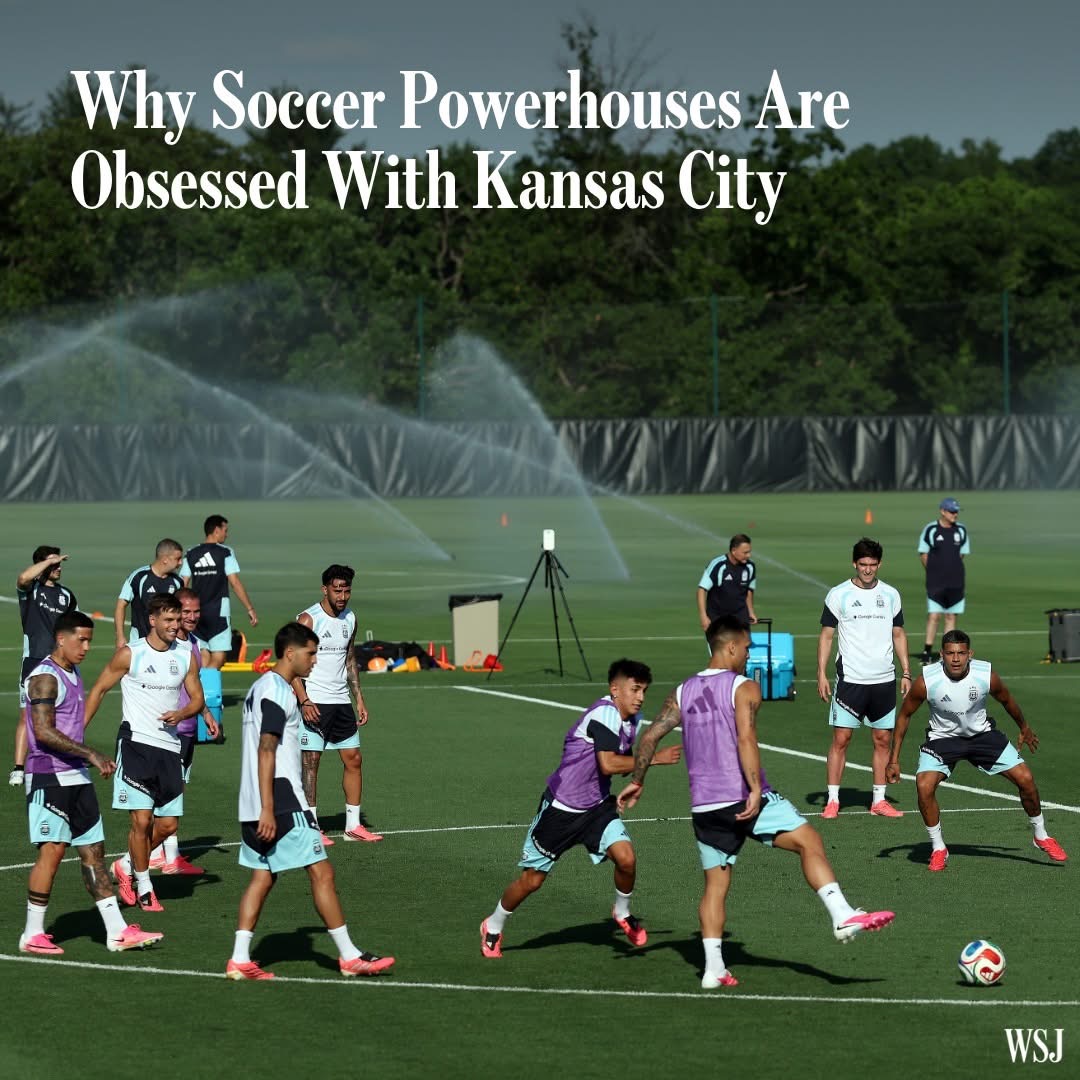
Lionel Messi’s Argentina prepared to defend its World Cup crown, team officials quietly traveled to the United States on a crucial mission: scouting the perfect base camp for the biggest, most sprawling World Cup in the tournament’s 96-year history.
For months, they searched across North America, evaluating training sites, hotels, logistics and climate. But when the final decision came, the world’s No. 1 ranked team did not choose New York, the host city for the final on July 19. Nor did they opt for Miami, the glitzy home of Messi’s Inter Miami CF.
Instead, La Albiceleste selected the 31st-largest metropolitan area in the United States — a region best known for burnt ends barbecue, the Wizard of Oz, and the whirlwind romance between Kansas City Chiefs tight end Travis Kelce and pop superstar Taylor Swift.
They picked Kansas City.
And the most surprising part? Argentina won’t be alone.
A Midwest Hub for World Cup Favorites
Three other nations have reached the same conclusion. England, the Netherlands and Algeria will also set up camp in the Kansas City area, drawn by an unusual combination of elite-level training grounds, a temperate spring climate, and a centrally located position that minimizes cross-country travel.
The four teams will be scattered across the metropolitan area. Argentina will train at Sporting Kansas City’s world-class facility in Kansas City, Kansas. England has secured the University of Kansas’ training grounds in Lawrence. The Netherlands will use the University of Missouri–Kansas City’s facilities. Algeria is expected to train at Swope Soccer Village, home to the Kansas City Current’s youth academy.
Why Kansas City?
Coaches and logistics experts cited several factors behind the surprising cluster.
Central location: Kansas City is within a two-hour flight of nearly every U.S. host city, reducing travel fatigue during the group stage. From here, teams can reach Dallas, Houston, Atlanta or Chicago with ease.
Climate: Unlike the humid Gulf Coast or the still-wintry Northeast in June, Kansas City offers mild, dry conditions ideal for training and recovery.
Training infrastructure: The region boasts five FIFA-quality grass pitches and climate-controlled indoor facilities, thanks to a decade of investment spurred by Major League Soccer’s Sporting KC and the National Women’s Soccer League’s Kansas City Current, which just opened the first stadium purpose-built for a women’s professional team.
Privacy: Unlike New York, Los Angeles or Miami, Kansas City offers a low-profile environment where players can move without constant media attention. As one Argentina staff member put it during scouting visits: “Here, Messi can have breakfast in peace.”
Local Excitement and Economic Boost
The news has sparked excitement across the metro area. Kansas City last hosted World Cup matches in 1994, when Arrowhead Stadium welcomed group-stage games. For 2026, Arrowhead will host four matches, including a Round of 32 elimination game and a quarterfinal.
Local businesses are already preparing. The American Royal Association, which runs the city’s famous barbecue contest, is planning a “World Cup Village” near the stadium. Hotels from Overland Park to downtown Kansas City are reporting a surge in bookings for June 2026.
“We’re going to show the world that Kansas City isn’t just about football — the American kind,” said Kansas City Mayor Quinton Lucas. “We’ve got world-class soccer infrastructure, incredible hospitality, and yes, the best barbecue on the planet. Argentina, England, Netherlands and Algeria are going to feel very welcome here.”
A Unique World Cup Challenge
The 2026 tournament, co-hosted by the United States, Canada and Mexico, will feature 48 teams and 104 matches across 16 cities — by far the largest in World Cup history. For teams, choosing a base camp has become a critical strategic decision, balancing training quality, travel logistics and player recovery.
England’s decision to join Argentina in the Midwest is particularly notable given the fierce rivalry between the two nations, dating back to Diego Maradona’s “Hand of God” goal in 1986 and England’s penalty shootout victory over Argentina in the 1998 Round of 16. But officials from both teams have downplayed any tension, noting that training sites are separated by nearly 40 miles.
“It’s a big metro area,” said an England team spokesperson. “We won’t be sharing a cafeteria with anyone.”
For Kansas City, the arrival of four World Cup heavyweights — including the defending champions — represents a coming-out party. Once known as a cowtown on the plains, the city now finds itself at the unexpected center of the global soccer universe this summer.
And somewhere, Travis Kelce is probably already planning to crash Messi’s barbecue.


