



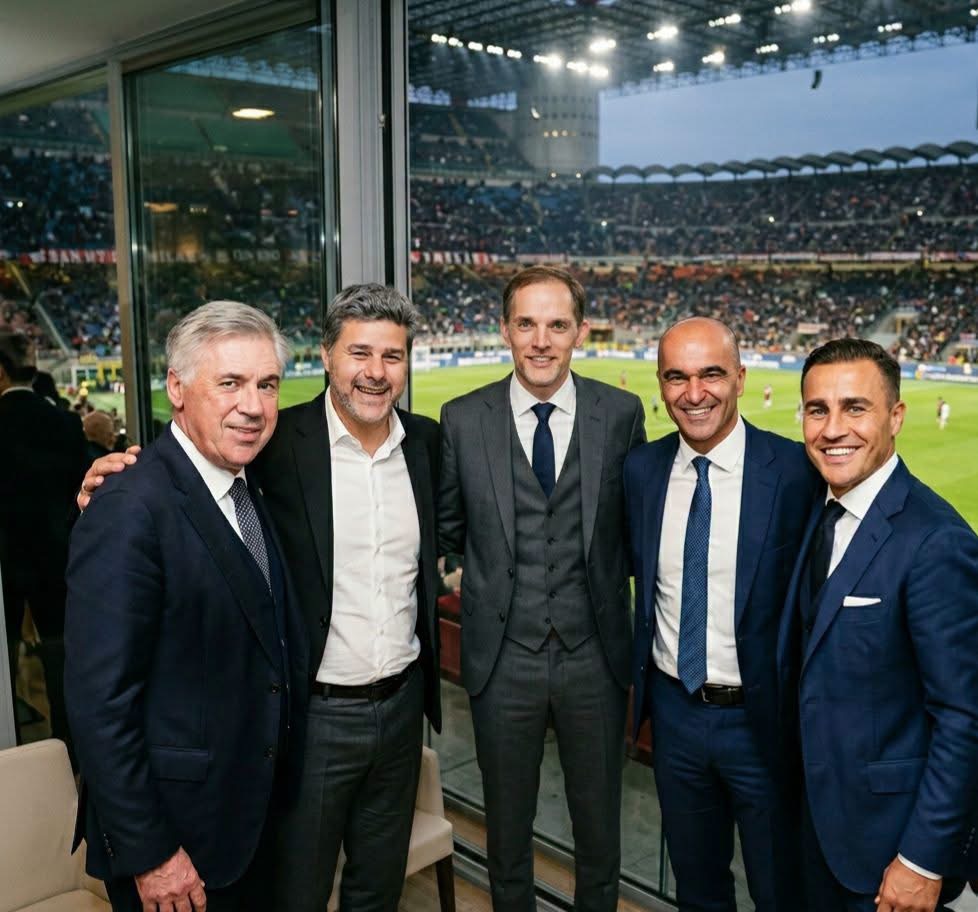
As the 2026 World Cup reaches fever pitch across North America, a fascinating sub-plot is unfolding off the pitch — the eye-watering salaries commanded by the tournament’s touchline generals.
According to figures compiled by Finance Football and reported by O Globo Esportes, a clear financial hierarchy has emerged among the 24 head coaches analysed. Topping the list is Brazil’s Carlo Ancelotti, whose €10 million annual package makes him the highest-paid manager in the tournament — and, quite possibly, in the history of international football.
The 66-year-old Italian, who took the reins in May 2025,was hired to end Brazil’s 24-year wait for a sixth World Cup title. That mission comes with a reported €5.4 million bonus should he succeed. “The figure reflects more than his current role,” notes The Times of India — it is a statement of intent from the five-time champions.
Germany’s Julian Nagelsmann occupies second place with €7 million annually. At just 38, the German tactician is the youngest manager at the finals — a striking 40-year age gap separates him from the oldest coach in the competition, Curaçao’s 78-year-old Dick Advocaat.
Host nation United States sits third with Mauricio Pochettino on €6 million. U.S. Soccer’s latest tax filings confirm the Argentine’s base salary at $6,040,600, making him the highest-paid coach in American national team history. Notably, his contract — partially funded by a donation from hedge fund billionaire Ken Griffin — runs only through the end of this tournament.
England’s Thomas Tuchel follows in fourth at €5.8 million, tasked with ending the Three Lions’ 60-year wait for major silverware.
The joint fifth-place tie, however, is where the list gets truly remarkable. Portugal’s Roberto Martínez and Uzbekistan’s Fabio Cannavaro are both listed at €4 million annually. For Cannavaro — the 2006 Ballon d’Or winner and World Cup champion with Italy — this places him ahead of France’s Didier Deschamps (€3.8 million), a manager who has actually won the World Cup.
Uzbekistan, ranked 50th in the world and appearing in their first-ever World Cup,is paying its Italian coach the same as Portugal, a European powerhouse. It is a staggering investment for a nation making its debut on football’s biggest stage.
The top 10 is rounded out by Ronald Koeman (Netherlands, €3M), Marcelo Bielsa (Uruguay, €3M), and Jesse Marsch (Canada, €2.5M). At the opposite end of the spectrum, Scotland’s Steve Clarke brings up the rear among the 24 analysed coaches with just €530,000 annually.
The salary gap tells its own story. Ancelotti earns nearly 19 times more than Clarke — a gulf that reflects both the weight of expectation on Brazil’s shoulders and the growing financial disparity within international football.
As the group stage unfolds, these managers now have to justify their price tags. For Ancelotti, the pressure is immense. For Cannavaro, simply guiding Uzbekistan out of the group stage would represent a monumental return on investment. And for the rest, the World Cup remains the ultimate stage — where no salary can guarantee glory, but where every euro spent is a bet on football’s most coveted prize.


