



Africa’s vast lithium deposits could hold the key to transforming the continent’s economic fortunes—if African countries can take control of the entire value chain and stop exporting raw minerals.
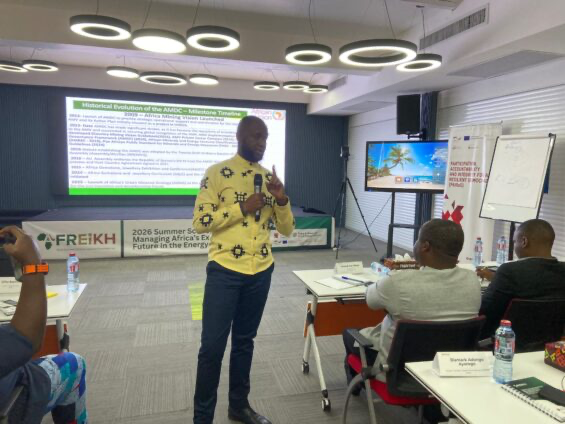
This is the emerging message from the ongoing Summer School on Managing Africa’s Extractive Future in the Energy Green Transition, organised by the Africa Centre for Energy Policy (ACEP) in Accra. The programme, which runs from August 18 to 28, 2026, has brought together civil society organisations, journalists, and extractive-sector experts from 15 African countries to examine how the continent can maximise its mineral wealth amid the global transition to clean energy.
A $9 Trillion Opportunity
Speaking at the Summer School, Nkuli Ncobe of Zimbabwe said Africa is sitting on enormous lithium resources estimated to be worth about US$9 trillion, describing the mineral as a potential game-changer for the continent. He argued that African countries must move beyond the traditional model of extracting minerals and exporting them in their raw state.
According to him, African countries should develop a strategic regional mineral-feedstock value chain covering the upstream, midstream, and downstream stages of lithium production.
From Rocks to Riches: A Continental Industrial Ecosystem
Mr Ncobe said countries could specialise in different segments of the lithium value chain, creating a continent-wide industrial ecosystem that generates jobs, investment, technology, and trade. Some countries, he explained, could focus on supplying capital goods and mining machinery, including dozers and other heavy equipment, while others could develop industries producing critical mining consumables such as explosives, drilling steel, spare parts, grinding media, and chemical services.
Other countries could position themselves as hubs for financial services, analytical services, security, information and communications technology (ICT) , and other support industries required by the lithium sector. Such a coordinated approach, he argued, could create a massive internal African market around lithium while ensuring that the wealth generated from the mineral remains largely on the continent.
Africa Must Stop Exporting Its Wealth
Mr Ncobe challenged African leaders to think beyond individual national interests and create a single continental market for African goods and services capable of supporting the emerging lithium economy. He believes stronger regional integration could allow African countries to leverage their different comparative advantages and build a competitive lithium industry capable of serving both African and international markets.
He also suggested that the Nigerian and Ghanaian stock exchanges could play a major role in mobilising the huge capital required to develop Africa’s lithium resources.
The Global Context: Surging Demand
The proposal comes at a time when lithium has become increasingly important to the global energy transition because of its use in batteries and energy-storage technologies. According to the International Energy Agency, demand for lithium is expected to rise tenfold between 2022 and 2050.
Sub-Saharan Africa is estimated to hold about 30 percent of the volume of proven critical mineral reserves globally. In 2024, Africa produced approximately 8 percent of global lithium. By 2028, that share is projected to reach 15–20 percent, making Africa the fourth-largest lithium-producing region globally after Australia, Latin America, and China.
Africa’s Lithium Landscape: Production Surge
Africa’s lithium output rose 44 percent in 2025, lifting the continent’s share of global lithium supply to 14 percent—more than double its 6 percent share from two years earlier.
Zimbabwe remains Africa’s largest producer, with mines like Bikita, Arcadia, and Sabi Star leading the expansion. The country holds Africa’s largest lithium reserves, with resources estimated at 126 million metric tons, according to official data. In 2025, Zimbabwe exported 1.128 million metric tons of spodumene concentrate, an 11 percent increase from the previous year.
The Democratic Republic of Congo is emerging as a major player. The Manono lithium project, a US$1 billion investment by China’s Zijin Mining, began production in May 2026—one month ahead of schedule. The company targets 30,000 metric tons of lithium carbonate equivalent output in 2026. Once fully operational, the mine is expected to process five million tonnes of ore annually and produce about one million tonnes of spodumene concentrate each year.
Mali is also rapidly scaling up. Combining production from the Bougouni and Goulamina mines, the country is expected to reach 590,000 tonnes of lithium concentrate in 2026, positioning it as Africa’s top producer.
Ghana is on the brink of becoming a lithium producer. Parliament ratified the mining lease for the Ewoyaa lithium project in March 2026, granting a 15-year lease. The project is expected to produce 3.6 million tonnes of spodumene concentrate over an estimated 12-year mine life.
Value Addition: The Push for Local Processing
Across the continent, countries are moving to capture more value from their lithium resources. Zimbabwe has enforced a ban on raw lithium exports, compelling mining companies to invest in local processing plants. The country will ban exports of lithium concentrates from January 2027.
Over 10 African countries have introduced or revised mining regulations since 2025, tightening raw mineral exports through export duties, local processing requirements, and mining rights准入 controls.
Chinese investment is playing a significant role in this push for local beneficiation. In Zimbabwe, Sinomine Resource Group plans to raise about US$764 million to finance several projects, including a lithium refinery. The China-owned Zhejiang Huayou factory opened in Zimbabwe in the first half of 2026, designed to refine around 6.5 kilotonnes of lithium sulphate.
In Morocco, Chinese lithium producer Yahua and South Korean battery manufacturer LGES are moving forward with plans to develop a lithium salts refinery, with US2 billion lithium-ion battery materials plant in Morocco in 2025—the first such facility outside Asia.
In Nigeria, a US$200 million lithium refinery on the outskirts of Abuja is nearing completion, with two additional processing plants expected to commence operations in Nasarawa State. A 6,000-metric-ton lithium processing plant built by Chinese investors has also been commissioned in Nasarawa. West Africa’s largest lithium processing plant, with a daily capacity of 6,000 tonnes of ore, has commenced operations in the country.
The AFREIKH Summer School: Confronting the Past, Building the Future
The ACEP Summer School, also known as the Africa Regional Extractives Industries Knowledge Hub (AFREIKH) , is designed to arm participants with the tools, foundations, and perspectives needed to navigate complex governance and fiscal constraints.
Benjamin Boakye, Executive Director of ACEP, noted that Africa’s experience with resource extraction provides an important starting point. “For decades, the continent has supplied oil, gas and minerals to global markets, yet resource wealth has too often failed to translate into broad-based economic development,” he said. He stated that oil revenues have generated significant expectations without always delivering the transformation citizens anticipated, while mining has been associated in many countries with environmental degradation, weak governance and unequal distribution of benefits.
“This history raises an uncomfortable question as Africa enters a new phase of the global energy transition: Will critical minerals become another missed opportunity, or can they mark a turning point for Africa’s industrialisation?” he quizzed.
Nafi Quarshie, Africa Director of the Natural Resource Governance Institute (NRGI), which co-organises the Summer School with support from GIZ, admonished the need for Africa to move beyond a model centred on extracting and exporting raw materials. “Africa must find ways to use its resource wealth to create jobs, develop industries, build productive capacity and retain a greater share of the value generated from its natural resources,” she noted.
This, however, requires more than favourable commodity prices or increased investment. “It requires capabilities,” she said.
Magdalena Wüst, Deputy Head of Cooperation at the Embassy of Switzerland, called for participants to see the Summer School as a leading platform for learning, knowledge sharing and collaboration. She challenged participants to confront the failures of the past, strengthen institutions, demand accountability, and challenge conventional approaches to resource governance. “The critical question is therefore shifting from what resources does Africa have? to what capabilities does Africa need to capture the value from those resources?” she said.
The Big Question: Who Will Control Africa’s Lithium?
For Africa, the lithium boom presents both an enormous opportunity and a major warning. The continent can either remain a supplier of raw materials to industries elsewhere, or use its mineral wealth to build factories, industries, jobs, technology, and prosperity at home.
The challenge, therefore, is no longer simply how much lithium Africa has underground. The real question is: Can African leaders turn the continent’s estimated US$9 trillion lithium wealth into African-owned industries and shared prosperity?
As the opening ceremony of the conference concluded: “Africa has the resources. The defining question is whether it can build the capabilities to turn those resources into industries, jobs, value, and lasting development” .
The ongoing ACEP Summer School is putting that question, and Africa’s broader extractive future, firmly on the table.


