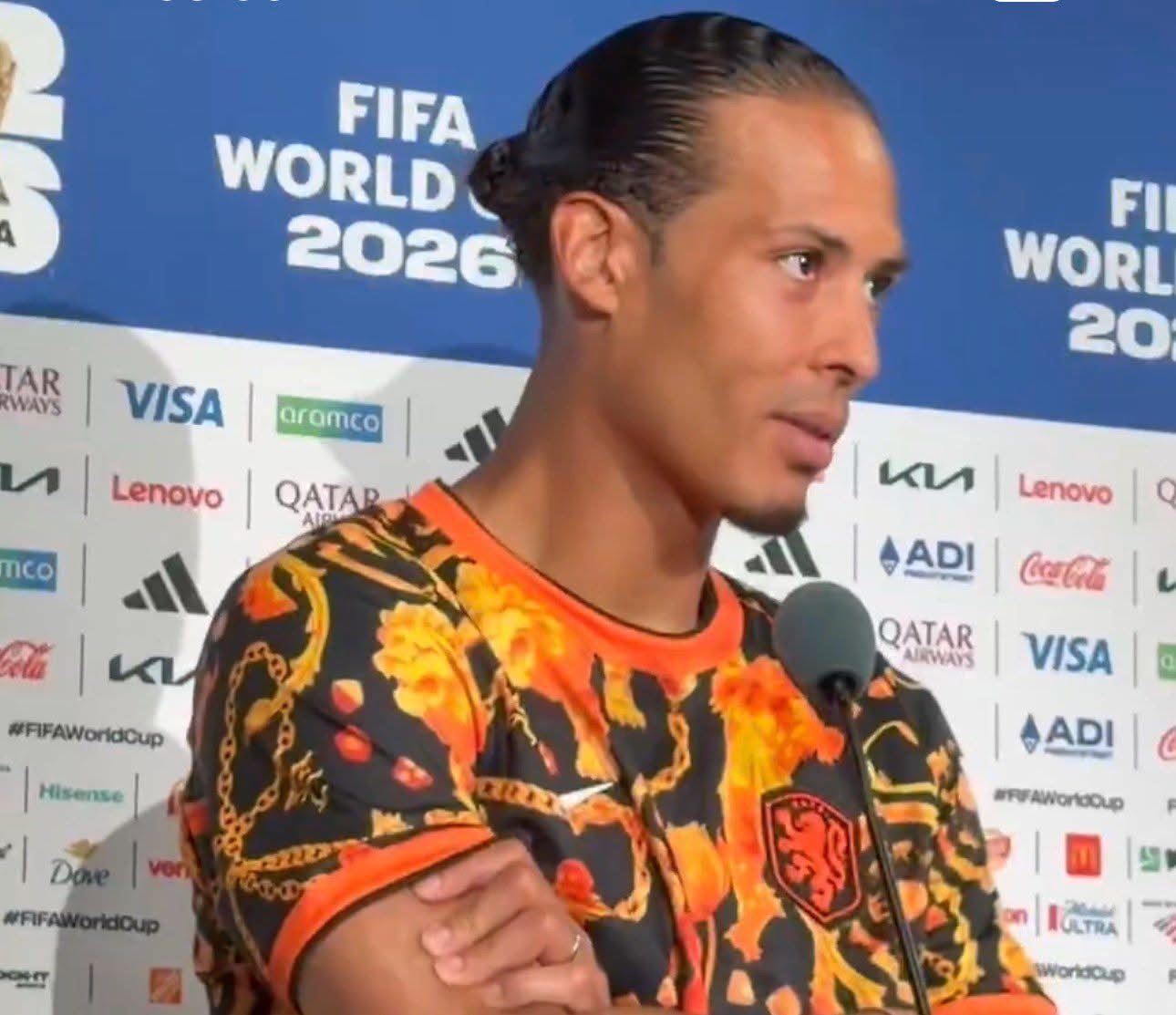
Netherlands captain Virgil van Dijk has become the latest high-profile figure to criticise FIFA’s mandatory hydration breaks at the 2026 World Cup, describing the blanket stoppages as detrimental to both players and the television audience.
Speaking after his side’s dramatic 2-2 draw with Japan at AT&T Stadium on Sunday — a match in which the Liverpool centre-back headed home his first major tournament goal for his country — van Dijk said he had “watched almost all the games” of the tournament and found the enforced pauses a persistent frustration.
“I think hydration breaks are really interesting. I was obviously watching almost all the games up until today,” van Dijk told reporters. “I think every time going to commercials is a bit, not really something that I like. I think for the neutral watchers on TV it is also not great.”
The Dutch captain, whose 34th-minute header and defensive leadership were central to his team’s performance, was measured but clear in his criticism. He did not reject player welfare concerns outright but argued that the breaks should be applied on a case-by-case basis rather than being mandated in every fixture.
“So if it is really hot it would be good to put them in, but I think you have to look at it in every game, separately, in my opinion. But I think I have said enough already on that.”
‘Momentum breaks’: how a player-safety measure sparked a tournament-wide debate
Van Dijk’s comments reflect a growing chorus of discontent surrounding FIFA’s decision to pause play for three minutes at approximately the 22nd minute of each half in all 104 matches of the expanded 48-team tournament, regardless of weather conditions, stadium type or temperature.
The new rule, announced on 5 December 2025, replaced the previous policy, which had allowed cooling breaks only when the temperature at kick-off exceeded 32 degrees Celsius (approximately 90 degrees Fahrenheit). Under the old system, the decision rested with match officials and medical staff; now, the referee blows his whistle to stop the game midway through each half without any temperature trigger.
FIFA has presented the measure as a necessary response to the stifling heat and humidity expected across the three host nations — the United States, Canada and Mexico — particularly as the tournament is being played in June and July. A report published by Football for the Future, Common Goal and Jupiter Intelligence found that 10 of the 16 stadiums across the host countries are at a “very high risk of extreme heat stress conditions,” and many squads have been preparing for conditions that could dictate how the game is played.
The governing body also drew on recent experience from the revamped Club World Cup, held in the United States last summer, where players reported dangerous heat-related symptoms. Chelsea and Argentina midfielder Enzo Fernández said he felt “really dizzy” while playing in temperatures he described as “very dangerous,” and then-Chelsea head coach Enzo Maresca was forced to cut training sessions short amid a “code red” heat warning in Philadelphia.
However, the mandatory nature of the breaks — applied even in air‑conditioned, roofed stadiums and in cooler host cities such as Seattle — has fuelled accusations that the policy is as much about commercial revenue as player safety.
A quartered game: the hidden commercial motive
The suspicion that FIFA is more concerned with its broadcast partners than with player welfare has been reinforced by the organisation’s simultaneous announcement of commercial guidelines for the breaks.
According to documents obtained by The Athletic, broadcasters are permitted to cut away from the pitch and run advertising during the three-minute pause. They must wait 20 seconds after the referee signals the break, and must return 30 seconds before play resumes — leaving a window of exactly two minutes and ten seconds for advertisements. Broadcasters also have the option of splitting the screen to run advertising alongside the stadium feed, though in that case only FIFA official sponsors may be shown.
The effect, as many have observed, is to transform the traditional structure of a football match — two 45‑minute halves — into something closer to four quarters of roughly 22 minutes each, a format more readily associated with American sports such as basketball and American football.
That perception was only heightened on the opening day of the tournament, when US broadcaster Fox Sports cut to full‑screen advertisements during the first hydration break of the Mexico‑South Africa match. Commentators were heard announcing that “this hydration break is powered by Powerade,” leaving fans on social media to vent their frustration at what many called an “interruption” to the natural flow of the game.
‘Football is being held hostage’: mounting criticism from managers and players
Van Dijk is far from alone in voicing his discontent. US head coach Mauricio Pochettino has been among the most outspoken critics, telling reporters: “I don’t like it. I only like it when the conditions are extreme. But when the conditions are good, it is unnecessary”.
Former Liverpool manager Jurgen Klopp, speaking on German broadcaster ZDF, delivered an even more scathing assessment. “Football is being held hostage by executives ensconced in air‑conditioned offices,” he said. “When I saw the players just standing there during a heat break while TV timeouts dictated the rhythm of the match, I couldn’t help asking myself: who does the World Cup really serve? The fans? The players? Or the advertisers?”
Klopp argued that the breaks destroy the organic tempo of the sport. “A World Cup match should flow like a river. Instead, we build dams right in the middle so commercials can get through. Football used to be the main event, but now it risks becoming the background music to an advertising show,” he added, describing the breaks as “nothing more than a gilded cage built for sponsors” while being “badged up as a noble sword against the heat”.
World Cup winner Juan Mata, a member of Spain’s 2010 champion squad, also weighed in, telling ITV Sport: “As a player I don’t think it’s great. When you’re losing, you want to score, and when you’re winning you want to keep the ball. I think they break the momentum”.
US women’s national team coach Emma Hayes has labelled them “momentum breaks,” noting that the stoppage offers a distinct advantage to the side that has been losing momentum. “When you’re on top, you don’t want it; when you’re losing, you do,” she explained. “It’s a shame. I can understand it in really warm parts of the country, but it seems like it could be something that could be here for good”.
Tactical impact: managers already exploiting the pause
The breaks are not merely an irritant; they are already having a tangible impact on match outcomes. Brazil coach Carlo Ancelotti acknowledged that a first‑half hydration break allowed him to deliver fresh instructions to his players when his side trailed Morocco 1‑0; six minutes after play resumed, Vinicius Jr had levelled the score.
“You can explain a problem to the players,” Ancelotti said. “[You can] make a tactical adjustment that can be very good”.
Canada equalised soon after a second‑half hydration break when substitute Cyle Larin cancelled out Bosnia‑Herzegovina’s lead; Scotland scored the only goal of their win over Haiti shortly after a break; and Australia grabbed their opener in similar circumstances in their 2‑0 victory against Turkey.
The trend has led some to question whether, if the breaks are genuinely about player welfare, managers should even be permitted to deliver tactical instructions during them.
‘A threshold that doesn’t exist’
Critics have pointed to the central contradiction in FIFA’s policy: if the breaks are a health measure, why are there no meteorological conditions attached? Under the previous rules, a cooling break would only be triggered when the temperature hit a certain threshold — typically 32 degrees Celsius (around 90 degrees Fahrenheit). That threshold was a tangible, objective measure.
Now, as the ABC’s analysis put it, the breaks are present “for every single game, no matter if it’s 23 degrees and raining or 33 degrees — or in an air‑conditioned stadium with the roof shut”. The absence of any temperature threshold has led many to conclude that the breaks are not about heat — or, at least, not about heat alone.
Van Dijk’s measured stance: not against safety, but against a one‑size‑fits‑all rule
What distinguishes van Dijk’s intervention from the more theatrical condemnations of Klopp and Pochettino is its pragmatic tone. The Dutch captain made clear that he is not opposed to hydration breaks in principle; he simply questions whether every World Cup match requires the same stoppage, no matter the conditions.
His timing was significant. The Netherlands had just lost control of a match they twice led, with Japan fighting back for a 2‑2 draw. Van Dijk himself had opened the scoring with a powerful header from Ryan Gravenberch’s cross — his first major tournament goal for his country — and later watched as Crysencio Summerville restored the Dutch advantage. But Japan refused to fade, equalising for a second time in the 88th minute through Daichi Kamada.
In that context, van Dijk’s critique of the hydration breaks was not offered as an excuse. It was a broader reflection on flow, on television interruptions, and on whether player‑welfare rules need more flexibility. His view, as Yahoo Sports noted, “was measured, but clear: Hydration breaks make sense in real heat, but the World Cup may not need a one‑size‑fits‑all rule for every stadium”.
What happens next?
The hydration breaks are now an established feature of the tournament, and FIFA has shown no indication of reversing course. Each of the 104 matches will feature two three‑minute pauses, and broadcasters have already integrated the breaks into their commercial schedules.
But the backlash is growing. Van Dijk joins Pochettino, Klopp, Mata, Hayes and a host of fans and pundits in questioning whether FIFA’s priority is truly player welfare — or whether the governing body has, as one commentator put it, “found the end of the world’s tether” by sacrificing the sport’s natural rhythm on the altar of commercial revenue.
For now, van Dijk and the Netherlands must turn their attention to their remaining group matches. But his words, delivered with characteristic calm, have added significant weight to a debate that shows no sign of going away.
“For the neutral watchers on TV, it’s not great,” he said. “But I think I have said enough already.”