



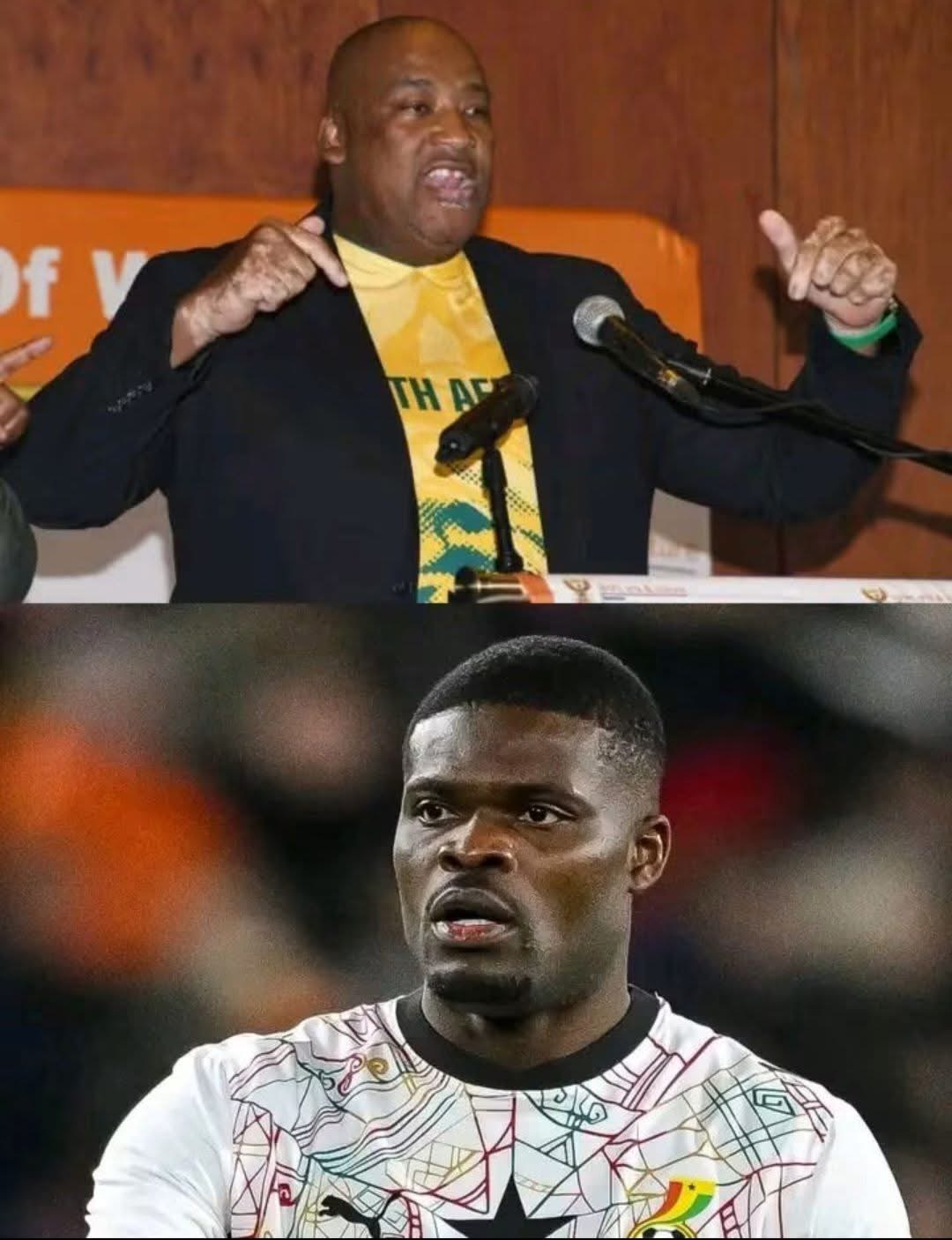
South Africa’s Sports Minister has unleashed a characteristically unfiltered defence of FIFA president Gianni Infantino, brushed aside visa concerns and vowed he will “not care” if rival nations suffer refereeing setbacks — in a remarkable interview that lays bare his zero‑apologies approach to sport diplomacy ahead of the 2026 FIFA World Cup.
By News Correspondent
JOHANNESBURG — South Africa’s Minister of Sports, Arts and Culture, Gayton McKenzie, has delivered a characteristically unfiltered defence of FIFA president Gianni Infantino’s record in Africa during a candid interview with veteran broadcaster Robert Marawa, while dismissing concerns over travel logistics and refusing to express sympathy for rival football nations.
Speaking as Bafana Bafana prepare for their first World Cup appearance since hosting the tournament in 2010, the former gang‑leader‑turned‑cabinet minister offered a blunt manifesto for his approach to international football: South Africa first, consequences second.
“People, for example in Ghana, say Bafana Bafana must lose and you think if they stop a Ghanaian referee, I will care?” McKenzie told Marawa. “Maybe you have a kind heart, but me, no!”
‘Infantino Has Been the Best Person for African Football’
At the heart of the interview was McKenzie’s staunch defence of FIFA President Gianni Infantino, whose close relationship with former US president Donald Trump has drawn scrutiny from some quarters of the global football community.
The relationship between Infantino and Trump has been described as unusually close. The FIFA chief has been a frequent guest at both the White House and Trump’s Mar‑a‑Lago estate, and attended Trump’s second inauguration. In 2018, Infantino famously introduced Trump to the concept of football’s yellow and red cards during an Oval Office visit. The pair reunited ahead of the 2026 World Cup — which the United States is co‑hosting with Canada and Mexico — with Infantino posting on social media: “I was honoured to meet US President Donald Trump at Mar‑a‑Lago … America welcomes the World and Football Unites The World!”
McKenzie rejected any suggestion that the Trump connection should colour Africa’s view of Infantino.
“Infantino has been the best person for African football,” McKenzie declared. “His relationship with Trump isn’t our business. He has been very kind to Africa. This World Cup is not what people think.”
The minister’s assessment aligns with available figures. In October 2025, Infantino told the 47th CAF Ordinary General Assembly in Kinshasa that FIFA has invested over USD 1 billion in African football development since the launch of the FIFA Forward Programme in 2016, with total support projected to reach USD 1.28 billion by the end of 2026. An unprecedented nine, and possibly ten, African nations will contest the expanded 48‑team World Cup in the United States, Canada and Mexico.
‘Did Everyone in South Africa Get Their Visas? Yes. So What’s the Problem?’
McKenzie also brushed aside questions about travel logistics, in a pointed reference to the visa delays that had disrupted Bafana Bafana’s departure for a pre‑tournament training camp in Mexico.
The South African senior men’s national team was scheduled to travel to Mexico on 31 May but was forced to postpone its departure after the South African Football Association (Safa) botched the visa application process. The team eventually departed a day later, though assistant coach Helman Mkhalele and head of security Mdu Mbatha were initially left behind. The episode drew widespread criticism, with one local publication calling it “another reminder that some of South African sport’s best‑paid and best‑resourced administrators continue to score own goals.”
McKenzie, however, took a markedly different view, focusing on the outcome rather than the process.
“I respect America’s rules,” he said. “Did everyone in South Africa get their visas? Yes, so what’s the problem?”
He reinforced the point with characteristic finality: “If South Africa is sorted, our players are sorted, my team is sorted with visas, that’s it.”
‘I Will Not Care’ — McKenzie’s Hard Line on Refereeing Controversies
Perhaps the most provocative segment of the interview came when Marawa pressed McKenzie on the prospect of hostile refereeing decisions — an issue with deep and painful resonance for South African football fans.
The context is unmistakable. In November 2021, Bafana Bafana suffered a deeply controversial 1‑0 defeat to Ghana in a World Cup qualifier that ultimately cost South Africa a place at the Qatar 2022 tournament. Senegal referee Maguette Ndiaye awarded Ghana a penalty that television replays suggested should not have stood, with the home player appearing to dive. South African captain Ronwen Williams later claimed that before a ball had even been kicked, the referee told him “he’s going to book me for time‑wasting,” adding that ball boys disappeared after the disputed goal. South Africa’s coach at the time, Hugo Broos, told his assistants just 15 minutes into the match: “Forget it, Ghana will win this game. The referee is against us.” The South African Football Association lodged a formal complaint with CAF and FIFA, demanding a replay, but the protest was ultimately unsuccessful.
When asked whether he would care if a Ghanaian referee were to be sanctioned in return, McKenzie’s response was swift and unyielding.
“People, for example in Ghana, say Bafana Bafana must lose and you think if they stop a Ghanaian referee, I will care? Maybe you have a kind heart, but me, no!” McKenzie told Marawa, who appeared taken aback by the minister’s candour.
It was a stark encapsulation of McKenzie’s broader philosophy: that sport diplomacy is not about fairness or reciprocity, but about securing outcomes for South Africa — by whatever means necessary.
From Prison to Parliament: The McKenzie Phenomenon
McKenzie’s approach to public office has been as unconventional as his path to it. The 50‑year‑old leader of the Patriotic Alliance (PA) robbed his first bank before turning 16, spent seven years in prison, and later reinvented himself as a nightclub owner, motivational speaker, author and politician. President Cyril Ramaphosa appointed him to the sports portfolio in July 2024, after the African National Congress (ANC) lost its parliamentary majority and was forced into a multi‑party coalition government.
Since taking office, McKenzie has proven to be one of South Africa’s most quotable — and controversial — cabinet members. He has tabled a R6.3 billion budget aimed at unlocking local talent, pushed for the return of Formula One to Kyalami, and signed a global charter to end online abuse in sport. Yet critics have noted that his bold statements often outpace follow‑through, with public transparency efforts sometimes described as “reactive rather than proactive.”
A New Era for African Football?
McKenzie’s praise for Infantino — and his willingness to overlook the FIFA president’s ties to Trump — reflects a broader calculation: that under Infantino’s leadership, African football has never had it better.
From 2016 to 2026, the FIFA Forward Programme will channel more than USD 1.2 billion into the continent, funding infrastructure, competitions and training for all 54 African member associations. Infantino has also opened up unprecedented playing opportunities, with African teams set to feature in record numbers at both the senior World Cup and youth tournaments.
For critics, the Trump connection remains troubling, and Infantino’s leadership style has drawn accusations of transactional diplomacy and political expediency. For McKenzie, however, such concerns are irrelevant when measured against the tangible benefits flowing to Africa.
“Infantino has been very kind to Africa,” the minister reiterated. “His relationship with Trump isn’t our business.”
What the World Cup Means — and What It Doesn’t
Perhaps the most enigmatic line of the interview came early, when McKenzie said of the 2026 tournament: “This World Cup is not what people think.” He did not elaborate, leaving listeners to speculate about whether he was referring to the tournament’s political dimensions, its commercial underpinnings, or something else entirely.
What is clear, however, is that McKenzie sees the World Cup as a moment for South Africa to assert itself — not to worry about what other nations think.
“I don’t care about his relationship with Trump,” McKenzie said of Infantino. “If South Africa is sorted, our players are sorted, my team is sorted with visas, that’s it.”
It is a message that will resonate with South African fans weary of administrative mismanagement and eager to see their team compete on the global stage after a 16‑year absence. But it is also a philosophy that raises uncomfortable questions about solidarity, fair play and the spirit of international competition.
For now, however, McKenzie is not inviting debate. With Bafana Bafana set to open their World Cup campaign against Mexico — a repeat of the first match of the 2010 tournament — South Africa’s sports minister has made his position unmistakably clear: his priorities are South African, his patience is limited, and he will not apologise for either.


