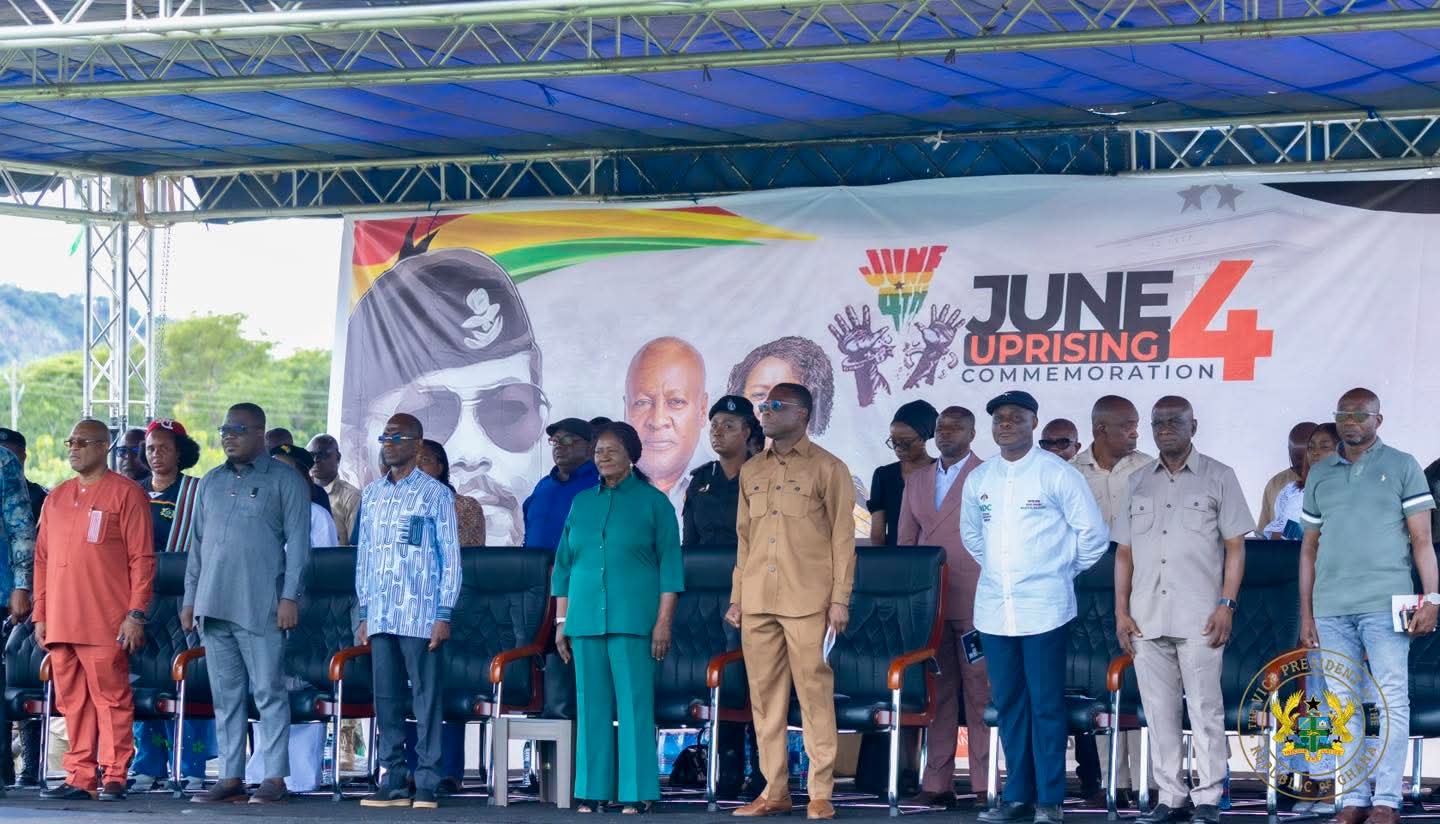
Ghana’s Vice President, Professor Jane Naana Opoku-Agyemang, today joined government officials, security services, religious leaders, and members of the National Democratic Congress (NDC) in Banda Ahenkro to commemorate the 47th anniversary of the June 4, 1979 uprising .
The event, held under the theme “Strengthening State Institutions: Lessons from the June 4, 1979 Uprising,” served as both a remembrance of a pivotal moment in Ghana’s political history and a platform to outline the government’s ongoing governance agenda .
Background: A Turning Point in Ghana’s History
The June 4 uprising remains one of the most significant and polarizing events in Ghana’s political evolution. Its roots trace back to May 15, 1979, when Flight Lieutenant Jerry John Rawlings, then a junior military officer, led a failed coup attempt against the ruling Supreme Military Council II (SMC II), chaired by General F. W. K. Akuffo .
The failed mutiny was sparked by widespread grievances among junior officers, including the denial of salaries, rampant corruption among senior military officials, severe economic hardship, and general indiscipline within the armed forces . Following the foiled attempt, Rawlings was arrested, publicly tried at Burma Hall in Accra, and sentenced to death .
During his trial, Rawlings turned the proceedings against the government, accusing the SMC II of systemic corruption and taking sole responsibility for the mutiny while demanding his colleagues be freed . His imprisonment drew sympathy from junior officers and students alike, who launched campaigns demanding his release .
On the night of June 3, 1979, junior military officers—led by figures including Captain Boakye Djan—broke into the jail where Rawlings was held, freed him, and marched him to the national radio station to announce the overthrow of the SMC II . The insurgents subsequently rounded up senior military officers, including three former heads of state—Lt. Gen. Akwasi Amankwaa Afrifa, Gen. Ignatius Kutu Acheampong, and Lt. Gen. Fred Akuffo—who were tried and executed by firing squad .
Rawlings was appointed Chairman of the Armed Forces Revolutionary Council (AFRC), which ruled until September 1979, when power was handed over to the democratically elected Dr. Hilla Limann . However, Rawlings overthrew Limann on December 31, 1981, a date that would later evolve into the establishment of the Provisional National Defence Council (PNDC) and eventually the NDC .
While supporters view the uprising as a necessary “house-cleaning exercise” that restored probity, accountability, and discipline in public life, critics remember it as a traumatic period marked by the unlawful seizure of businesses, breakdown of military hierarchy, and state-sanctioned executions .
Vice President’s Address: Learning from History, Resetting Governance
Addressing the gathering, Vice President Opoku-Agyemang struck a reflective yet forward-looking tone, urging Ghanaians to draw valuable lessons from the past while focusing on national development.
“While history carries difficult lessons that we must not lose sight of, we must also highlight how far we have come so that we are encouraged to do even better,” she said .
The Vice President emphasized that the NDC’s origins were rooted in a desire to correct governance failures—a purpose that must continue to guide their work in office.
“There is a reason why we became a party that should never escape our minds. We became a party because we thought there was something going wrong. If we are here, we must right that wrong and ensure that the rightness that we have established remains,” she stated .
She stressed that government policies must translate into tangible improvements in citizens’ daily lives. “Whatever policy we bring should translate into the physical and everyday life of people. Whatever policy that we worked so hard to manufacture in our manifesto must mean the way we are implementing this manifesto to better the lives of people,” Opoku-Agyemang added .
The Reset Agenda: Facts and Figures
The Vice President used the platform to highlight the Mahama administration’s efforts to “reset” Ghana, focusing on reducing government bloat while improving efficiency and strengthening democratic accountability.
According to an assessment by the Legal Green Association reviewing the administration’s first year, several key governance and economic measures have been implemented :
Governance Reforms:
· Reduction in the number of ministers from 120 to 60, a move expected to save the state approximately GH¢300 million over three years
· Presidential directive barring ministers from traveling first class on official duties
· Cancellation of fuel allowances and allocations for political appointees
Economic Relief Measures:
· Repeal of several taxes including the electronic levy, betting tax, emissions levy, and COVID-19 Health Recovery Levy
· Value-added tax reforms resulting in GH¢6.5 billion returned to households through reduced prices
· Fuel prices declining from approximately GH¢15.45 per litre in January 2025 to GH¢10.99 by January 2026
Macroeconomic Stabilization:
· Inflation fell sharply to 5.4 per cent in December 2025, compared with 23.8 per cent a year earlier
· Average lending rates reduced from over 30 per cent in December 2024 to about 20 per cent by the end of 2025
Revenue and Resource Management:
· Establishment of GoldBod, a centralized gold purchase and export entity, generating more than GH¢960 million in revenue in 2025
· Resumption of crude oil refining at the Tema Oil Refinery, strengthening energy security
Social Interventions:
· Free Senior High School policy maintained and expanded with an allocation of GH¢3.5 billion in 2025
· “No Fees Stress” policy removing academic fees for first-year tertiary students; more than 152,000 students have benefited from reimbursements
· Establishment of MahamaCare Trust Fund to support treatment of non-communicable diseases not fully covered by the National Health Insurance Scheme
· Launch of nationwide free sanitary pad distribution programme
Infrastructure Investment:
· Launch of Ghana Infrastructure Plan in October 2025 with GH¢13.9 billion allocated to the government’s “Big Push” initiative
· Additional GH¢30 billion planned for 2026 across sectors including health, education, agriculture, and sports
Strengthening State Institutions
The commemoration’s theme resonated throughout the Vice President’s remarks. She noted that as part of the government’s reset agenda, deliberate efforts are being made to maintain the pillars of democracy and accountability.
“As part of our aim to reset Ghana, the Mahama Government was structured to reduce bloat while improving efficiency, and to be deliberate about maintaining the pillars of democracy and accountability,” she said.
This focus aligns with broader institutional strengthening efforts, including Parliament’s recent launch of its Corporate Strategic Plan (2026-2030), which focuses on legislative management, parliamentary oversight and accountability, parliamentary representation, parliamentary diplomacy, and support services .
Mr. Fifi Fiavi Kwetey, NDC General Secretary, had earlier noted that the principles of probity, accountability, inclusiveness, and people-centered governance that formed the moral foundation of June 4 remain inseparable from the broader national reset agenda .
Call to Action
The Vice President commended Ministers of State and Metropolitan, Municipal, and District Chief Executives (MMDCEs) for their efforts in implementing government programmes. She also called on all citizens to play active roles in nation-building.
“We still have far to go as a nation. We continue to encourage every citizen to play an active role in building the Ghana we all want,” Opoku-Agyemang said .
As part of the day’s activities, the Vice President also led a sod-cutting ceremony for the construction of Banda Inner Town roads, demonstrating the government’s commitment to infrastructure development even in commemorative settings .
The 47th anniversary commemoration serves as a reminder that while June 4 remains a contested and painful memory for many Ghanaians, its legacy—particularly the demand for accountability and integrity in public life—continues to shape the nation’s democratic journey.