



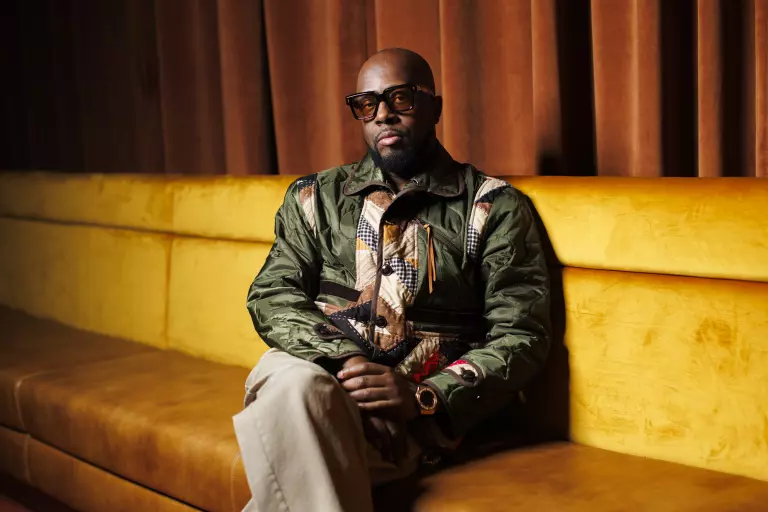
Backstage at the Blue Note jazz club, Wyclef Jean stretches out on a couch with the ease of a man who has spent three decades in the spotlight. The rider in his dressing room contains only healthful snacks: granola bars, melon slices, grapes large as ping-pong balls. The scent of weed drifts through the doors. Does he still smoke? “Do fish swim?” he responds with a grin.
Jean describes himself as a man of two personalities: “the peaceful one here, and the bonkers one onstage.” On this evening, the rascal within is momentarily at rest, glimpsed only occasionally behind dark sunglasses.
The interview comes just days after the death of John Forté, a close friend and collaborator whose contributions to the Fugees’ platinum-selling sound have long been under-credited. “We would talk all the time,” Jean says quietly. His last text to Forté read simply: “Yo, text me, so I know you okay?” There was no reply. “He had this smile that shook the universe.”
A Carnival of Memory
For Jean, memory has become his greatest muse. He is in the midst of a five-night residency at Blue Note Los Angeles, delivering a carnivalesque staging of his life and career that vaults from Haitian rara to boom-bap, from reggae-inflected balladry to rock guitar theatrics. At one point, he performs cunnilingus on his guitar. The show serves as a walk-back to his beginnings, mirroring his forthcoming seven-part project, “Quantum Leap.”
Over three decades, Jean has established himself as a foundational figure in modern pop music—one of its most vital cultural coalitionists, fusing Pan-American sounds into music that is both party-ready and politically alert. He anticipated today’s globalized music economy long before the industry had language for it, though his influence has often been curiously overlooked.
As a solo artist, he has released nine albums selling upward of 9 million copies worldwide, from his 1997 debut “The Carnival” to 2000’s aptly titled “The Ecleftic: 2 Sides II a Book,” which transformed wrestling superstar The Rock into a pop hitmaker. Along the way, Jean has consistently championed emerging talent, helping introduce Beyoncé to the world with Destiny’s Child’s breakthrough single “No, No, No,” and co-writing and appearing on Shakira’s global smash “Hips Don’t Lie.”
Yet despite the accolades, Jean feels misunderstood.
“I still don’t feel like the world’s figured me out yet,” he says. He compares his career, more than once, to Bob Marley’s. “Bob Marley don’t got one Grammy even though he was the biggest artist in the world.”
Seven Albums, Seven Months
“Quantum Leap,” he hopes, will finally provide clarity. The ambitious project consists of seven albums released over seven months, each devoted to a different genre—hip-hop, reggae, jazz, country, Haitian kompa, R&B—and each traceable to a pivotal moment in his career. He has been working on it for five years, structuring it in seven sections to reflect the 35 years he has spent in music. “You find inspiration in your origin,” he says.
That origin began in Croix-des-Bouquets, Haiti, where Jean was born into hardship. Doctors had to forcibly wrench him from his mother at birth. As a child in a country where most live on less than a dollar a day, he was so poor he ate dirt. When he was 9, his family moved to Brooklyn’s Marlboro Projects. He spoke Creole at home and learned English at school.
Inspired by Grandmaster Flash, he began freestyling in his early teens—first to himself in the bathroom, then to anyone who would listen in the cafeteria. “All I ever wanted,” he says, “was for people to hear me.” His minister father loathed rap, yet Jean teasingly and earnestly called himself “the preacher’s son,” filling his verses with biblical language that still surfaces in “Quantum Leap.”
At 13, he began conducting the church choir. His music teacher, Valerie Price, discovered him playing guitar alone in the school auditorium. “Where did you learn this?” she asked. “I can just see it in my head,” he replied. “I see numbers. I see one, three, five.” She taught him to read sheet music and urged him to learn jazz. “Hell no,” he said. “That’s for old people. I wanna battle rap.” “Why not both?” she countered—a remark Jean now credits with forming his entire philosophy.
The Fugees and Falling Out
After Brooklyn, the family moved to New Jersey, where Jean built a makeshift studio in his uncle’s basement. He produced hip-hop tracks, wrote the score for an off-Broadway play attended by Quincy Jones, and came under Jones’ tutelage. Around this time, he met Lauryn Hill, with whom Jean would form the Fugees alongside his cousin Pras.
The trio wrote and produced one of hip-hop’s most iconic albums, “The Score,” in that same basement studio. Jean still has demos and outtakes from those sessions but refuses to release them. “Think of the Beatles, Pink Floyd, Queen,” he says. “They’ve got so many unreleased files, right? I would never want to change the perception of ‘The Score.'” There was never any conversation about making a sequel. “Basquiat never duplicated his paintings,” he says.
Jean and Hill’s relationship—both creative and romantic—became one of hip-hop’s stormiest, culminating in a much-publicized fight on an airplane and decades of silence.
Was there a moment when he wanted to reach out? “Always,” he says. What stopped him? “The universe.” He pauses. “All the hurt. We both needed to heal.” Now, he says, “the vibes are good.” He is “Uncle Wyclef” to Hill’s children. In recent years, they have reunited onstage, most recently performing their cover of “Killing Me Softly” at the Grammys, dedicating it to Roberta Flack during the in memoriam segment. “I think this reconciliation between me and Lauryn is one of the best things that could possibly happen to the planet.”
Haiti and Legacy
Jean is acutely aware of his influence—from “Hips Don’t Lie” setting the mainstream template for global genre fusion to the younger artists who have hailed him in their songs. “When you have kids like Young Thug with songs called ‘Wyclef Jean,’ and G Herbo sampling ‘911,’ you know, very few of us can connect those bridges,” he says.
His influence resonates most powerfully in his home country. Jean has spent much of his career as a roving ambassador for Haiti, becoming a key figure in the jaspora. In 2010, he ran unsuccessfully for the presidency. “I still got to write the book,” he says. “There was no course in poly-sci that could have prepared me for that.” He learned, he says, “just how badly Haiti had gotten it within the geopolitical structure.”
He declines to dwell on President Trump’s many racist comments about Haitian immigrants. “I don’t get caught up in the politics of what people say because it’s all just a big distraction for the bigger issue,” he says. “If there’s a comment, I make a statement, then I keep it moving.” He describes himself as a centrist. “I just ride the middle.”
At the Blue Note, Jean performs a kind of Haitian exceptionalism: sensorially rich, festal theater that serves as a necessary counterweight to the country’s grim realities of poverty and political neglect. His large band, squeezed onto a stage scarcely longer than two kayaks laid end to end, consists almost entirely of Haitian preachers’ kids raised in the country’s gospel tradition. One musician lifts a Haitian conch. “Go crazy!” Jean commands the crowd, again and again. And they do as he says.
Yet for all his command, Jean still answers to a higher authority. Recently, Price, his old music teacher, attended one of his shows with a notebook, telling him she would be grading him at the end of the night. He watched her scribble notes during his performance. “It still put the fear in me,” he says, backstage again. He inches up the couch, now smiling, giddy. “She gave me an A.”


