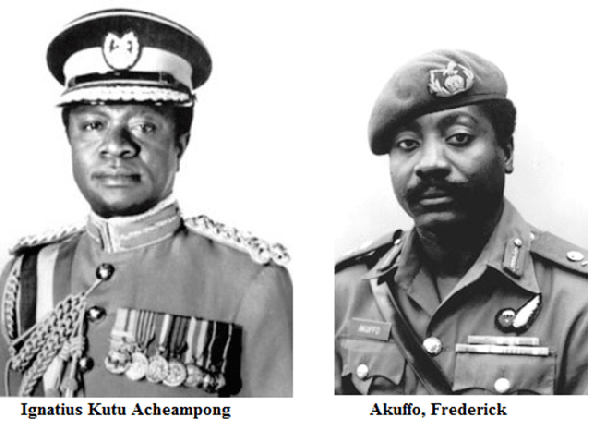
More than four decades have passed, but the echoes of the gunfire that rang out in Accra in 1979 continue to reverberate through Ghana’s political landscape. The execution of three former heads of state—Ignatius Kutu Acheampong, Frederick Akuffo, and Akwasi Afrifa—remains one of the most contentious and emotionally charged events in the nation’s history, a pivotal moment that continues to spark debate about justice, revenge, and the rule of law.
The executions were carried out during the turbulent era of the June 4th Revolution, led by then-Flight Lieutenant Jerry John Rawlings. Rising on a wave of public anger over deep-seated corruption, economic collapse, and widespread disillusionment with the political elite, the revolutionary movement promised a radical “house-cleaning” exercise to restore moral accountability and national dignity.
The three former leaders, who had all played significant roles in Ghana’s post-independence governance, were tried by military tribunals and found guilty of corruption, abuse of power, and the deliberate mismanagement of the economy. To the revolutionaries and their supporters, their deaths were a necessary, albeit drastic, act of national catharsis.
A Symbolic Break or a Violation of Rights?
For proponents of the revolution, the executions were a powerful and symbolic break from a past riddled with impunity. They argued that the swift and severe punishment sent an unequivocal message that henceforth, no leader would be above the law. For many ordinary Ghanaians suffering under severe economic hardship, it was seen as a long-overdue act of justice against those they held responsible for their plight.
However, this view has always been fiercely contested. Critics, including human rights advocates, legal scholars, and political opponents, have condemned the killings as extrajudicial and a gross violation of human rights. They argue that the tribunals lacked the due process and fair trial guarantees essential to any civilized justice system. For them, the events of 1979 represent a dark chapter where revolutionary fervor trumped the rule of law, setting a dangerous precedent.
A Complex Legacy
Over the years, the late Jerry John Rawlings consistently defended the actions of the Armed Forces Revolutionary Council (AFRC), insisting they were not driven by personal vendettas but were a direct response to the overwhelming demands of the Ghanaian people for accountability. He framed the revolution as a necessary intervention to correct systemic rot and restore faith in the nation’s leadership.
Despite these explanations, the moral and ethical questions surrounding the executions have never been fully resolved. The events continue to be a point of deep national reflection, forcing Ghanaians to grapple with a difficult question: Can justice be achieved outside the framework of established law?
A National Reflection Point
Today, the 1979 executions are studied not as an isolated event, but as a critical turning point in Ghana’s political evolution. The period underscored the fragility of democratic institutions and the devastating consequences of political instability. It served as a stark lesson that helped shape the country’s collective commitment to constitutional democracy, which has now endured for over three decades.
As Ghana continues to strengthen its democratic institutions, the memory of June 4th, 1979, serves as both a historical lesson and a somber reminder. It highlights the paramount importance of due process, the need for resilient justice systems, and the necessity of peaceful and lawful mechanisms for ensuring political accountability.
More than forty years later, the story of Acheampong, Akuffo, and Afrifa remains seared into Ghana’s collective memory—not merely as a historical footnote, but as a powerful and tragic symbol of a nation at war with itself, and the enduring struggle between the demand for justice and the preservation of human rights. The ongoing national conversation about this period reflects Ghana’s maturity in confronting its most difficult histories as part of its evolving national identity.