



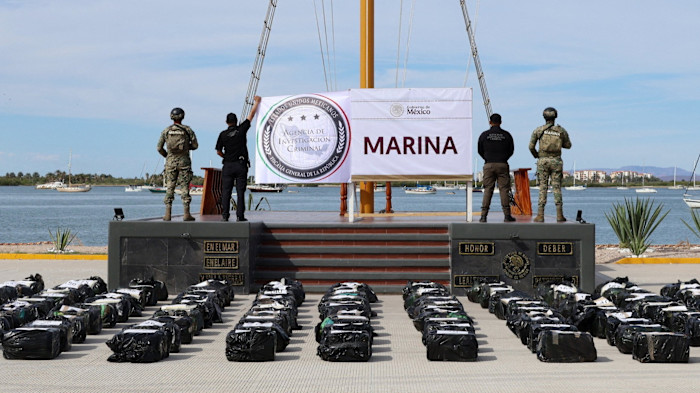
Mexico’s navy has seized several tonnes of cocaine in the Pacific Ocean during a rare joint operation with United States forces, underscoring the delicate security cooperation between the two nations as Washington increases pressure on cartel activity.
The operation, conducted on Wednesday off the coast of Clarion Island—located southwest of the Baja California peninsula—resulted in the confiscation of approximately 188 packages of cocaine, Mexican naval authorities confirmed in a statement. While no exact weight was provided, the haul is estimated to be worth millions of dollars.
The mission was carried out in coordination with the U.S. Coast Guard and American naval authorities, involving the Joint Interagency Task Force South. According to the Mexican navy, the seizure was the result of bilateral intelligence sharing aimed at combating illicit maritime activities. Several individuals were arrested, though authorities declined to provide further details regarding the number of detainees or their nationalities.
The operation came just hours after a brief, temporary closure of airspace over El Paso, Texas, which initially fueled widespread speculation of imminent U.S. military action against drug cartels operating in Mexico. The closure, first announced as a 10-day shutdown, was later clarified by U.S. authorities as a precautionary measure following the unannounced use of a military laser near the El Paso airport by Customs and Border Protection, which interfered with civil aviation operations. Initial reports from the administration had suggested the closure was a response to cartel drones crossing into American airspace.
President Claudia Sheinbaum has consistently resisted any unilateral U.S. intervention on Mexican soil, emphasizing that while Mexico is open to collaboration, sovereignty remains paramount. Wednesday’s joint naval operation aligns with Sheinbaum’s stated position of cooperation without foreign enforcement.
The operation follows recent friction regarding law enforcement transparency. Last month, FBI Director Kash Patel suggested that the agency’s Hostage Rescue Team had been involved “alongside our Mexican partners” in the arrest of Canadian former Olympic snowboarder Ryan Wedding in Mexico. Wedding, wanted by the FBI on drug trafficking charges, has since pleaded not guilty. President Sheinbaum was quick to clarify that no U.S. ground forces participated in that arrest, seeking to dispel any confusion regarding foreign involvement in domestic security matters.
In a related development, Mexico’s Senate approved the entry of 19 U.S. Navy Seals—members of America’s elite special operations force—for a two-month training mission within Mexico, set to begin February 15. The approval highlights the complex and often contradictory nature of bilateral relations, where cooperation exists alongside fierce protection of national autonomy.
The seizure off Clarion Island represents one of the most significant joint anti-drug operations in recent years and signals a potential template for future collaboration as both nations grapple with the pervasive influence of transnational cartels.


