


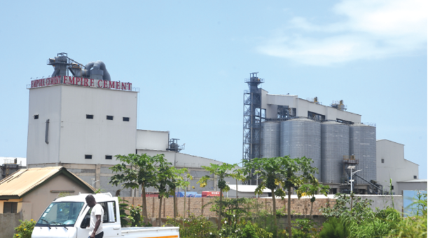
The Environmental Protection Authority (EPA) has directed Empire Cement Ghana Limited to submit a comprehensive plan within 30 days to relocate its cement grinding and bagging facility away from the environmentally sensitive Densu Delta Ramsar Site.
In a directive dated October 28, 2026, and signed by EPA Chief Executive Officer Prof. Nana Ama Browne Klutse, the Authority stated that a Closure Notice issued to the company on September 14, 2026, remains firmly in force. The company must present a detailed relocation strategy and operational transition plan, including identification of potential sites in designated industrial zones, implementation timelines, arrangements for the transition period, and measures to protect workers.
The order cites Section 35 of the Environmental Protection Act, 2025 (Act 1124), which strengthened the Authority’s enforcement powers after it replaced the former Environmental Protection Agency. Empire Cement must also obtain the necessary environmental and land-use approvals for any new site, including full environmental impact assessments, and work with the EPA and other state institutions to set an enforceable timetable for decommissioning the existing plant and rehabilitating the current site. Existing environmental safeguards and pollution-control measures under the permit and Closure Notice must continue during the transition. The EPA warned that any unauthorised resumption of operations while the Closure Notice is active could attract sanctions under the Act.
Long history of regulatory concerns
Concerns over the facility’s location date back to June 2020, when the then Environmental Protection Agency first ordered Empire Cement to halt construction and identify an alternative site due to land-use incompatibility. Subsequent environmental assessments concluded that large-scale cement manufacturing was unsuitable for the area because of potential public health risks from dust and emissions, flood risks linked to the wetland, and the movement of heavy-duty vehicles through residential communities.
Although the company secured an Environmental Permit in October 2023, the permit required it to submit a decommissioning plan and relocate before the permit expired. Conditions were varied in January 2024 following ministerial intervention, but the EPA maintains that the core problems—public health impacts, flooding, and traffic—were never resolved.
The plant sits in the Weija-Gbawe Municipal District near residential neighbourhoods including McCarthy Hill, Weija and Gbawe, and close to Panbros Salt Industries Limited, a long-established edible salt producer. Residents’ associations in the Weija-Gbawe area have repeatedly petitioned the President and the Minister for Environment, Science and Technology, citing air pollution, nuisance, and increased flooding. In September 2026, the EPA shut down operations after investigations confirmed sustained emissions of visible particulate matter and gases that breached permit conditions, including failure to submit quarterly monitoring returns and inadequate pollution-control systems.
Sensitive ecological location
The Densu Delta Ramsar Site, designated in 1992, covers nearly 5,900 hectares of estuary, lagoon, salt pans, freshwater marsh, scrubland, dunes and mangroves. It supports dozens of waterbird species, including migratory birds, and serves as an important sediment trap and shoreline stabiliser. The Densu River, which feeds the delta, supplies water to a significant portion of the Accra metropolitan area. Conservation groups, including the Centre for Biodiversity Conservation Research, have repeatedly warned about threats from industrial encroachment, pollution and habitat loss at the site, linking such activities to worsening flooding in low-lying communities and risks to water quality and local livelihoods dependent on fishing and salt production.
Empire Cement, a Chinese-backed cement grinding and bagging operation, has operated amid ongoing tension with nearby residents who argue that heavy industry is incompatible with both the residential setting and the protected wetland.
The EPA’s latest directive marks a firm escalation after years of warnings, temporary permits and community pressure. The company now has one month to present a credible relocation pathway or face continued enforcement action.