


A proposed model for redeveloping Kantamanto Market, the sprawling secondhand clothing hub in Accra’s central business district, could cost more than US$70 million if extended across the entire site, according to The Or Foundation, the non-profit that has spearheaded relief and rebuilding efforts since a devastating fire tore through the market nearly two years ago.
The estimate emerged as the foundation showcased an 80-stall demonstration facility built on land entrusted to the project by the Accra Metropolitan Assembly (AMA). The site, designed by Ghanaian architect Nana Ayensua Amonoo of Unapparant using repurposed shipping containers, represents less than one per cent of the market but is intended to illustrate how improved infrastructure could enhance safety, accessibility, and working conditions for traders.
The foundation stressed that the demonstration site is not a comprehensive solution for the entire market, which supports more than 26,700 livelihoods across roughly 8,500 stalls, approximately 66% of them women. Extending a similar model across Kantamanto would require funding from multiple sources, including producer responsibility mechanisms, government-led special levies, public fundraising, and private philanthropic support, the foundation said.
A Market Rebuilding After Disaster
The redevelopment discussion comes against the backdrop of the January 1, 2025 fire that razed more than half of Kantamanto within less than 24 hours, claiming two lives and destroying over 10,000 livelihoods. The blaze exposed severe infrastructure deficits: the lack of fire lanes prevented trucks from reaching the source of the fire, and the absence of functioning hydrants forced firefighters into near-constant tanker runs that “greatly impeded” the response. Hazardous electrical wiring and unattended open flames were deemed the most plausible causes.
The Or Foundation, which has operated around Kantamanto since 2011, launched a three-phase plan covering emergency operations, data collection, and direct financial relief. By the end of October 2025, it had spent approximately US5 million initially estimated. The market reopened for business within three months, and traders began reconstructing stalls largely on their own initiative.
The proposed 80-stall facility incorporates fire-resistant materials, wider aisles to accommodate carts carrying large bales of clothing, a solar-powered upcycling centre, and waste-management infrastructure. Its modular structure is intended to allow faster construction and reduce trader displacement during any future redevelopment.
Consultations and Concerns
Over the past 12 months, The Or Foundation said it has engaged representatives of the Kantamanto Women’s Association, the Kantamanto Upcyclers’ Association, and other market leaders to gather feedback on the proposed model. The consultations are meant to ensure that any improvements respond to the needs of the thousands of traders, tailors, porters, and recyclers whose livelihoods depend on the market.
The scale of the challenge is immense. Kantamanto receives roughly 15 million garments weekly, and The Or Foundation estimates that about 40% eventually leave the market as waste. The market is widely recognised as the world’s largest reuse hub, with workers adding value to garments through sorting, repairing, remanufacturing, and upcycling. Any redevelopment must therefore balance physical infrastructure improvements with the informal economic ecosystem that sustains the trade.
The funding conversation also intersects with broader debates about who bears responsibility for the global secondhand clothing trade. The Or Foundation has been a leading advocate for “globally accountable extended producer responsibility” (EPR) mechanisms, arguing that brands and producers in the Global North should contribute to the costs of managing the waste their products generate. The foundation recently helped launch the Apparel Recovery Coalition, through which four brands are testing voluntary funding models at Kantamanto.
What Comes Next
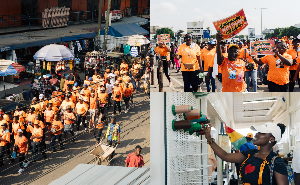
The demonstration site was highlighted during the fifth anniversary of the Obroni Wawu October (OWO) Festival, which celebrates secondhand fashion, textile recycling, and the contributions of market workers to Ghana’s circular fashion economy. A four-kilometre health walk led by Hiplife musician Reggie Rockstone, the festival’s 2026 ambassador, ended at the facility.
Rockstone said the walk was intended to promote physical fitness and unity among traders while drawing attention to the economic contribution of the secondhand clothing industry. He also highlighted the potential of textile recycling and upcycling to turn discarded clothing into commercially valuable products, but stressed that the sector needs investment, technical expertise, and stronger support from government and other stakeholders.
For now, the US$70 million figure remains an estimate attached to a model, not a committed government project. But with Kantamanto’s traders having rebuilt much of the market themselves and the memory of the 2025 fire still fresh, the pressure for a more permanent, safer, and better-funded solution is unlikely to fade.