

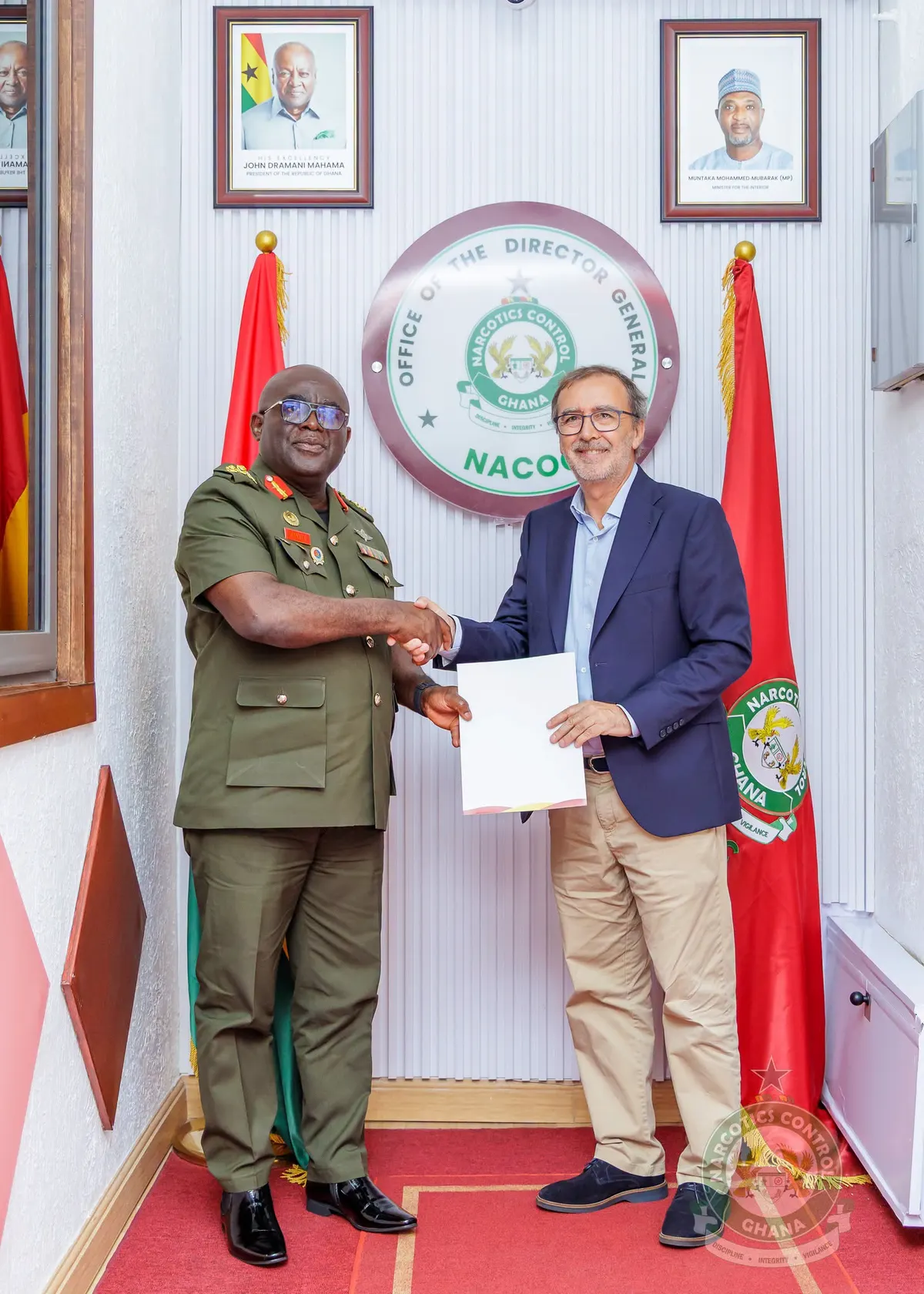
The Government of Spain has provided €300,000 to the Narcotics Control Commission (NACOC) to support the completion of its first dedicated forensic laboratory, a move aimed at addressing a longstanding operational bottleneck that has hindered drug investigations and prosecutions in Ghana.
The funding, announced during a brief handover ceremony in Accra on Tuesday, forms part of broader efforts to deepen bilateral cooperation between Ghana and Spain in combating illicit drug trafficking and transnational organized crime.
Spain’s Ambassador to Ghana, Ángel Lossada, presented the package to NACOC management, reaffirming Madrid’s commitment to supporting the Commission through capacity building, specialized training, and technical assistance. Lossada indicated that Spanish cooperation with Ghana on security matters is being stepped up through the European Union Security and Defence Partnership framework or via bilateral agreements being negotiated with Ghana’s Ministry of the Interior.
Beyond the financial contribution, the Ambassador pledged support for training forensic officers to ensure the laboratory operates effectively once completed.
A Critical Gap in Drug Enforcement
Receiving the support, NACOC Director-General Major General Maxwell Obuba Mantey described the funding as timely, noting that establishing a modern forensic laboratory has been one of his key priorities since assuming office.
According to Mantey, the absence of a dedicated forensic facility has posed a major operational challenge, forcing NACOC to rely on other state institutions for forensic examinations. This arrangement, he explained, often delays the receipt of laboratory results, directly affecting the pace of investigations and prosecutions.
“The completion of the laboratory would significantly enhance the Commission’s capacity to conduct timely forensic examinations, strengthen investigations, and facilitate the effective prosecution of drug-related offences,” Mantey said.
Background: Rising Drug Pressures and Institutional Gaps
The Spanish contribution comes at a critical juncture for Ghana’s anti-narcotics efforts. The country has faced increasing pressure from transnational drug trafficking networks, with authorities intercepting significant quantities of illicit substances in recent years.
In September 2026, Ghana reported at the 33rd Meeting of Heads of National Drug Law Enforcement Agencies in Vienna that intelligence-led operations had resulted in 217 arrests and 165 prosecutions, with more than 8.5 tonnes of assorted narcotic drugs and 45.4 million tramadol tablets intercepted during the review period. Construction on the dedicated forensic laboratory had already commenced at that time, with Ghana highlighting its efforts to strengthen digital intelligence, forensic investigations, and financial investigations targeting the proceeds of drug trafficking.
The lack of in-house forensic capacity has been a recognized weakness. During a December 2025 courtesy call, Ambassador Lossada noted that Ghana’s strategic position in Africa, with two major harbors, makes it easier for drug cartels to use the country as a transit point for illicit drug trafficking. The Ambassador had previously emphasized that drug abuse and trafficking are not merely national problems for Ghana but international challenges requiring structured cooperation at all levels—including police, law enforcement agencies, the judiciary, and civil society.
Broader Cooperation
The Spanish funding is part of a wider security partnership. Spain has been increasing its engagement with Ghana on multiple fronts, including maritime security in the Gulf of Guinea, where Spanish Navy vessels patrol for nearly eight months a year alongside European Union maritime operations. Spain and Ghana are also set to mark 60 years of diplomatic relations next year, with both countries signaling ambitions to deepen cooperation on security, trade, and development.
For NACOC, the immediate priority remains completing the facility and preparing officers to operate it. Once equipped with trained personnel, the laboratory is expected to reduce dependence on external forensic services, speed up evidence processing, and support more effective prosecution of drug-related offences—a critical need as Ghana seeks to dismantle the criminal networks behind the narcotics trade rather than merely intercepting shipments.