


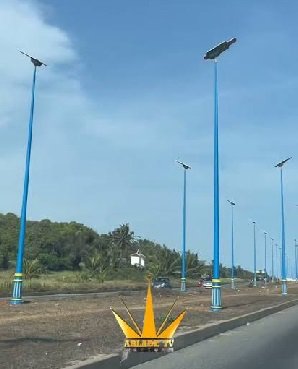
The Ministry of Energy and Green Transition has commenced the installation of solar-powered streetlights along the La and Teshie Road corridor in Accra, launching a key phase of a nationwide initiative aimed at improving road safety, enhancing nighttime visibility, and reducing the country’s dependence on grid electricity for public lighting.
The project, which began this week, forms part of a broader government programme to deploy 23,500 all-in-one solar streetlights across 700 kilometres of roads nationwide. The La-Teshie stretch, a busy urban corridor connecting the capital to surrounding coastal communities, has long been plagued by inadequate lighting, with motorists and pedestrians repeatedly raising concerns about safety risks after dark.
Addressing a Longstanding Safety Deficit
The Teshie Road corridor, commonly referred to by commuters as the “Teshie stretch,” serves as a vital artery linking Accra to Teshie and neighbouring coastal settlements. Poor nighttime visibility has been a persistent challenge for residents and commuters alike, with reports of criminal activity and road accidents linked to unlit stretches. The new solar units are expected to improve visibility for motorists and pedestrians, help deter criminal activities, and support commercial activities that continue into the evening hours.
The initiative aligns with the government’s broader “24-hour economy” vision, which seeks to extend productivity beyond daylight hours by ensuring safe nighttime movement and enabling businesses to operate longer.
Easing Pressure on the National Grid
Beyond safety improvements, the shift to solar-powered streetlights is a strategic move to reduce the burden on Ghana’s national electricity grid. Conventional, grid-connected streetlights have historically consumed an estimated 200 to 300 megawatts during peak evening periods. By transitioning to independent solar units, the government aims to shave off that load and improve overall energy efficiency.
Unlike conventional streetlights, which depend on the national grid and may go dark during power outages or local faults, solar-powered units operate autonomously, providing a more reliable source of illumination. The Ministry of Energy and Green Transition has previously emphasised that this transition will contribute significantly to energy sector stability.
Greater Accra’s Broader Solar Push
The La-Teshie installation is part of a wider regional effort. The Greater Accra Regional Coordinating Council, in collaboration with the Ministry of Energy, has announced plans to deploy an additional 25,000 solar streetlights across districts in the region to address poor visibility and support nighttime economic activities. Greater Accra has already received approximately 3,000 streetlights under the national programme, with distribution to metropolitan, municipal, and district assemblies ongoing.
Regional Minister Linda Ocloo has underscored the importance of protecting the infrastructure, urging communities to guard against theft and vandalism. “These streetlights belong to all of us; therefore, protecting them is a shared responsibility,” she stated during a previous launch event.
What’s Next
The Ministry has indicated that installation along the Teshie Road will continue in phases, with the solar units expected to provide immediate relief to commuters who have long called for adequate lighting on the stretch. The project forms part of the government’s wider drive toward sustainable, energy-efficient public infrastructure and a gradual transition away from fossil fuel-dependent systems.