

President John Dramani Mahama has set a hard deadline of 2030 for Ghana to stop exporting unprocessed minerals, announcing a phased prohibition that would fundamentally reshape the country’s relationship with its vast natural resources and force investors to build processing capacity onshore.
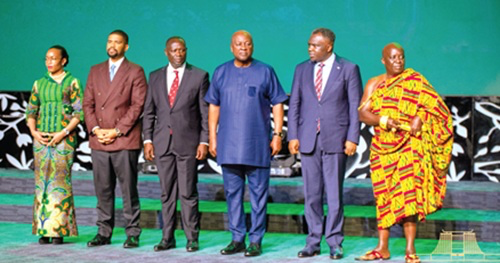
Addressing the 2026 Mining in Motion Summit in Accra on Monday, Mahama declared that raw bauxite, manganese, iron ore, lithium and other minerals “should no longer leave our shores” within four years, framing the policy as a cornerstone of his broader “Accra Reset” agenda aimed at securing greater economic sovereignty for Ghana and the wider continent .
“For generations, ships have departed from Ghana’s ports, carrying Ghanaian manganese and bauxite,” Mahama told delegates. “Much of these materials has supplied industries in other parts of the world, while we have imported the finished products made from these mineral ores” . That arrangement, he argued, had systematically deprived the country of skilled employment, technological learning and the industrial capacity that resource-rich nations must build to prosper.
A Phased and Legally Backed Prohibition
The ban will not take effect overnight. Mahama said his administration would pursue a “phased prohibition on exports of unprocessed ores, supported by the necessary legal measures, mineral-specific requirements and transparent implementation timetables” . Different minerals would face different deadlines and conditions, though the government has not yet published the specific legislation or the timetable for each commodity .
Ghana has already taken preliminary steps in this direction. The country banned the export of scrap iron and non-ferrous metals, and in 2023 prohibited lithium ore exports as it prepared to open its first lithium mine . Since September 2026, certain categories of artisanal gold intended for export have been required to undergo local refining .
The policy carries significant implications for global mineral supply chains, particularly for manganese. Ghana was the world’s fourth-largest manganese producer in 2024, accounting for roughly 7% of global output, and it is the only country that has achieved large-scale export of high-grade carbonate manganese ore. Chinese customs data show China imported 5.32 million tonnes of Ghanaian manganese in 2025—about 16% of its total imports, making Ghana its third-largest supplier . Chinese imports of Ghanaian manganese have already been declining since October 2025, partly because the prospect of a ban has pushed up export costs .
Building the Industrial Base
The harder question is whether Ghana can build competitive processing facilities within four years. Alumina refineries, smelters and manganese plants require reliable and affordable electricity, adequate water, rail and port links, and steady ore supply—infrastructure that Ghana is still developing.
Mahama acknowledged that legislation alone would not deliver industrial transformation. “Investors must understand the processing obligations associated with access to our resources,” he said. “Government must help secure the infrastructure, skills and financing required for competitive local production” .
He pointed to two state-backed vehicles as the institutional anchors of the strategy. The Ghana Integrated Aluminium Development Corporation (GIADEC) is tasked with linking bauxite mining to alumina refining, aluminium smelting and finished product manufacturing, including the modernisation of the Volta Aluminium Company (VALCO) . GIADEC has already secured strategic investors for the VALCO retrofit and alumina refinery projects, with the government targeting a ramp-up of VALCO production from 40,000 to at least 200,000 tonnes per year by 2028 . The Ghana Integrated Iron and Steel Development Corporation (GIISDEC) is pursuing a parallel path for iron ore, with plans for a mine and processing plant potentially commencing by 2027 .
“Processing opens the door to wider industrial development,” Mahama said. “African copper can supply cable manufacturers. Aluminium can support power systems. Steel can serve our railways, construction and mining industries” .
A Continental Call
The summit, organised by the Ashanti Green Initiative and supported by the World Bank, World Gold Council and African Union, drew high-level delegates including Liberia’s Vice-President Jeremiah Kpan Koung, former UK Deputy Prime Minister Dominic Raab, OECD Secretary-General Mathias Cormann, and ministers from Guinea, Tanzania, Nigeria, Sierra Leone, Malawi and Liberia .
Mahama used the platform to call for a unified African voice on mineral negotiations, warning that fragmented deals and generous concessions to foreign interests had left African nations with only a fraction of the wealth extracted from their soil. “Will our copper bring electricity to African homes? Will our bauxite power African factories?” he asked, challenging delegates to rethink how mineral agreements are structured . He called for regional value chains that would allow minerals mined in one country to be processed in another and supplied to manufacturers across the continent.
Lands and Natural Resources Minister Emmanuel Armah-Kofi Buah echoed the sentiment, saying the world needs Africa’s resources but that Africa would welcome partnerships only on terms of mutual benefit .
Gold Success Offers a Template
The government is pointing to recent success in the gold sector as evidence that formalisation and local value retention can deliver results. The Ghana Gold Board, established in April 2025, reported that artisanal and small-scale gold exports reached 103 tonnes in 2025, generating approximately $10.8 billion—outperforming the large-scale mining sector’s 96.6 tonnes valued at $9.2 billion for the first time in the country’s history . Total gold exports reached roughly $20 billion in 2025, up sharply from $10.3 billion in 2024 .
GoldBod CEO Sammy Gyamfi attributed the surge not solely to high global prices but to deliberate policy reforms, including the removal of a withholding tax on artisanal gold that had previously driven trade into informal channels . The board’s anti-smuggling taskforce has also helped route nearly all small-scale gold exports through formal channels .
What Comes Next
The government has not yet released the draft legislation or mineral-by-mineral implementation schedules. Success will depend on mobilising investment, securing reliable energy supplies and developing infrastructure—and on offering sufficiently attractive terms to persuade companies to build processing facilities in Ghana rather than simply buying refined products elsewhere .
Mahama said progress toward the 2030 target would be measured not by speeches but by “the establishment of operating facilities and the creation of sustainable jobs” . For a country that has exported its mineral wealth in raw form for over a century, the deadline represents both an ambition and a gamble—one that will test whether Ghana can convert its geological endowment into industrial capability before the window closes.
Editor’s note: This article was compiled from official government statements, agency reports and commodity market data. The government has not yet published the specific legislative instrument or timetable for each mineral covered by the proposed ban.