



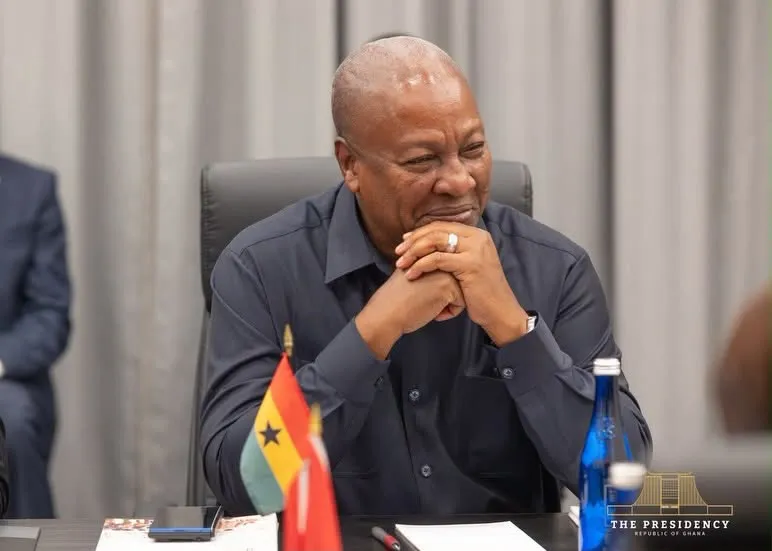
Ghana will deploy $10 billion over five years across nine productive sectors under a new economic policy aimed at creating jobs and reducing dependency on imports, President John Dramani Mahama announced, stressing that the programme will be funded entirely from domestic resources rather than debt.
The “New Economy Policy,” which will be formally unveiled in the 2027 budget, will allocate approximately $2 billion annually to sectors including textiles and garments, agriculture and agribusiness, pharmaceuticals, and tourism, Mahama told a delegation of chiefs from the Western North Region at the presidency this week.
“When the Minister presents the 2027 Budget, he is going to announce what we call the New Economy Policy,” Mahama said. “The policy has selected nine areas, or nine pillars, in which the government is going to invest about $2 billion every year for five years. That is a total of $10 billion.”
“As I have said, this is our own money. We are not going to borrow money for the New Economy Policy.”
The announcement comes as Ghana’s economic outlook has improved markedly following the debt crisis that confronted the administration when it took office in January 2025. The International Monetary Fund this month raised its 2026 growth forecast for Ghana to 5.7 percent, up from 4.6 percent in April, citing fiscal consolidation and strong gold export earnings . The projection exceeds the government’s own budget target of 4.8 percent.
Mahama said reduced reliance on domestic borrowing has already begun to ease pressure on the banking sector, with Treasury bill rates falling sharply. The yield on the 91-day bill, a key benchmark, has dropped below 5 percent in recent auctions, down from levels above 29 percent during the crisis period . The president argued that lower government borrowing costs would free banks to lend to private enterprises at more affordable rates.
“It is better for them to lend at about 13 percent to a private company,” he said. “That is going to enable private companies to invest, expand their businesses and employ more people.”
Infrastructure and Manufacturing Drive
The president pointed to the government’s $10 billion “Big Push” infrastructure programme, launched in September 2025, as an early engine of job creation. The initiative, which spans five years and covers road, interchange, and expressway projects nationwide, has already generated hundreds of thousands of construction jobs, according to the government .
Mahama specifically cited Northshore Apparel Ghana Limited, a garment factory in Savelugu in the Northern Region that he inaugurated in August. The facility, described as Ghana’s first regenerative, zero-waste apparel manufacturing hub, employs 2,300 people—approximately 80 percent of them women—and operates on a shift basis under the government’s 24-hour economy model . The factory, funded by the Ghana Export-Import Bank, German development bank KfW, and the Agricultural Development Bank, produces garments for export to the United States and European markets.
“The facility was creating opportunities for young women who might otherwise migrate to major cities to engage in head porterage,” Mahama said, referring to the informal labor practice known locally as kayayei.
He also noted production-line expansions by established manufacturers including Nestlé and Kasapreko as evidence of growing private-sector confidence.
Vaccine Hub and Health Sovereignty
A central pillar of the pharmaceutical investment is the establishment of a vaccine production hub intended to reduce Africa’s dependence on imported medicines—a vulnerability Mahama said was exposed starkly during the COVID-19 pandemic.
“We learnt a lesson from COVID-19. When vaccines became available, Africa was placed at the end of the queue,” he said. “If God had not given us immunity that prevented COVID-19 from affecting us severely, the whole of Africa could have been wiped out before even one vaccine arrived here.”
The president disclosed that foreign pharmaceutical companies have expressed interest in a pharmaceutical hub for which the government has acquired land and provided roads, electricity, and water. The initiative aligns with the “Accra Reset” agenda, a broader policy framework Mahama launched at the United Nations last month aimed at achieving health sovereignty for the Global South .
Ghana has already taken preparatory steps. In August, the country signed a memorandum with the Africa CDC to join the African Pooled Procurement Mechanism, which would give Ghanaian manufacturers access to a continental market of more than 1.4 billion people . The government has also engaged Indian pharmaceutical firms, including Atlantic Life Sciences, which is working with local partner KinaPharma on vaccine development .
The World Health Organization and European Union have separately launched a €1.1 million project to strengthen Ghana’s regulatory capacity and research infrastructure for local pharmaceutical production .
Fiscal Discipline as Foundation
The no-borrowing pledge represents a significant political commitment for a government that inherited a debt default and has since pursued fiscal consolidation under an IMF-supported programme. Finance Minister Cassiel Ato Forson said at the IMF-World Bank Annual Meetings in Bangkok this month that Ghana has “turned the tide” and remains committed to fiscal credibility .
The strategy carries risks. The IMF has cautioned that Ghana’s dependence on commodity exports, particularly gold, leaves the economy vulnerable to price fluctuations . The Fund projects growth to moderate to 5.2 percent in 2027, and inflation—while expected to fall to 4.8 percent by year-end—remains sensitive to global energy prices and exchange-rate movements .
Mahama’s announcement also leaves key questions unanswered: the specific allocation of the $10 billion across the nine pillars, the precise revenue sources within the domestic budget, and the implementation timeline beyond the 2027 budget presentation. The government has not yet published a detailed policy document.
For now, the president is framing the initiative as a philosophical break from dependency—both fiscal and industrial.
“Today, the government is living within its means, and everything we are financing is being financed from our taxes and what the government brings into the Exchequer,” he said.
About the New Economy Policy
The policy is expected to be detailed in Ghana’s 2027 Budget statement, to be presented by Finance Minister Cassiel Ato Forson later this year. It will target nine “pillars” including textiles and garments, agriculture and agribusiness, pharmaceuticals, and tourism, with an average annual allocation of $2 billion drawn from domestic revenue.


