



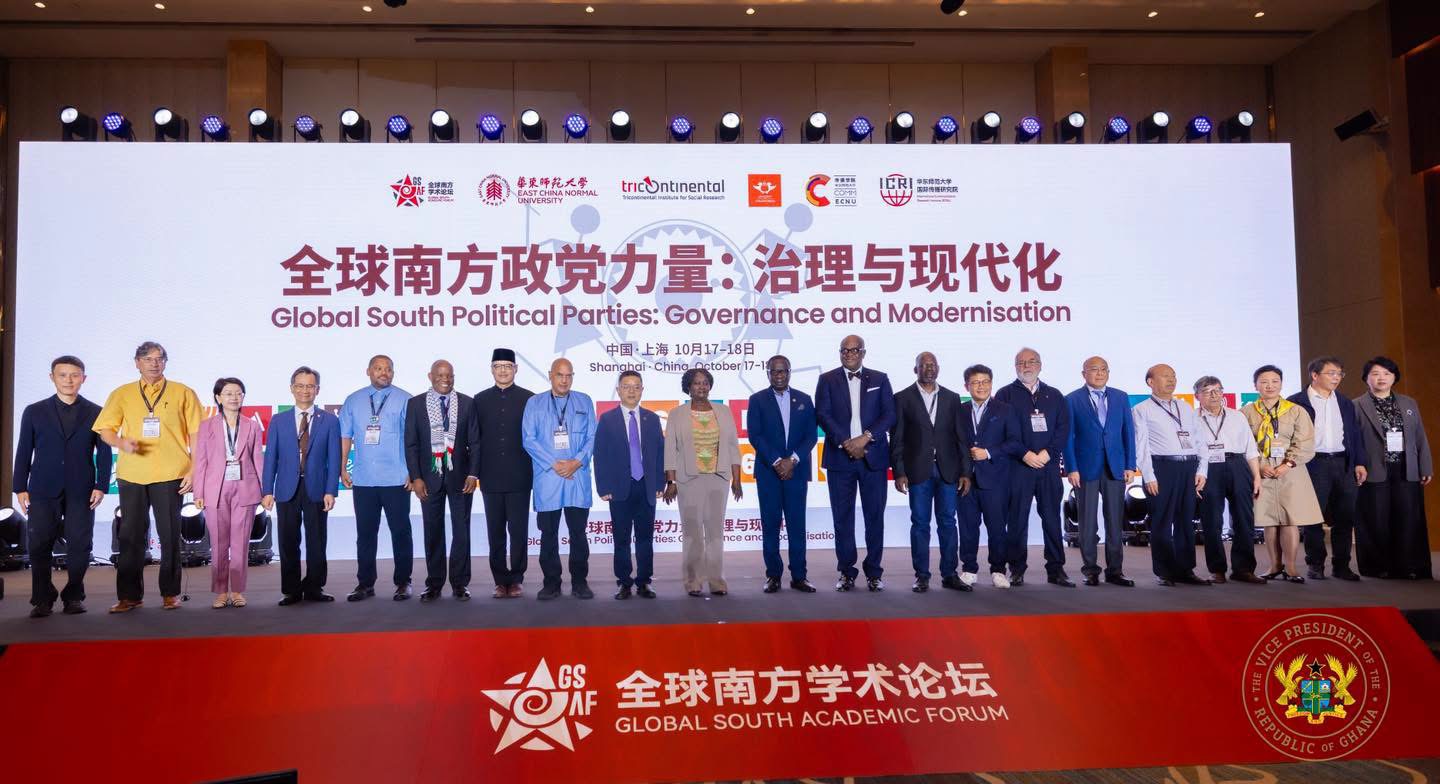
Ghana’s Vice President, Professor Jane Naana Opoku-Agyemang, has urged countries of the Global South to move beyond the achievement of political independence and focus on the harder task of building strong institutions, productive economies and governance systems that respond to the aspirations of their people.
Addressing the opening of the 2026 Global South Academic Forum in Shanghai on Saturday, October 17, under the theme “Global South Political Parties: Governance and Modernisation,” the Vice President said winning political power and governing effectively are related but distinct responsibilities.
“Political independence is only the beginning,” she told the gathering. “The greater task is to build strong institutions, productive economies and systems that respond to our people’s aspirations.”
Reflecting on the historical struggles that shaped the Global South, Professor Opoku-Agyemang traced the journey from the Pan-African vision of Osagyefo Dr. Kwame Nkrumah—who led Ghana to independence in 1957 and championed African liberation—to anti-colonial and liberation movements across Asia, Africa, Latin America and the Caribbean. She said that shared history remains a powerful reminder that sovereignty alone is not enough, and that political parties, governments, universities and other institutions must continually evolve, strengthen accountability and build the capacity to respond to changing realities.
Turning to China’s development experience, the Vice President said it offers valuable lessons in long-term planning, industrialisation, poverty reduction and institutional coordination. But she cautioned that meaningful South-South cooperation must be grounded in mutual learning rather than the assumption that countries must follow identical development paths.
“Our different histories and circumstances require solutions that reflect our realities,” she said, noting that China’s modernisation pathway had been shaped by its own history, institutions and national priorities.
Professor Opoku-Agyemang also called for a more representative and equitable international order. She said the Global South must work towards better multilateralism, with fairer global financial arrangements, stronger representation in international institutions and greater participation in shaping decisions that affect developing countries. She argued that although the Global South accounts for a substantial share of the world’s population, resources and economic activity, its voice in global governance remains inadequate.
On research and innovation, the Vice President highlighted the importance of strengthening cooperation across education, technology and emerging fields such as artificial intelligence. She said universities and research institutions across the Global South must collaborate more directly, share knowledge and develop solutions that meet the needs of their own societies. South-South cooperation, she added, must extend beyond infrastructure to strengthen local productive capacity, support research and innovation, and create opportunities for young people.
Addressing the forum’s focus on political parties, Professor Opoku-Agyemang said parties must go beyond mobilising citizens for political power. They must also strengthen policy development, political education, democratic accountability and the participation of women and young people.
In her closing remarks, she encouraged the Forum to sustain the intellectual partnerships and honest exchanges needed to move beyond familiar debates and towards practical solutions.
“Cooperation does not require us to think alike,” she said. “We must have the confidence to disagree respectfully, learn from one another’s successes and failures, and continue working together towards shared goals.”
Her central message was clear: the next chapter of the Global South’s development must be defined not only by political sovereignty, but by the capacity to govern effectively, innovate and help shape a fairer global order.


