



The Industrial and Commercial Workers’ Union (ICU Ghana) has called on the government to revitalise struggling state-owned enterprises, including the Volta Aluminium Company (VALCO), PBC Limited and the Cocoa Processing Company (CPC), warning that their continued decline is costing the country jobs and industrial capacity.
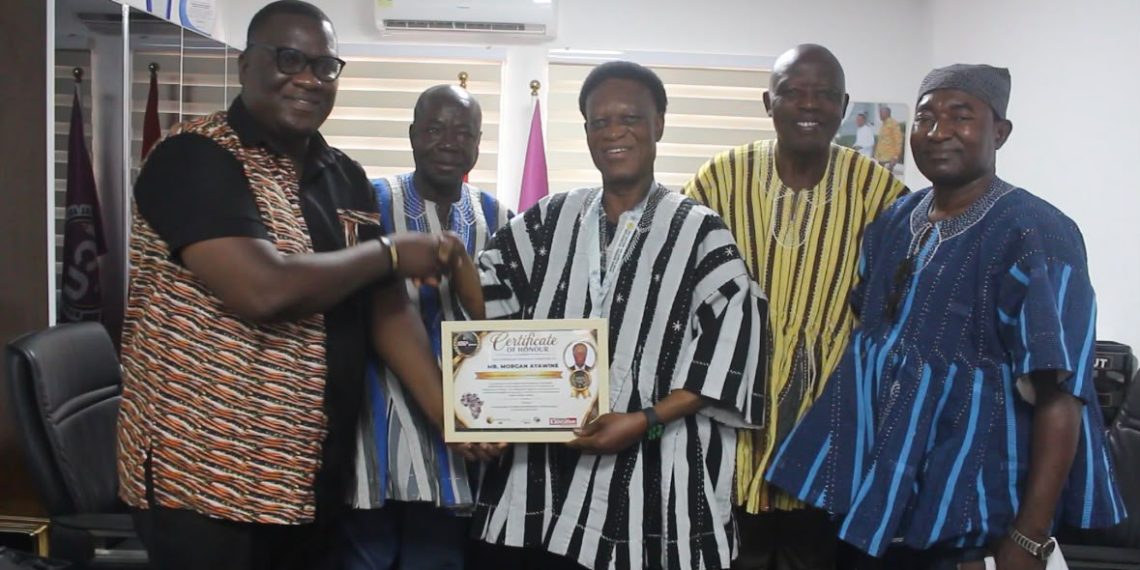
General Secretary Morgan Ayawine made the call on Wednesday, October 15, 2026, at an event organised by Business Executive, organisers of the Africa’s Most Influential Persons Awards 2026, where he was named one of the 100 most influential trade unionists in Africa. The organisers cited his leadership and advocacy in trade unionism, corporate governance and government policy direction.
“Government Should Rather Maintain and Recapitalise VALCO”
Ayawine was emphatic that VALCO must not be sold, reiterating a position the union has held throughout the year. “When government decided to sell out one of its great assets that we have in this country, precisely that is about VALCO, we said, no. Government should rather maintain VALCO and recapitalise VALCO,” he said.
The union’s opposition has been sustained and public. In July 2026, hundreds of VALCO workers backed by ICU-Ghana staged a protest in Tema against what they described as a disguised attempt to sell a key national asset. The union has argued that VALCO is a strategic national asset requiring targeted government investment rather than being handed over to private, profit-driven companies.
The government has denied any intention to sell VALCO, insisting it is seeking a strategic investor to inject capital and restore the smelter to profitability. More than US250 million in accumulated power debts, obsolete equipment and declining production. Active cells at the Tema smelter fell from 127 in 2025 to about 90 by August 2026. A negotiation team has been inaugurated to engage a strategic partner, with the government insisting the process is not outright privatisation.
VALCO was established in 1964 as part of Kwame Nkrumah’s vision of using power from the Akosombo Dam to build an integrated aluminium industry. Ghana acquired 100 per cent of its shares in 2008 after Kaiser Aluminium exited, but the smelter has since struggled with unreliable and expensive power and inadequate capital for retooling.
PBC and CPC: “Struggling to Survive”
Ayawine also flagged the precarious state of PBC Limited and the Cocoa Processing Company. “We are making interventions on behalf of PBC to bounce back to the field to purchase cocoa. We have the Cocoa Processing Company that is also struggling to survive. Government must strengthen efforts to help some of these struggling companies to survive,” he said.
PBC, formerly the Produce Buying Company, is Ghana’s largest licensed cocoa buyer with a market share of about 31 per cent, purchasing cocoa from farmers and selling it to COCOBOD. But the company has been mired in a liquidity crisis. Workers have gone without salaries for 27 months, with casual workers unpaid for over 36 months, while PBC halted cocoa purchases in May 2026 after accumulating debts of GH¢673 million that left it facing asset seizure.
CPC’s situation is equally dire. The Tema-based processor reported a 46.87 per cent plunge in operating revenue in 2025, from GH¢481.88 million to GH¢256.01 million, while net losses widened to GH¢144.06 million — meaning the company lost more than 56 pesewas for every cedi of revenue generated. Equity fell by 62.35 per cent, and the debt-to-asset ratio climbed to 94 per cent, leaving the company “highly leveraged and financially fragile,” according to the State Interests and Governance Authority.
Textile Industry and the Wider SOE Crisis
Beyond the three flagship enterprises, ICU-Ghana has pressed for the revival of the textile industry, identifying Volta Star Textiles Limited, Akosombo Industrial Company Limited, Neoplan Ghana Limited and Aluworks as strategic assets requiring urgent recapitalisation. The union has argued that reviving these companies would restore industrial production, create sustainable employment, reduce import dependence and conserve foreign exchange.
The union’s concerns have been echoed by the government’s own reform agenda. The Finance Ministry has signalled that underperforming state enterprises will be reformed, merged, privatised or shut down, while President Mahama has charged SOE boards to shift focus from mere survival to value creation. The government also intends to list 10 SOEs on the Ghana Stock Exchange to transform them into public companies.
Award and Outlook
Commenting on his recognition, Ayawine attributed the honour to the support of the union’s leadership, management, staff and rank-and-file members, as well as its social partners, and said he looked forward to continued collaboration to advance shared objectives. He has also outlined plans for a transformation agenda to reposition the union and expand its influence across Africa.
For ICU-Ghana, the message to government is that SOE recapitalisation is not a cost but an investment in jobs, industrial capacity and economic sovereignty — and that the time to act is now.


