



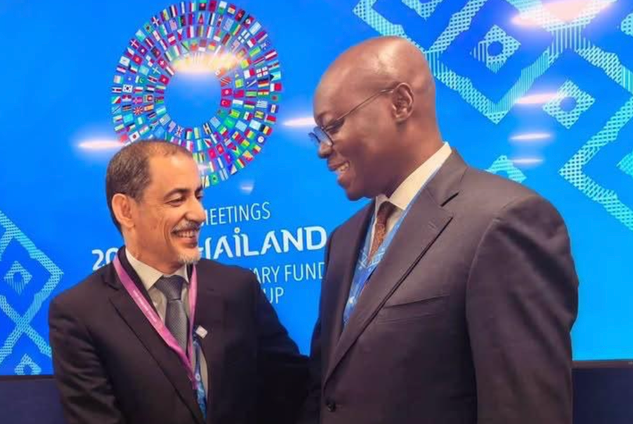
Ghana is entering the coming months from a strong position to withstand potential commodity price shocks, the Director of the International Monetary Fund’s African Department, Zeine Zeidane, has said, crediting the country’s policy reforms and the economic buffers it has built for its improved resilience.
Zeidane was responding to a question from Joy Business at the launch of the IMF’s Regional Economic Outlook report in Bangkok, Thailand, on the sidelines of the IMF/World Bank Annual Meetings. He acknowledged that a decline in commodity prices would affect exporting countries, including Ghana, but said measures implemented in recent months had strengthened the country’s ability to absorb the impact. “Of course, the risk in terms of commodity prices, every country can face them, but I think Ghana is, if that happens, we will face them from a very strong position,” he said.
The comments come amid persistent concerns that Ghana’s heavy reliance on gold for export revenue could leave the economy vulnerable to a downturn in prices. Gold was the main driver of Ghana’s record US14.86 billion, up sharply from US8.8 billion, compared with US$7.6 billion a year earlier.
A Recovery Built on Reform
Zeidane’s assessment reflects a remarkable turnaround for Ghana, which only recently completed its 17th financial bailout programme with the IMF. Ghana formally exited its US$3 billion Extended Credit Facility in May 2026, having restored macroeconomic stability and debt sustainability ahead of schedule through frontloaded fiscal consolidation, expenditure rationalisation and structural reforms. The programme delivered sharply lower inflation, rebuilt international reserves, improved confidence in the cedi and marked gains in debt sustainability.
The recovery has been underscored by a string of positive indicators. Gross international reserves reached approximately US$14.5 billion by February 2026, representing almost six months of import cover, while the cedi gained 40.7 per cent against the dollar in 2025 alone. The IMF has since reclassified Ghana’s debt distress rating from “critical” to “moderate,” ending four years in the extreme red.
Credit Ratings Upgraded
Zeidane specifically noted that Ghana’s strong economic performance had led two credit rating agencies to upgrade the country’s ratings. Fitch raised Ghana’s sovereign rating from B- to B with a positive outlook in May 2026, following the December 2022 default on external commercial debt. Overall, Ghana’s sovereign credit ratings have improved from restricted default status to “B” with a positive outlook, representing five successive rating upgrades. The improvements have lowered borrowing costs and renewed market confidence, with the government operationalising a Sinking Fund to support future debt obligations.
Growth Forecast Raised to 5.7 Per Cent
The IMF’s October 2026 World Economic Outlook raised Ghana’s growth forecast for 2026 to 5.7 per cent, up 1.1 percentage points from the 4.6 per cent projected in April, citing stronger economic activity and increased production of goods and services. The revised forecast is also above the government’s 4.8 per cent growth target outlined in the 2026 Budget. The Fund expects growth to moderate to 5.2 per cent in 2027.
The IMF also revised its forecast for Ghana’s year-end inflation to 4.8 per cent, down from its April projection of 7.9 per cent, and below the Bank of Ghana’s target of 8 per cent with a tolerance band of two percentage points. Inflation stood at 5.2 per cent in September 2026.
From Bailout to Partnership
Ghana’s engagement with the IMF has shifted from a financing arrangement to a non-financing Policy Coordination Instrument, a 36-month framework that provides technical support and policy guidance without direct financial assistance. The PCI is intended to preserve the gains made under the ECF while supporting further reforms in fiscal management, debt sustainability, governance and financial-sector stability. Zeidane said Ghana’s performance under the new instrument had been strong so far. “The performance has been strong up to now. And also, you certainly have seen that recently, there was an upgrade of Ghana. So, things are moving in Ghana in the right direction,” he said.
The government has been emphatic that the PCI is not another bailout. Finance Minister Dr Cassiel Ato Forson has stated that “no further IMF financial bailout will be required in the foreseeable future,” noting that the government recalibrated the programme to ensure more equitable burden-sharing and deeper structural reforms.
Risks Remain
Despite the improved outlook, the IMF has cautioned that sustaining the growth momentum would depend on Ghana’s fiscal discipline, export diversification and the resilience of domestic economic activity. The Fund has also flagged elevated fiscal risks from state-owned enterprises and quasi-fiscal activities, with the PCI reform agenda prioritising stronger safeguards, transparency and accountability.
On the external front, the reported pause in gold exports by the Ghana Gold Board since August 2026 and the US Federal Reserve’s decision to raise interest rates could put pressure on gold prices in the coming months, with a sustained decline potentially affecting one of the major drivers of Ghana’s export earnings.
AI and Fuel Subsidies
Responding to a separate question on artificial intelligence and its implications for productivity, Zeidane said the technology’s full impact on Ghana and other African economies remained uncertain. He suggested that its effect on jobs in Africa could be limited, while cautioning against underestimating its potential influence.
On fuel subsidies, Zeidane said the IMF was not opposed to measures aimed at reducing petroleum prices at the pump. He explained, however, that poor targeting often prevented such policies from delivering their intended benefits.
As the Bangkok meetings closed, the IMF’s assessment provided an encouraging signal for Ghana. But sustaining that confidence will depend on continued implementation of the reforms underpinning its economic recovery — and on whether the country can translate its improving macroeconomic outlook into lasting gains for households still grappling with the cost of living.


