



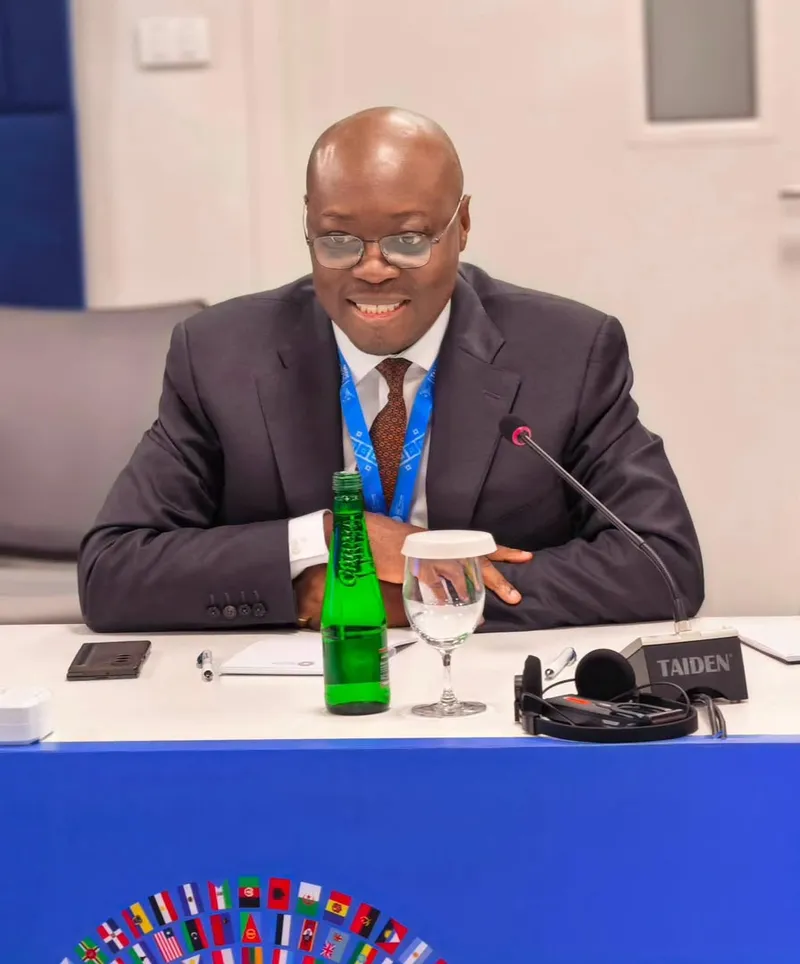
Finance Minister Dr. Cassiel Ato Forson has expressed confidence that Ghana’s economy will outperform the International Monetary Fund’s revised growth forecast of 5.7% for 2026, following high-level engagements at the IMF–World Bank Annual Meetings in Bangkok.
Reacting to the Fund’s upward revision from its April projection of 4.6%, Dr. Forson said the government remained committed to the fiscal discipline and reforms supporting the country’s economic turnaround.
“The IMF has upgraded Ghana’s 2026 growth forecast from 4.6% to 5.7%. We are confident we will exceed that projection,” he stated.
The revision represents an increase of 1.1 percentage points in the Fund’s growth forecast and exceeds the government’s own growth target of 4.8% outlined in the 2026 Budget.
Dr. Forson’s remarks followed a meeting with the Director of the IMF’s African Department, Zeine Zeidane, on the sidelines of the ongoing IMF–World Bank Annual Meetings in Bangkok, Thailand. “In Bangkok, I met with the IMF’s African Department Director, Zeine Zeidane, and reaffirmed our commitment to the fiscal credibility, discipline, and bold reforms powering Ghana’s economic turnaround,” he said.
IMF Raises Growth Forecast Amid Strong Economic Data
The IMF’s upgraded forecast, contained in its October 2026 World Economic Outlook, was released on October 13 during the Annual Meetings. The upward revision reflects Ghana’s commitment to fiscal discipline, spending targeted at stimulating growth, and strong commodity export earnings, particularly from gold. Higher gold export earnings have supported the country’s trade balance and helped build economic buffers.
The Fund also lowered its forecast for Ghana’s year-end inflation to 4.8%, down from its earlier estimate of 7.9%. The new projection is below the Bank of Ghana’s medium-term inflation target of 8%, although the central bank allows for a two-percentage-point margin on either side of the target. With inflation falling to 5.2% in September 2026, the IMF’s forecast suggests that price pressures could ease further before the end of the year, marking Ghana’s second consecutive year of single-digit year-end inflation.
Data from the Ghana Statistical Service show that the economy grew by 6.0% year-on-year in the second quarter of 2026, bringing growth for the first half of the year to 6.2%. On the expenditure side, investment increased by 53.0%, while domestic demand rose by 11.2%, reflecting continued strength in private and public spending.
However, the IMF expects Ghana’s growth to moderate to 5.2% in 2027, indicating that the current pace of economic expansion may not be sustained.
IMF Africa Director Praises Ghana’s Performance
Zeine Zeidane, the Director of the IMF’s African Department, commended Ghana’s economic performance during the meeting, declaring that “Ghana is in a very good place.”
Mr. Zeidane praised Ghana’s progress under the Extended Credit Facility (ECF) programme and reforms to strengthen economic management. “I want to first commend you on how you are performing. The ECF was a great success,” he said.
He indicated that Ghana’s performance had become an example for other countries. “We tell others to follow your steps,” he stated.
Mr. Zeidane also praised the use of artificial intelligence in customs administration and welcomed the work undertaken on state-owned enterprises and stock-flow adjustments.
Background: Ghana’s ECF Programme and Economic Turnaround
Ghana’s economic recovery follows a successful three-year Extended Credit Facility (ECF) programme with the IMF, which concluded in May 2026. The ECF-supported programme delivered substantial stabilisation gains driven by strong reform efforts and significant progress in public debt restructuring, leading to sharply lower inflation, higher external buffers, improved confidence in the cedi, and marked debt sustainability gains.
Ghana received a final disbursement of approximately US3 billion. The programme marked Ghana’s successful exit from its financial bailout, transitioning to a non-financing Policy Coordination Instrument (PCI) focused on reform and resilience building.
Under the ECF programme, inflation declined rapidly, international reserves were rebuilt, and confidence in the cedi improved. Fiscal performance strengthened markedly, with the primary surplus overperforming the programme target in 2025, while the public debt ratio declined sharply. Growth exceeded expectations in 2025, supported by broad-based activity, and the external position strengthened on the back of historically high gold export receipts.
Ghana’s economic recovery follows the 2022 debt crisis, during which the country faced acute financing pressures. The ECF programme helped restore macroeconomic stability and ease those pressures.
Looking Ahead: The New Economy Blueprint
Dr. Forson is leading Ghana’s delegation to the 2026 Annual Meetings, which are being held in Bangkok from October 12 to 18. The meetings come ahead of the 2027 Budget, in which Dr. Forson is expected to unveil the New Economy, the government’s blueprint for Ghana’s next phase of economic development.
“Stabilisation was never the destination. It was the price of entry,” Dr. Forson stated during his presentation of the 2026 Mid-Year Fiscal Policy Review, signalling the government’s shift from stabilisation to sustained transformation.
In Bangkok, the Finance Minister is engaging world leaders, senior representatives of international financial institutions, and fellow finance ministers in a series of bilateral meetings and multilateral discussions. His programme includes talks with the IMF’s leadership, senior World Bank officials, and other multilateral institutions, alongside engagements with development and financial partners.
Global Context and Risks
Despite Ghana’s improved domestic outlook, the IMF says global economic conditions remain uncertain. The Fund projects global economic growth of 3.1% in 2026, rising to 3.4% in 2027. Global headline inflation is expected to reach 4.7% this year before declining to 4.1% in 2027.
The IMF has cautioned that geopolitical conflicts, renewed trade tensions, high public debt, and uncertainty over investment in artificial intelligence could weigh on global economic activity. For Ghana, sustained increases in international oil prices could raise the cost of fuel imports and increase transport, electricity generation, and production costs. Higher food and energy prices could also complicate efforts to maintain price stability.
The Fund has also warned that Ghana’s dependence on commodity exports leaves the economy vulnerable to fluctuations in international prices, stressing the need for the country to diversify its exports to reduce exposure to external shocks and build a stronger foundation for long-term growth.
For emerging economies such as Ghana, the IMF’s broader outlook reinforces the importance of sound fiscal management and stronger revenue collection to sustain development spending amid global uncertainty.
Investor Confidence and Credit Ratings
The IMF’s improved outlook could strengthen investor confidence in Ghana’s economy and support efforts to attract foreign direct investment and additional assistance from development partners. For investors, stronger growth and lower inflation could improve perceptions of economic stability and the prospects for returns. Ghana’s participation in the PCI programme could also provide further reassurance to development partners about the government’s commitment to fiscal discipline.
The outlook comes alongside recent upgrades to Ghana’s credit ratings by Moody’s and Standard & Poor’s. Together, these developments could improve Ghana’s borrowing conditions and potentially lower the cost of future financing.


