



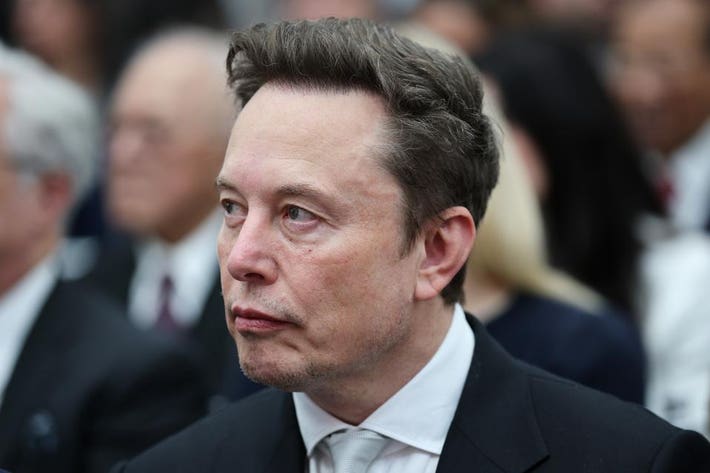
Elon Musk’s net worth climbed back above $1 trillion on Friday morning, just a day after he fell below the mark, as a rally in SpaceX and Tesla shares boosted his fortune by $22 billion in a matter of hours.
According to Forbes’ Real-Time Billionaires list, Musk’s net worth rose to $1.012 trillion at around 10 a.m. on Friday, up 2.15% from the previous day, when he lost $36 billion and briefly surrendered his trillionaire status.
The swift recovery underscores the volatile nature of Musk’s wealth, which is tied almost entirely to the stock prices of the two companies he leads. He owns approximately 11% of Tesla and 38% of SpaceX, meaning daily market movements can swing his net worth by billions of dollars.
Tesla’s China Sales Boost Sentiment
Tesla stock was up over 2.5% at around 10:15 a.m. on Friday after China’s Passenger Car Association released data showing that sales of Shanghai-built electric vehicles, including Model 3 and Model Y units, rose 5% year-over-year. Tesla sold 95,366 China-made vehicles in September, up from 90,812 a year earlier, marking its 11th consecutive month of annual growth. The figures include vehicles sold in China and exported to other markets.
While domestic sales in China fell 9% to 64,837 vehicles amid intensifying competition, a 58% surge in exports to 30,529 vehicles helped the Shanghai factory record its strongest sales month of 2026. European registrations also provided a lift, with France up 61.9%, Portugal up 128.3%, and Sweden up 38.4% year-over-year.
The strong September performance followed Tesla’s third-quarter delivery report, which showed 486,532 total vehicles delivered, beating Wall Street estimates of approximately 461,000 and keeping the company on track to return to annual delivery growth after two consecutive years of declines. Tesla delivered 1.32 million vehicles in the first nine months of 2026, an 8.8% increase from the same period last year.
SpaceX’s Spectrum Deal
SpaceX shares were up around 1.5% at 10:15 a.m. after the company announced it had agreed to acquire a nationwide portfolio of low-band spectrum licenses, a move the company said would “pave the way” for its cellular service, Starlink Mobile.
The agreement covers up to 14 megahertz of paired spectrum in the 800 MHz band, reportedly valued at $8 billion. The low-band frequencies will allow Starlink Mobile’s signal to penetrate obstacles such as walls and buildings, addressing a key technical gap in providing indoor coverage. Most existing mobile devices already support the band.
The acquisition complements Starlink Mobile’s global 2 GHz mid-band spectrum, which SpaceX plans to use for high-bandwidth capacity in the U.S. The deal remains subject to final approval from the Federal Communications Commission. Separately, the FCC this week approved SpaceX’s next-generation Starlink Mobile constellation application, authorizing the launch of 15,000 satellites optimized for global operations using 2 GHz spectrum. The company said its V2 Starlink Mobile satellites would deliver more than 100 times the bandwidth of the current generation.
A Whirlwind of Trillionaire Status Changes
Musk’s return to trillionaire status on Friday is the latest chapter in a remarkable series of fluctuations over the past several months.
He first became a trillionaire on June 12, when SpaceX went public in a record-breaking initial public offering. The IPO, which raised $75 billion, valued the company at $2.2 trillion at open and made Musk the world’s first trillionaire, with an estimated net worth of $1.1 trillion. His peak net worth reached $1.45 trillion on June 16, when SpaceX shares hit their all-time high.
Since then, Musk has lost and regained trillionaire status multiple times. In late June, he fell below the mark after SpaceX shares fell 31% in a multi-day selloff and new restrictions were placed on $116 billion of his Tesla stock. Under a new agreement signed in April, Musk’s Tesla options were converted into restricted stock that he will forfeit unless he remains at Tesla through January 2028 as CEO or as an executive officer responsible for product development or operations.
He regained trillionaire status on Monday, lost it on Thursday, and then regained it again on Friday morning. Despite the wild swings—which have seen his fortune drop by as much as $600 billion from its peak—Musk remains firmly in the No. 1 spot on Forbes’ Real-Time Billionaires list. Amazon founder Jeff Bezos holds the No. 2 spot with an estimated net worth of $378.2 billion, a gap of more than $600 billion.
What’s Next
Musk’s fluctuating trillionaire status reflects the fact that his wealth is directly tied to volatile stock prices, and his public comments have acknowledged the unusual nature of his fortune. “It’s not like it’s sitting in a bank account,” he said recently, referring to his holdings.
For Tesla, investors will get another look at the company’s automotive profitability when it reports third-quarter financial results on October 21. For SpaceX, the closing of the spectrum deal and the launch of the next-generation Starlink Mobile constellation will be key milestones in its bid to become a major U.S. mobile carrier.


