


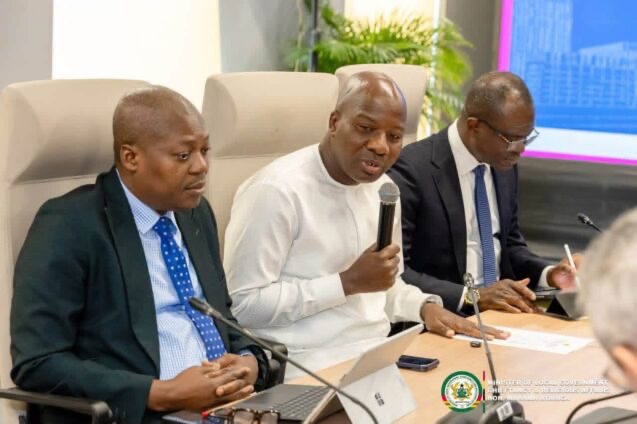
The Minister for Local Government, Chieftaincy and Religious Affairs, Mahama Ayariga, has called on banks to play a greater role in maintaining and beautifying public spaces across the country, proposing a partnership under which selected streets could be renamed to reflect collaboration between financial institutions and society.
Speaking at a meeting with Heads of Banks at the Bank Square in Accra on Tuesday, October 6, 2026, Mr. Ayariga said financial institutions have the resources, reach, and corporate responsibility to contribute meaningfully to cleaner, greener, and more welcoming communities. “I believe that banks have the resources, the reach, and the responsibility to help keep our public spaces clean, green, and welcoming,” he said.
The Proposal: Adopt, Beautify and Brand
Mr. Ayariga proposed that designated stretches of roads be assigned to banks and other companies willing and able to maintain them, with the institutions subsequently encouraged to adopt, maintain, and beautify those streets. Under the arrangement, the Land Use and Spatial Planning Authority and the Urban Roads Directorate would provide designs for the adopted streets, while participating companies would finance landscaping and maintenance.
Companies would be expected to maintain greenery, plant and care for trees, and provide grass, flowers, and other landscaping features to improve the appearance of the streets. In return, participating companies could brand the stretches they maintain as part of a structured corporate social responsibility initiative. Using the Obasanjo Highway as an example, Mr. Ayariga suggested that a company such as Access Bank could be given responsibility for redeveloping and maintaining the road. “So we would add Access Bank Obasanjo Highway and then give Access Bank the mandate to redevelop the street, make sure that it is maintained, make sure that it is lit, make sure that there is adequate greenery and make sure that the walkways are always paved and safe,” he said.
“When a bank adopts a street, it is not merely cleaning a road; it is investing in the dignity of our people and the pride of our communities,” the Minister added.
Partnership, Not Compulsion
Mr. Ayariga emphasised that the initiative would be based on partnership rather than compulsion, stressing that the Ministry would work closely with the banking sector to develop a transparent and sustainable framework. He said the initiative should not be regarded as an additional burden on banks but rather as a partnership between the banking sector and government to improve public spaces and strengthen community development.
He also proposed that companies incorporate the initiative into their annual budgets to ensure sustained maintenance, and suggested that companies could adopt different lengths of roads depending on their operations and geographical presence. A bank could maintain several kilometres in Greater Accra, shorter stretches in the Ashanti Region, and at least one kilometre in regional capitals where it operates.
The Minister further argued that the programme could create jobs for young people through an expanded Parks and Gardens Department and the engagement of subcontractors. He also noted that a cleaner and greener urban environment could enhance Ghana’s attractiveness to tourists and improve the country’s overall image. “Ultimately if everybody took a stretch, not just banks but all companies in the country, everybody took a stretch, the entire country would look beautiful,” he said.
Broader Government Urban Renewal Agenda
The initiative is part of a broader government plan to transform the physical appearance and functionality of Ghanaian cities. Mr. Ayariga has previously announced that the government, under the direction of President John Dramani Mahama, has commenced an exercise to assign streets in major capital cities to private businesses including banks, manufacturing companies, construction firms, logistics companies, and insurance firms, so they assume responsibility for the reconstruction, redevelopment, and maintenance of those streets.
He said the framework for the initiative was being finalised, with an initial report expected from the Chief Executive of the Land Use and Spatial Planning Authority and the National Urban Roads Director. Details on how companies would participate were expected to be approved by President Mahama the following week, paving the way for the launch of the programme. The Minister expressed the ambition of making Ghana’s major cities more attractive and better organised, drawing comparisons with cities such as Singapore, London, and Brussels. “We aspire to make our cities also look like Singapore or London or Brussels. Yes, We Can!” he stated.
The initiative is also expected to complement other urban infrastructure measures being pursued by the government, including the proposed Inner City Big Push Initiative, which seeks to improve roads, drainage, walkways, street lighting, and green spaces in urban neighbourhoods.
Bank of Ghana Backs the Initiative
The Governor of the Bank of Ghana (BoG), Dr. Johnson Asiama, has thrown his weight behind the proposal, charging the Ghana Association of Banks (GAB) to engage with the government on how banks can support the initiative. The Governor made the call at the same meeting on October 6 at the Bank Square, following the engagement between the Minister and bank executives.
Dr. Asiama said the banking industry should explore practical ways of supporting the initiative while ensuring that the arrangement benefits both the private sector and the wider community. “Certainly, this is something we’ll look into. John [John Awuah, President of GAB] and your team, let’s see how we can make it a win-win so that we beautify our environment,” he said. He argued that such initiatives should not depend entirely on government funding, stating: “We don’t have to be relying on the central government budget for everything. These things that we can do”.
The Governor directed the Ghana Association of Banks to examine how the proposal could be implemented and report back on possible arrangements. “We’ll get back to you on the feedback and how to operationalise this, even if on a small scale,” he said.
Banks Already Leading Community Impact
The Minister’s proposal builds on existing corporate social responsibility efforts already being undertaken by some financial institutions. GCB Bank PLC, for instance, has launched a Staff Community Impact Programme (SCIP), through which more than 4,500 employees, working in 95 teams, are implementing 95 community projects across Ghana between August and September 2026. The projects address needs across healthcare, education, water and sanitation, environmental sustainability, youth development, and community safety, with the collective interventions aimed at positively impacting up to one million lives.
Speaking on the significance of the programme, GCB Bank’s Chief Marketing, Communications and Customer Experience Officer, Mrs. Cynthia Eyram Ofori-Dwumfuo, said it empowers employees to actively contribute to solving challenges within their communities. “SCIP provides our employees with a platform to make a meaningful difference in the communities where they live and work,” she said.
Other banks, including Absa Bank Ghana, have also undertaken greening initiatives such as planting over 200 coconut trees at Bortianor Beach, while Prudential Bank has invested in community infrastructure projects.
National Sanitation Context
The street adoption and beautification programme aligns with the government’s broader “Clean Up Ghana” agenda, anchored on the reintroduction of the National Sanitation Day in September 2025. The initiative, spearheaded by the Ministry of Local Government, Chieftaincy and Religious Affairs, is part of efforts to tackle unsanitary conditions, reduce disease outbreaks, and improve the quality of life of citizens. The exercise is observed nationwide on the first Saturday of every month.
At the launch of the National Sanitation Day, President Mahama emphasised that the revived exercise would help safeguard public health, improve hygiene, enhance the aesthetic beauty of towns and cities, promote national pride and identity, and attract tourism and investment. The government has also rolled out supporting initiatives, including the Blue Water River Guards, which engages 2,000 youth to protect water bodies, and the Tree for Life Restoration project, which promotes afforestation and creates sustainable youth employment.
The Ministry has also been actively supporting Metropolitan, Municipal and District Assemblies (MMDAs) in their sanitation efforts. In February 2026, the Ministry commissioned and handed over sanitation and cleaning tools and equipment to all 29 MMDAs in the Greater Accra Region, including 550 waste bins, 970 rakes, 1,000 shovels, 1,600 hand gloves, 120 Wellington boots, 1,000 long brooms, and 100 wheelbarrows.
In October 2026, Mr. Ayariga announced plans by the government to provide households with separate waste bins, replace open-bucket waste tricycles, and establish waste transfer stations across MMDAs. All MMDAs have been given 30 days to identify and submit one-acre sites for the construction of waste transfer stations.
About the Minister
Mahama Ayariga was appointed Minister for Local Government, Chieftaincy and Religious Affairs by President John Dramani Mahama on August 7, 2026, and sworn into office on August 29, 2026. He is the Member of Parliament for Bawku Central and previously served as Majority Leader, Minister of Information, and Minister of Employment and Labour Relations under the Mahama administration’s first term.
Mr. Ayariga has disclosed that his decision to leave Parliament and join the executive was a personal choice driven by a conviction that he could make a greater impact on Ghana’s local governance system. “I was happy to go to local government because I have always felt that that’s really where we need a lot of fixing,” he said.
His latest initiative to mobilise private-sector participation in urban beautification forms part of a broader vision of building a society where every institution and citizen recognises their role in contributing to national development. The Minister said he would follow up with the Chief Executive Officer of the Ghana Association of Banks on how the proposal could be implemented, following the direction of the Governor of the Bank of Ghana.