

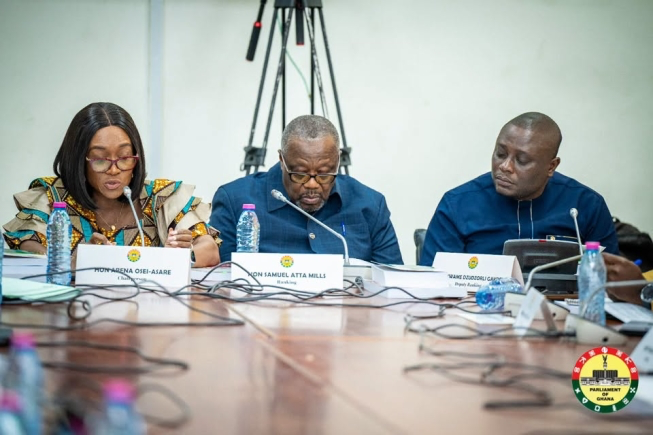
The Public Accounts Committee (PAC) of Parliament has taken the Central Regional Coordinating Council (CRCC) to task over payment vouchers totalling GH¢14,882,540.98 that were processed outside the Ghana Integrated Financial Management Information System (GIFMIS), the government’s core electronic financial management platform.
The Committee issued a stern warning to the Council: if the same breach is identified in a subsequent audit, it will be regarded as conclusive evidence that the institution failed to implement the corrective measures it claims to have introduced.
The Audit Finding
The issue came up at the Committee’s sitting on Tuesday, October 6, 2026, when it considered the Auditor-General’s 2025 report on Ministries, Departments and other Agencies. According to the audit finding presented to the Committee, the Central Regional Coordinating Council failed to process payment vouchers totalling GH¢14,882,540.98 through GIFMIS.
The Auditor-General’s 2025 report had earlier flagged “incomplete processing of transactions by covered entities through the Ghana Integrated Financial Management Information System (GIFMIS)” as a key concern, calling for strict enforcement of the Public Financial Management Act provisions backed by capacity building, system upgrades, and sanctions for persistent non-compliance.
The Council’s Defence
A representative of the Ministry of Local Government, Chieftaincy and Religious Affairs told the Committee that the transactions involved donor funds and were subsequently captured through journal vouchers. He said subsequent transactions had been processed through GIFMIS after the audit observation was raised.
The explanation prompted further questions from the Committee about why the transactions had initially been processed outside the system. A Committee member questioned whether the fact that the funds were donor-funded justified their exclusion from GIFMIS, stressing that donor funds were still public funds.
The representative later explained that the funds formed part of the approved budget and that the donor components had been captured during the budget process. He said the problem arose because, when the releases were made, there was an issue with the budget code required to process the transactions through GIFMIS. According to him, journal vouchers were subsequently raised to capture the transactions on the system and ensure that the accounts accurately reflected the expenditure.
PAC Chairperson’s Stern Warning
The Chairperson of the Committee, Abena Osei-Asare, said the concern was not only about the transactions already identified but also whether the system had since been corrected. She warned that if the same problem appeared in a future audit, the Committee would regard it as evidence that the institution had failed to implement the corrective system it claimed to have introduced.
“If we find this, then clearly we will know that you failed to learn or you failed to implement the system that you are telling us you have implemented,” she said.
The warning followed the Chairperson’s position at the opening of the 2025 audit hearings that institutions must show what had changed after previous audit findings instead of repeatedly appearing before the Committee with explanations for the same weaknesses. She said the Committee would distinguish between administrative infractions and actual financial losses, while requiring institutions to show whether audit recommendations had been implemented and weak systems corrected.
Background: What is GIFMIS?
The Ghana Integrated Financial Management Information System (GIFMIS) is an integrated computerised financial management system used across Ministries, Departments and Agencies (MDAs) at the national, regional, and district levels, as well as Metropolitan, Municipal and District Assemblies (MMDAs). Its aim is to establish an integrated ICT-based Public Financial Management (PFM) information system to improve efficiency in public financial management.
GIFMIS is under the institutional management of the Controller and Accountant General’s Department (CAGD) and remains the core financial management system for the Government of Ghana. It is designed to enhance the comprehensiveness and consolidation of financial data across covered entities. The system covers four main types of funds: the Consolidated Fund, donor funds, statutory funds, and Internally Generated Funds (IGFs).
The system was launched in 2009 but was introduced for the 2015 budget. It supports budgetary planning, budget preparation, and budget execution using a government-wide ICT platform that deploys modern best practices.
Legal Framework: The PFM Act and GIFMIS Compliance
The use of GIFMIS is not merely an administrative preference — it is a legal requirement. Section 25(6) of the Public Financial Management Act, 2016 (Act 921) mandates that all public financial transactions be processed through GIFMIS.
Regulation 83 of the Public Financial Management Regulations, 2019 (L.I. 2378) further requires that “all payments for expenditure of covered entities shall be made through the Ghana Integrated Financial Management Information System (GIFMIS)”.
The Ministry of Finance has issued Budget Implementation Instructions in accordance with the PFM Act, requiring that all Covered Entities must use the GIFMIS platform to process funds, ensuring proper accounting and reporting of approved budgetary inflows and adherence to the specified appropriation.
The Auditor-General’s 2025 report called for strict enforcement of PFM Act provisions, backed by capacity building, system upgrades, and sanctions for persistent non-compliance.
Why Donor Funds Must Go Through GIFMIS
The assertion by the Council’s representative that the transactions involved donor funds does not exempt them from GIFMIS processing. The GIFMIS platform is explicitly designed to support the management of public funds, including the Consolidated Fund, Internally Generated Funds, statutory funds, and donor funds.
The Ministry of Finance’s Budget Implementation Instructions confirm that all IGF-generating institutions must process their retained IGF portions on GIFMIS and submit GIFMIS-generated monthly returns. All Covered Entities must use the GIFMIS platform to process funding from all sources, ensuring proper accounting and reporting of approved budgetary inflows and adherence to the specified appropriation.
Donor-funded projects are expected to use GIFMIS to initiate and pay for transactions, with the platform facilitating access to expenditures of donor-funded projects where these are funded through commercial bank accounts held by MDAs.
About the Central Regional Coordinating Council
The Central Regional Coordinating Council (CRCC) exists as an arm of the Executive to provide quality administrative and technical services for Ministries, Departments, Metropolitan, Municipal and District Assemblies, and non-governmental organisations through monitoring, coordination, and evaluation of activities and performances geared towards improving the lives of citizens.
The Council is headquartered in Cape Coast, the regional capital, which was until 1877 the national capital of the then Gold Coast. The CRCC is currently led by the Regional Minister, Hon. Ekow Panyin Okyere Eduamoah, and ensures policy coherence and supports the effective operation of decentralised government agencies in the region.
About the Public Accounts Committee
The Public Accounts Committee is established under Article 103 of the 1992 Constitution and is mandated to examine the Auditor-General’s report on Ghana’s public accounts. The Committee consists of a Chairperson, Ranking Member, Vice Chairperson, Deputy Ranking Member, and up to twenty-one other members. By convention, the Chairperson is from the opposition party.
The Committee’s work is part of Parliament’s oversight functions, aimed at promoting accountability and transparency in the public sector. The PAC holds public hearings where institutions are required to respond to audit queries and demonstrate corrective measures.
The PAC has adopted a new approach to audit findings, focusing more on whether public institutions have implemented recommendations made in previous audit reports.
Broader Context: GIFMIS Non-Compliance Across Ghana
The Central Regional Coordinating Council’s case is not isolated. Audit findings across various public institutions have repeatedly identified failure to process transactions through GIFMIS. In one audit finding, the District Coordinating Director and District Finance Officer were recommended to be held jointly accountable for failing to process transactions through GIFMIS. The failure was attributed to internet connectivity challenges.
In another case, four Assemblies paid GH¢2,301,593.76 to various contractors and service providers but failed to process the transactions through the GIFMIS platform. The Finance Officers attributed the anomaly to lack of training of the Assembly’s staff as well as lack of logistics such as computers to enable them use the GIFMIS platform.
The Auditor-General’s 2025 report had also flagged that the Sefwi Akontombra Assembly made 40 payments of GH¢428,120.31 without using GIFMIS, recommending that the Coordinating Director and Finance Officer address challenges associated with the use of GIFMIS and make payments using the platform.
The Auditor-General also uncovered GH¢583 million in irregularities in African Games expenditure, citing “payments made outside the mandatory Government Integrated Financial Management Information System (GIFMIS)” among recurring patterns of financial mismanagement.
National Financial Irregularities on the Rise
The 2025 Auditor-General’s Report revealed that total financial irregularities skyrocketed by 256.3% in one year, reaching GH¢5,266,315,079 — a sharp increase from the approximately GH¢2.06 billion recorded in 2024. The report cited GH¢410.7 million in cash irregularities and significant tax losses.
The Auditor-General, Johnson Akuamoah-Asiedu, has emphasised the need for urgent attention to enhance fiscal transparency, accuracy, and accountability in public financial management.
PAC’s Determination to Enforce Change
The PAC Chairperson has previously accused some Metropolitan, Municipal and District Assemblies of undermining the work of internal auditors, contributing to recurring financial irregularities. She said many of the infractions cited in the Auditor-General’s reports could have been prevented if internal auditors were allowed to perform their duties without interference.
Speaking at the launch of the Public Financial Management Compliance League Table in Accra, she noted that strong internal controls are the foundation of accountability and prudent financial management, stressing that compliance with the Public Financial Management Act and other regulations was not optional but a statutory obligation owed to citizens.
She has also stressed that for Ghana to achieve true accountability, it must become a culture and not a one-day affair. “Deliberating on the Auditor-General’s report is the very culture we are trying to build as a nation. That does not take just one day; it must be done consistently,” she said.
What’s Next
The Central Regional Coordinating Council’s representative maintained that subsequent transactions had been processed through GIFMIS and that journal vouchers had been used to capture the earlier transactions that had not gone through the system.
The Committee has indicated it will continue to monitor compliance and will treat any recurrence of the same breach in future audits as evidence of institutional failure to implement promised reforms. The PAC’s public hearings are part of Parliament’s oversight mandate and will continue to examine the Auditor-General’s 2025 report across all MDAs and MMDAs in the coming weeks.