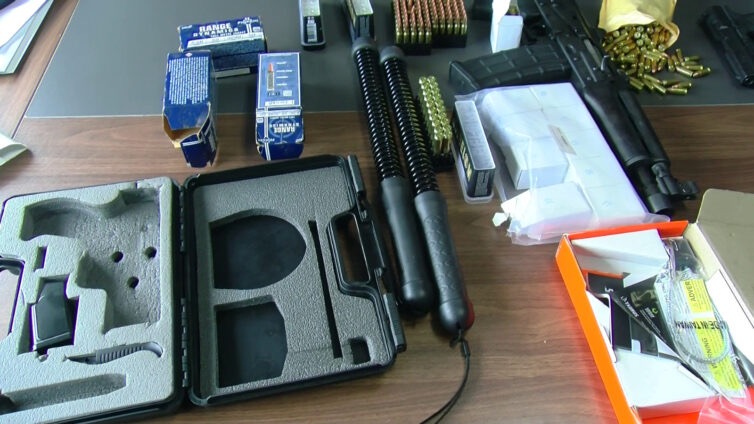
The Customs Division of the Ghana Revenue Authority (GRA) has stepped up surveillance and scanning operations at Ghana’s entry and exit points after intercepting an assault rifle, two pistols and 610 rounds of ammunition concealed among personal effects at the Tema Port, in a case that has prompted fresh warnings to importers against concealing prohibited and restricted goods.
The seizure, made at the Golden Jubilee Terminal of the Tema Port at about 5:15 p.m. on Friday, September 25, 2026, involved a consignment shipped from the United States of America and falsely declared as personal effects, without the necessary permits or documentation.
How the Interception Unfolded
According to the Deputy Commissioner in charge of Communications and Public Affairs at the GRA, Florence Asante, two Customs officers conducting a routine inspection subjected the consignment to further examination after initial scanning raised suspicions.
“The firearms, ammunition and related accessories had not been declared to Customs and were instead concealed among goods described as personal effects,” Asante told journalists at a press briefing in Accra on Monday, September 28, 2026.
The seized items included an assault rifle, two pistols and 610 rounds of ammunition, along with related accessories. The weapons have since been handed over to the Ghana Police Service for further investigation and appropriate action, while the importer has been detained to assist with investigations.
GRA Places Personnel on High Alert
Briefing journalists after the arrest, Asante announced that Customs personnel have been placed on high alert across all of Ghana’s entry and exit points, describing the interception as part of a broader intensification of scanning and physical examination of consignments.
“We want to inform the trading community and general public that Customs have stepped up surveillance and scanning activities at the entry points—not only at the Tema Port, but at all other entry and exit points,” she said.
“So, I will use the opportunity to advise people who know that items being imported are restricted or prohibited to try their best to do the needful to obtain the required license and documentation before doing so in order not to fall foul of the law. We take this caution as a serious measure to safeguard our country against illicit activities”.
Asante also cautioned importers, particularly those who accept consignments on behalf of third parties, to establish the contents of the goods before bringing them into the country, warning that ignorance of the contents of a consignment may not necessarily exempt an importer from liability for breaches of the law.
“Make sure that you have a licence to import those items and make sure you declare them correctly so that you will not fall foul of the law,” she advised.
The Legal Framework: Arms and Ammunition as Restricted Goods
Ghana’s customs regime classifies arms and ammunition as restricted goods, requiring a permit from the Ministry of the Interior for their importation. Under the Arms and Ammunition Act, 1972 (NRCD 9), as amended, no person may import or export any arms or ammunition without the prior written consent of the Minister of the Interior.
The penalties for breaching Ghana’s customs laws are severe. Under the Customs, Excise and Preventive Service (Management) Act, 1993 (PNDCL 330), any person concerned in importing prohibited or restricted goods contrary to the restriction, or who conceals such goods with intent to defraud the Republic of duty, commits an offence and is liable on conviction to a fine not exceeding three times the duty evaded or to a term of imprisonment of not less than five years and not exceeding ten years, or to both. The goods in respect of which the offence was committed shall also be forfeited to the State.
Ghana’s import prohibition framework also lists “dangerous weapons” including flick knives and other weapons considered dangerous by the Inspector-General of Police as absolutely prohibited, while other weapons and ammunition fall under conditional import restrictions requiring licences, certificates and other forms of approval before entry.
A Pattern of Port Seizures
The latest interception is part of a series of significant seizures at Tema Port that have exposed persistent smuggling attempts through Ghana’s busiest port. In June 2025, officials intercepted over 500,000 tramadol pills in two separate consignments concealed in misdeclared cargo.
More recently, in February and March 2026, the GRA intercepted a massive shipment of undeclared tramadol at Tema Port in an intelligence-led operation that led to the arrest of nine public officers, including five Customs officials, on suspicion of involvement in the smuggling attempt. Customs officers also seized 560 units of CHANG FANG diesel engines suspected to be intended for illegal mining operations at the Golden Jubilee Terminal.
In November 2025, the GRA foiled a GH¢3.6 million smuggling operation, intercepting four trucks carrying diverted goods—including 9,000 jerry cans of cooking oil—falsely declared as transit goods bound for Burkina Faso.
These cases have exposed the dual challenge facing Ghana’s port security: not only are smugglers persistently attempting to bring restricted items into the country, but in some instances, Customs officials themselves have been implicated in facilitating the illicit trade. President John Dramani Mahama has since directed the establishment of an inter-agency task force to combat narcotics trafficking through Ghana’s borders, following briefings that 10 individuals, including four Customs officers, were being held in connection with drug-related investigations.
Technology and Personnel Bolstering Surveillance
The GRA’s intensified surveillance is being supported by significant investments in scanning technology at Tema Port. The port now operates state-of-the-art cargo scanners, including the FS6000 bi-directional drive-through scanner installed at Terminal 2 in June 2025, which has a penetration level of 6/3 MeV.
Meridian Port Services has also deployed six HCVP Z60-D5 systems for X-ray screening of both import and export traffic, along with a Dataset Management System that allows Customs officers to verify cargo manifests against captured X-ray images, reducing the need for manual inspections and detecting drugs, explosives and weapons. Non-intrusive scanning technology at the port also includes GAMA, trans-infrared spectroscopy, field Raman spectroscopy and backscatter equipment that allow officers to examine cargo without opening it.
The GRA has also strengthened its K-9 Unit with trained Springer Spaniels donated by the Deutsche Gesellschaft für Internationale Zusammenarbeit (GIZ), which are deployed to detect narcotics and illegal currency at border posts.
What Happens Next
The GRA is expected to hand over the seized weapons and ammunition to the Criminal Investigations Department (CID) of the Ghana Police Service for onward prosecution. The importer remains in custody as investigations continue into the origins of the consignment and whether any other individuals or entities were involved in the smuggling attempt.
For Ghana’s trading community, the message from Customs is unambiguous: the era of exploiting gaps in port surveillance is over, and importers who fail to declare restricted items correctly will face the full weight of the law.
The GRA has advised importers seeking to bring restricted items into Ghana to contact the Ministry of the Interior for the required permits before shipping any consignment.