



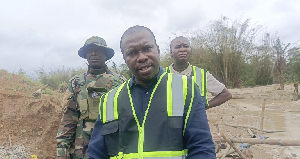
The Ghana Integrated Iron and Steel Development Corporation (GIISDEC) has appealed to the government for urgent financial and logistical support to sustain the evacuation of abandoned illegal mining equipment from galamsey sites across the country, warning that the exercise is being crippled by a lack of critical machinery and personnel.
The Chief Executive Officer of GIISDEC, Williams Okofo-Dateh, made the appeal at the Akango galamsey site in the Nzema East Municipality of the Western Region, during a national exercise by GIISDEC and the National Anti-Illegal Mining Operations Secretariat (NAIMOS) to retrieve abandoned equipment along the Ankobra River.
Okofo-Dateh said that while the operation was crucial to ridding the environment of hazardous iron and steel materials, it came at a significant cost to the Corporation due to logistical and human resource constraints.
“But this comes at a very serious cost. We have a lot of challenges in carrying out these things from the sites. We are renting equipment from outside the Corporation and it comes at a great cost,” he said.
He disclosed that GIISDEC lacked critical equipment, including cranes and low-bed trucks, needed to lift and transport heavy machinery from remote and difficult terrains where illegal mining activities had taken place. “What we need is the support of the Ministry to assist us financially, help us with logistics to be able to carry out all these things. Sometimes you need a crane to carry these things onto the trucks but we don’t have it,” he stated.
The CEO said the Akango site was considered one of the easier terrains compared with other galamsey sites the team had visited in the Eastern Region and other parts of the Western Region, where accessibility remained a major challenge. “We need men to carry these things from the very deep, very dangerous places. This place is even considered to be one of the easiest places. The other sites are very difficult,” he said. He added that the Corporation also required additional personnel to manually move heavy metal scraps from valleys and riverbeds to accessible points for loading and transportation.
The operation at Akango, which lies along the Ankobra River, saw illegal miners flee upon the arrival of the joint team, leaving behind their tools and heavy equipment. “As soon as we got here, the boys doing the mining just took to their heels and these are their tools. We’ve been tasked by the Ministry to come after these guys, collaborate with NAIMOS, seize all these tools that they use in doing galamsey,” Okofo-Dateh said.
The team worked along the banks and within the Ankobra River to retrieve chanfangs, water-pumping machines, metal pipes and other heavy machinery used for illegal mining activities. “We are collecting all these metal items from the land, from the water bodies and anywhere we find them. Once the military retrieves them, they become scrap and we have the responsibility to make sure that the environment is rid of all those things,” he stated.
Background: A Mandate Rooted in Law
The Ghana Integrated Iron and Steel Development Corporation was established by an Act of Parliament in March 2019 — the Ghana Integrated Iron and Steel Development Act, 2019 (Act 988) — with a mandate to promote and develop an integrated iron and steel industry in Ghana. As part of its broader mandate, GIISDEC is responsible for the collection and proper management of scrap metals and other waste materials generated within NAIMOS operational areas, an initiative aimed at promoting responsible resource utilisation and environmental stewardship.
The Corporation has also taken steps to regulate and formalise the scrap trade in Ghana, working with the Ministry of Lands and Natural Resources to introduce a mandatory licensing regime targeting scrap dealers and exporters.
Environmental Toll of Galamsey
The operation comes amid growing national concern over the devastating environmental impact of illegal small-scale mining. The Ankobra River, one of Ghana’s major water bodies in the Western Region, has been heavily polluted by years of illegal mining activities. In August 2026, NAIMOS raids along the Ankobra led to the destruction of 86 chanfang machines, 11 water pumps and two makeshift structures, with GIISDEC providing support to remove floating mining equipment for use as scrap.
Research indicates that approximately 60% of Ghana’s water bodies are polluted, with rivers such as the Pra, Ankobra, Offin and Densu experiencing significant increases in turbidity, reducing their potability, aquatic productivity and overall ecosystem health. Galamsey operations contribute to the pollution of water bodies with heavy metals including mercury, cadmium and arsenic, as well as river siltation, deforestation and the release of harmful chemicals such as cyanide.
A Nationwide Exercise
The exercise at Akango formed part of a national operation ordered by the Ministry of Lands and Natural Resources to ensure that abandoned tools used for illegal small-scale mining were removed from the environment. Similar operations had already been undertaken in the Eastern Region, and the exercise is expected to be extended to other galamsey-prone areas in the Western Region and across the country.
Okofo-Dateh commended the personnel of NAIMOS and the security agencies for providing protection for his team during the operation and described the collaboration as effective. “Today I’m here, I have the protection of the bureau. They are giving protection to the boys we brought around to carry all these things and I think it’s a good collaboration. With their support, we are able to do our work without any fear,” he added.
Despite the challenges, Okofo-Dateh said GIISDEC remained committed to executing its mandate of clearing scrap metals from mining sites to help protect water bodies and the environment. He appealed to the government, through the Ministry of Lands and Natural Resources, to provide the necessary funding and equipment to enable the Corporation to scale up the exercise nationwide.
The Ankobra River is one of the major water bodies the government is seeking to reclaim as part of its broader efforts to fight galamsey and restore degraded lands in the Western Region.


