



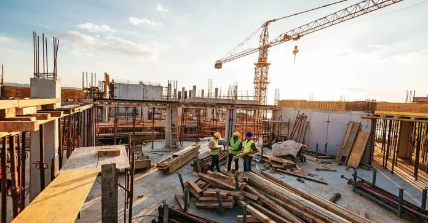
Ghana’s construction sector emerged as the largest recipient of secured credit in the second quarter of 2026, receiving nearly GH¢9.9 billion, according to the latest data from the Bank of Ghana’s Collateral Registry. The figures underscore the sector’s growing dominance in the secured lending market, driven by a surge in infrastructure spending under the government’s Big Push programme and the 24-Hour Economy policy.
Secured credit to construction surged by 900.1% year-on-year, rising from GH¢989.2 million in Q2 2025 to GH¢9.9 billion in Q2 2026. The figure represents 31.4% of the total GH¢31.5 billion in secured credit registered during the quarter, making construction the biggest destination for secured financing. On a quarterly basis, secured lending to construction increased by 147.3%, from GH¢4.0 billion in the first quarter of 2026 to GH¢9.9 billion in the second quarter.
Broader Market Expansion
The construction sector’s performance comes amid an overall expansion in Ghana’s secured credit market. Total registered secured credit increased by 73.4% year-on-year to GH¢31.5 billion in Q2 2026, up from GH¢18.2 billion a year earlier. The overall value of secured credit registered also increased by 57.5% compared with the first quarter of 2026.
However, the surge in value occurred alongside a sharp decline in registration volumes. Security-interest registrations fell 32.2% year-on-year to 92,033 from 135,721, largely driven by Savings and Loans companies, whose registrations dropped 42.4% to 68,871. The combination points to a market in which larger transactions, rather than more borrowing relationships, are driving the increase.
Commerce and Finance Follows
Commerce and Finance was the second-largest recipient of secured credit, attracting GH¢8.1 billion during the quarter, up from GH¢6.4 billion a year earlier, representing a 25.9% year-on-year increase. Services followed with GH¢4.4 billion, with secured lending to the sector growing by 154.8% year-on-year. The Mining and Quarrying sector received GH¢3.3 billion, while Manufacturing accounted for GH¢1.4 billion. Agriculture, forestry and fishing received GH¢785 million.
Sharp Movements Across Sectors
The Collateral Registry data also points to significant quarterly changes across several sectors. Secured credit to Mining and Quarrying increased by 645.8% quarter-on-quarter, while lending to Electricity, Gas and Water rose by 716.1%. The Information and Communications sector recorded an even larger quarterly increase of 914.6%, although the growth came from a significantly smaller base.
Foreign Banks Dominate
Foreign-controlled banks accounted for a dominant share of secured credit registered by banks in Q2 2026. Out of the total GH¢19.9 billion registered by banks, foreign-controlled banks registered GH¢14.1 billion, representing 71.1%, an increase of 19.3% over the GH¢11.8 billion recorded in Q2 2025. Indigenous banks registered GH¢5.7 billion, corresponding to a year-on-year growth of 112.4% from GH¢2.7 billion.
SME Lending and Large Enterprise Focus
Large enterprises received GH¢13.8 billion, representing 43.9% of all secured credit. SMEs obtained GH¢3.8 billion, up 28.9% from the same quarter of 2025, but their secured credit declined 48.2% compared with the first quarter of 2026, reflecting the greater financing constraints SMEs typically face.
Background: The Collateral Registry
Ghana’s Collateral Registry was established by Parliament under the Borrowers and Lenders Act, 2020 (Act 1052) to register security interests and collateral created by borrowers to secure credit facilities. The Registry, the first of its kind in Africa, provides a web-based platform — the Collateral Registry Application System — used to register security interests in movable and immovable assets and to conduct searches on assets pledged as collateral. Searches on the platform rose 13.9% year-on-year to 19,518, indicating growing reliance on secured transaction mechanisms and improved credit due diligence by lenders.
Construction Sector Drivers
The construction boom is being propelled by several major government initiatives. The government has allocated GH¢30.8 billion for the Big Push infrastructure programme in 2026, covering improvements in roads, rail and other critical infrastructure. In July 2026, the government announced that 87 road projects were underway under the programme, with 13 projects reaching at least 50% completion by the end of June. President Mahama has also announced that construction on the Volivo Bridge project across the Volta Lake will commence before the end of the year.
The 24-Hour Economy policy, signed into law in February 2026, has also generated significant construction activity, with every district required to commit 25% of its quarterly District Assembly Common Fund to build round-the-clock trading hubs. The government has signed a Memorandum of Understanding with the Hunan Architectural Design Institute Group to support large-scale infrastructure planning under the programme.
International analysis from Fitch Solutions projects that Ghana’s construction industry gross value added will grow by 5.2% in real terms in 2026, up from 3.1% in 2025, supported by public-private investment in transport, mining and energy infrastructure development.
Broader Economic Context
The surge in secured credit aligns with broader improvements in Ghana’s banking sector. Gross loans and advances rose 39.4% year-on-year to GH¢124.3 billion at the end of June 2026, with private businesses and households accounting for 96.2% of bank credit. Private-sector credit grew by 41.2% year-on-year in nominal terms and 34.1% in real terms in June 2026, compared with 8.6% a year earlier.
The credit expansion follows significant macroeconomic stabilisation under the Mahama administration. Inflation has declined from 23.8% at the end of 2024 to 3.2% as of March 2026, while the Ghana cedi has appreciated by more than 40% against the US dollar since 2025.
Outlook
The construction sector’s dominance in secured lending reflects the government’s infrastructure-led growth strategy, but analysts caution that the headline figures may overstate the breadth of the credit recovery. A without small number of large facilities can producing the same breadth of access as lift total credit value sharply many smaller business loans. Nevertheless, the data confirms that construction has become the primary engine of Ghana’s secured credit market, with significant spillovers expected for cement production, transport, labour and ancillary services.
The Bank of Ghana’s Collateral Registry data therefore paints a picture of a credit market in transition — one where large-scale infrastructure financing is driving unprecedented growth in secured lending value, even as the number of individual credit relationships declines.


