



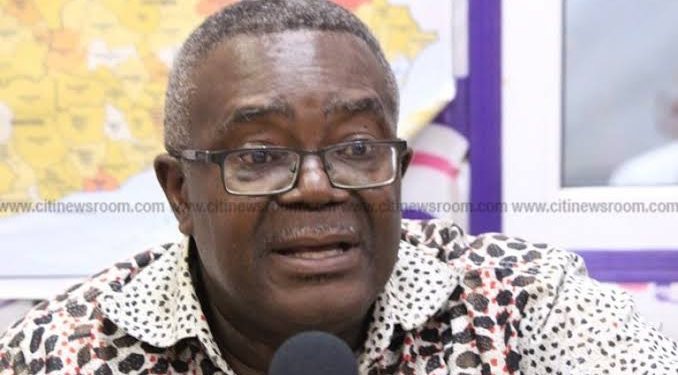
A former Director-General of the Ghana Education Service (GES), Dr. Charles Aheto-Tsegah, has described the Computerised School Selection and Placement System (CSSPS) as a failed experiment, calling for the authority to place students into senior high schools to be returned to headteachers.
Speaking on Channel One TV’s The Big Issue on Saturday, September 12, Aheto-Tsegah said the CSSPS had not delivered on the objectives for which it was established, particularly in resolving the core difficulties associated with placing Basic Education Certificate Examination (BECE) graduates into second-cycle institutions.
Original Intent vs. Reality
The CSSPS was introduced in 2005 to replace the Manual System of Selection and Placement (MSSP), which had been plagued by inefficiency, favouritism, and corruption. Under the old system, heads of senior high schools and GES officials would gather at regional centres to manually review candidates’ records, a process that left considerable room for manipulation and resulted in only 42 to 46.6 per cent of qualified candidates successfully being admitted.
Aheto-Tsegah explained that the computerised system was intended to remove excessive discretion from headteachers and replace it with algorithms that would ensure fairness and transparency.
“If you look at what informed the change to the CSSPS system, there was deep suspicion of the efforts of the headteachers. People impugned corruption and so many things and took the power away from the headteachers, and then we were thinking that we were going to use the CSSPS system with all of its algorithms to correct protocol and the whole lot of the side issues that were connected with the placement situation,” he said.
“Unfortunately, we have failed. I had the opportunity to call one of the people who led the transition and said we have failed in this whole thing because if we cannot address the key challenge that inspired us to set off to bring in the CSSPS, we have failed and we better go back and give it to the headteachers.”
A System Under Scrutiny
The call for reform comes amid renewed scrutiny of the 2026 placement process. The Ministry of Education announced that 54,985 candidates were not placed during the initial CSSPS exercise, with 35,382 candidates obtaining grade 9 in either Mathematics or English Language, while 3,372 did not sit for the examination.
Aheto-Tsegah has previously challenged the classification of these candidates, arguing that the figure should not be interpreted as a measure of academic failure.
“We need to change the way we begin to place our children in terms of looking at their general performance,” he said on Eyewitness News earlier this month. “The person might not get a credit, but would have performed so well that his progression can be considered.”
The pressure on the placement system has also been exacerbated by a surge in demand for Category A schools. Education Minister Haruna Iddrisu revealed that 328,000 students selected Category A schools during the 2026 exercise, but only 76,000 vacancies were available. The government has announced plans to upgrade 20 Category B schools to Category A status and construct 10 new model Category A schools to ease the pressure.
Decades of Unresolved Complaints
Critics note that the corruption concerns that prompted the shift from manual placement did not disappear under CSSPS—they simply changed shape. After more than two decades of operation, the recurring nature of placement-related problems suggests the fundamental question remains unanswered: whether Ghana’s placement system is transparent, predictable and fair enough to match its promise.
Aheto-Tsegah’s call to return authority to headteachers represents a significant reversal of the rationale that led to the creation of the CSSPS, and is likely to reignite debate over the most equitable way to place Ghana’s BECE graduates into second-cycle institutions.


