



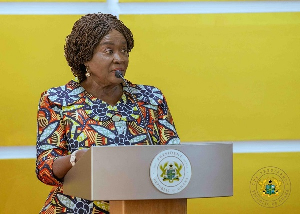
Vice President Professor Naana Jane Opoku-Agyemang has announced that the government is expanding the National Apprenticeship Programme (NAP) to provide more young Ghanaians with access to practical, technical, and vocational skills training.
Speaking at a gathering of Catholic youth in Accra on the theme “Take courage: Catholic youth as actors and agents of peace, hope in West Africa,” the Vice President said the initiative was part of broader government efforts to create sustainable livelihoods for young people .
“Our education must open doors to opportunity. Those who want to learn a skill must be able to do so, and hard work must offer a credible path to a better life,” she stated .
Prof Opoku-Agyemang emphasised that creating opportunities for young people was a critical responsibility of government, particularly as West African nations grapple with economic pressures and other challenges. “That responsibility first belongs to those of us entrusted with leadership,” she said .
Scale and scope of the programme
The National Apprenticeship Programme, launched by President John Dramani Mahama in Tamale, is designed to provide free and inclusive skills training to young people across the country, including those who may not have had the opportunity to pursue formal education .
According to the Chief Executive Officer of the National Youth Authority (NYA), Osman Abdulai Ayariga, the programme combines 30 per cent classroom-based learning with 70 per cent practical workplace training, ensuring participants acquire skills relevant to the realities of the marketplace .
The programme commenced with over 14,000 apprentices in 2025. The Minister of Youth Development and Empowerment, George Opare Addo, has announced that the government intends to enrol 100,000 young people this year . This marks a significant scale-up from the initial cohort.
The programme is backed by a US$300 million allocation in 2025 to cover training costs and stipends, removing financial barriers for beneficiaries .
Programme coverage and structure
The NAP covers nine broad areas, including agriculture and agro-processing, artisanal trades, information and communication technology (ICT) and digital services, creative arts, hospitality and tourism, personal care, and mechanical and electrical trades .
Since its launch, over 235,000 young people have applied, with 20,000 shortlisted. Of that number, 14,335 have been onboarded and are currently undergoing training, with thousands of master craft persons engaged to provide mentorship .
Master Craft Persons have been trained, certified and deployed as trainers under the programme to improve the quality, standardisation and effectiveness of apprenticeship training . The programme operates under a contractual framework to ensure that master craft persons fulfil their training obligations .
The Ashanti Region is targeting approximately 400 master craft persons and about 2,000 apprentices across various districts and constituencies . In the Atwima Kwanwoma District, six master craft persons have been selected, each assigned five apprentices .
Complementary youth initiatives
The Vice President also highlighted other government programmes aimed at supporting young people:
Adwumawura (Ejumaura) Programme: This initiative provides entrepreneurship training, business development support and access to funding, targeting 10,000 youth and businesses annually .
One Million Coders Programme: This initiative aims to equip Ghanaians with digital skills needed for a rapidly changing economy .
Additionally, the government is introducing the Graduates in Corporate Support (GRiCS) programme to provide National Service personnel with extended employment opportunities after completing their mandatory service . The Youth Employment Agency is also creating opportunities through the Labour Exchange Programme, which will facilitate the movement of skilled Ghanaian workers to countries where their skills are needed .
The NYA has also been working with the Ghana Revenue Authority to support youth-owned businesses through tax relief measures, with 21 applications for five-year tax holidays and exemptions approved so far .
Investment in Ghana’s future
The Vice President described the various programmes as investments in young people and in the stability and prosperity of the country . She said the government remained committed to improving education, creating more opportunities, supporting enterprise, and building an economy capable of generating decent and productive work .
“We are not only expanding the National Apprenticeship Programme to give more young people opportunities to acquire skills but also supporting them through entrepreneurship programmes such as Adwumawura to transition from apprenticeship to entrepreneurship,” she said.
The NYA CEO, Osman Ayariga, stressed that the Authority’s objective goes beyond increasing the number of apprentices enrolled, with emphasis also being placed on mentorship, certification and ensuring that training responds to contemporary industry requirements .
“Our objective is therefore to contribute to the transformation and professionalisation of Ghana’s informal apprenticeship sector and create a credible pathway through which Ghanaian youth can transition from skills acquisition to decent and sustainable livelihoods,” he stated .
The Vice President acknowledged that government programmes alone would not address every challenge facing young people, calling for continued collaboration between government, private sector, and development partners. “The work must continue to improve education, create more opportunities, support enterprise, and build an economy capable of creating decent and productive work,” she said .
Beneficiaries who complete the programme will receive certificates, and training facilities will be accredited to ensure quality standards . Excelling trainees may also transition into the government’s work abroad programme, opening international opportunities .


