



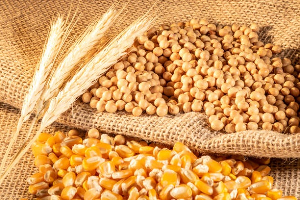
Sumaila Doho, the 2023 Upper West Regional Best Farmer, has called on the government to adopt policies that will strengthen Ghana’s maize production and reduce the country’s heavy reliance on imported grain.
Speaking during a visit to Farmer Pride maize farms at Duwie in the Sissala East Municipality, Mr Doho said Ghana has the potential to become a maize-surplus nation but continues to spend millions of dollars importing what could be produced locally. The visit formed part of the third-trimester field practical programme for students of the University of Business and Integrated Development Studies.
Economic concerns and food security risks
In an interview with the Ghana News Agency (GNA), Mr Doho warned that continued dependence on imported maize posed not only an economic threat but also jeopardised the country’s food security and the livelihoods of local farmers.
According to the U.S. Department of Agriculture’s Grain and Feed Annual 2025 Report, Ghana is projected to import 500,000 metric tonnes of corn during the 2025/2026 marketing year—a 67 per cent increase over the 2024/2025 estimate—despite anticipated improvements in local harvests . Local production is forecast at 3.3 million metric tonnes, up 26 per cent from the previous year’s 2.6 million metric tonnes, driven by expanded cultivation area and favourable weather projections .
However, the Ghana Meteorological Agency has forecast normal-to-below-normal rainfall and possibly longer dry spells in 2025, raising caution flags that could impact production .
Mr Doho noted that maize remains one of Ghana’s most vital food crops, serving as a staple in meals such as kenkey, banku, tuozaafi and koko, while also providing critical inputs for the poultry and animal-feed industries.
‘We are supporting foreign farmers’
The commercial farmer argued that importing maize from countries such as Argentina, South Africa and the United States meant Ghana was effectively creating jobs and economic opportunities for foreign farmers while local producers struggled to find markets.
“When Ghana imports maize, we are paying foreign farmers and supporting foreign agricultural value chains, while our own farmers are sometimes left with unsold produce,” he said .
He stressed that greater support for local maize production would keep more money within the Ghanaian economy and improve the livelihoods of farming families across the country’s major maize-producing regions.
Lessons from global shocks
Mr Doho described local maize production as critical to Ghana’s long-term food security, pointing to global events including the COVID-19 pandemic and the Russia-Ukraine war, which demonstrated the vulnerability of international food supply chains when fertiliser and grain prices spiked sharply .
He also noted that fluctuations in the value of the Ghana cedi could make imported food significantly more expensive, adding that “a country that cannot feed itself cannot claim to be truly independent.”
Proposals for industry transformation
Mr Doho proposed several measures to transform Ghana’s maize industry, including a guaranteed minimum price and market for maize. He suggested that the National Food Buffer Stock Company (NAFCO) should announce a fair minimum price before the planting season and commit to purchasing from farmers—a policy that would give farmers the confidence to invest in expanding production without fear of heavy losses at harvest .
The government has already taken steps in this direction. The Ministry of Food and Agriculture recently announced the establishment of five maize processing factories across the country as a long-term solution to address gluts, with NAFCO engaging approximately 45 accredited licensed buying companies to purchase locally produced grains at guaranteed minimum prices . An initial GH₵100 million was released in November 2025, with an additional GH₵200 million provided in the 2026 Budget .
However, farmers have expressed frustration over delays in actual purchases. The Peasant Farmers Association of Ghana (PFAG) has reported that more than 200,000 metric tonnes of unsold paddy rice and maize remain stuck in warehouses and on farms, with some rice still unharvested .
In April 2026, President John Dramani Mahama unveiled a major plan to transform Ghana’s maize and rice production into a large-scale export industry, with five new maize processing plants to be established and expanded rice milling capacity, including a major facility in the Fumbisi Valley .
“We have excess maize and rice production. The opportunity is not just to store, but to process, export, and bring foreign exchange back to Ghana,” the President said during his Resetting Ghana tour in the Northern Region .
Mr Doho also called for increased investment in storage and processing facilities to address post-harvest losses, stronger links between maize production and industries involved in animal feed, flour and starch production, timely access to affordable agricultural inputs, and investment in irrigation facilities to reduce dependence on rain-fed agriculture .
The Feed Ghana Programme, launched in April 2025 as part of the government’s Agriculture for Economic Transformation Agenda, is already working to address these challenges by supporting farmers with improved seeds, fertilisers, mechanisation services and extension support . According to the 2026 Budget, the government plans to supply 4,388 metric tonnes of maize seed, 31,000 metric tonnes of rice seed, and 272,000 metric tonnes of fertilisers in 2026 to consolidate yields .


