



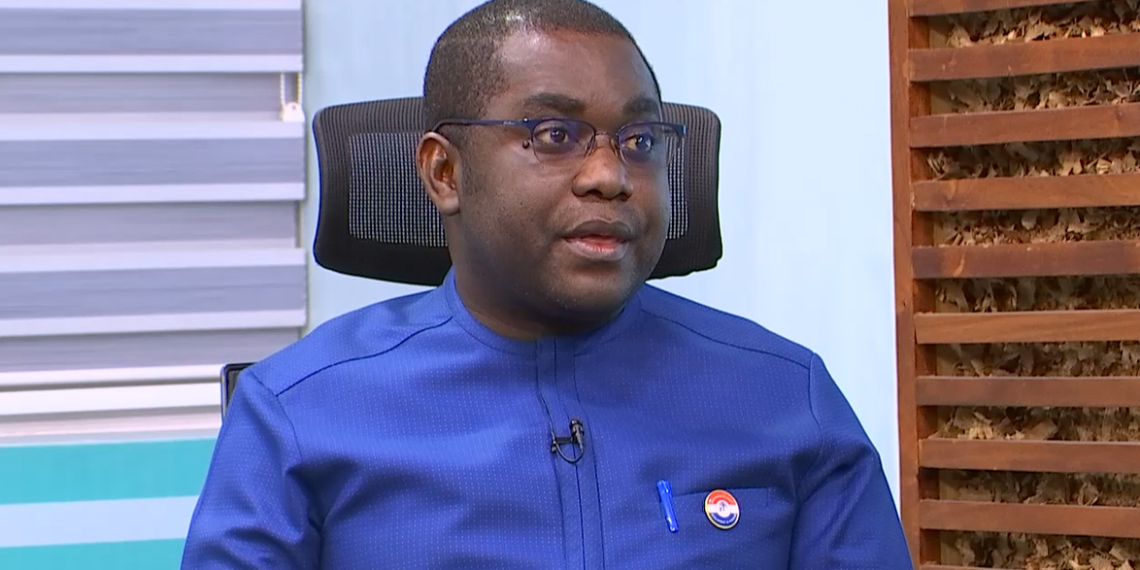
Aspiring General Secretary of the New Patriotic Party (NPP) and former Deputy Ambassador to China, Dr Charles Dwamena—popularly known as Dr China—has issued a strong caution to Ghanaian traders, regulators, and consumers regarding the quality of goods imported from China.
Speaking in an interview with Umaru Sanda Amadu on Channel One TV’s Face to Face on Tuesday, September 8, Dr Dwamena stressed that Chinese manufacturers produce goods in multiple quality grades, making it crucial for local stakeholders to exercise due diligence before procuring products for the Ghanaian market.
“This is like doing business with your twin brother or your twin sister. The onus will be on you to cross your T and dot your I,” he said.
He warned against the assumption that products from Chinese manufacturers are automatically of good quality because of the close trading relationship between the two countries. “If you just take it on the surface that, oh, that’s my twin brother, so I’ll not do the due diligence, you’ll be eating your kenkey raw,” he cautioned.
According to Dr Dwamena, the quality segmentation in Chinese manufacturing is extensive. “If it’s a pair of shoes they are producing, they’ll have about 10 grades. Top grade, then the lowest grade. It’s up to you to choose which one you want,” he explained.
A Call for Shared Responsibility
The former diplomat stressed that responsibility for ensuring quality must be shared across the entire supply chain—from importers to regulators, and ultimately to consumers.
“It’s also up to the regulators at the entry point to ensure that we do not allow inferior products to come in,” he said.
He also cautioned consumers against prioritising low prices over quality. “If you always go with the lower price, you may not necessarily be getting what quality is,” he warned.
Dr Dwamena drew a comparison with the European Union market, where stringent regulations at entry points compel manufacturers and importers to prioritise quality. He noted that consumers in such markets also play an active role by demanding quality rather than simply seeking the cheapest products.
“The consumer is not only after cheaper prices, but looking for quality,” he said.
He therefore argued that Ghana should look beyond blaming Chinese manufacturers for the quality of products available on the local market. “You can’t blame that on the Chinese manufacturer. So you need to look at your own space—the people going for it and the people who are regulating at the entry point. And of course, eventually the buyers who are going to buy these things,” he said.
Current Regulatory Landscape
The comments come amid ongoing efforts to tighten import quality controls in Ghana. Since July 1, 2026, the Ghana Standards Authority (GSA) has assumed direct control of the EasyPASS Conformity Assessment Programme, which requires pre-shipment quality verification for a wide range of imported industrial and consumer goods, including chemical products, plastics, textiles, metals, machinery, vehicles, and measuring equipment . Goods that meet the required standards are issued a Certificate of Conformity (CoC), which must be presented at the point of entry .
However, the Consumer Protection Agency (CPA) recently called for legal action against five e-commerce platforms, including Temu, for selling imported products that have not been certified by the FDA or GSA . The agency cited consumer complaints involving defective products, including a belly-fat reduction cream that allegedly caused severe skin burns and an electronic device that reportedly exploded while charging .
The FDA and CPA have also conducted enforcement operations, including a crackdown on unregistered baby diapers in Cape Coast and Kasoa, where 140 packs and 50 pieces of unregistered diapers were seized .
Trade at a Crossroads
Ghana’s trade relationship with China has grown significantly, with bilateral trade surpassing $14.1 billion, marking a year-on-year increase of more than 193 percent, according to Ghana’s acting Chinese Ambassador . China has also announced zero-tariff treatment for 53 African countries, including Ghana, effective May 2026, creating new opportunities for Ghanaian exports .
However, Ghana continues to record a trade deficit with China, and officials have cautioned that the country must address non-tariff barriers, including limited customs capacity and quality compliance, to fully benefit from the trade relationship .
A Systems Man for the NPP
Beyond his comments on trade, Dr Dwamena is currently vying for the position of NPP General Secretary. The current National Treasurer has gained a reputation for financial administration and systems reform, having grown the party’s internally generated funds from GH¢100 per month to a current daily average of GH¢30,000 through improved systems and accountability measures .
His campaign is anchored on the theme “Let’s Rebuild to Restore the Love,” and he has pledged to prioritise welfare schemes for party members, including a group accident insurance scheme, a political mentorship programme, and a business incubation fund . He has also called on President John Dramani Mahama to continue the One District, One Factory (1D1F) programme, drawing lessons from China’s approach to industrial development and youth entrepreneurship .
As Ghana navigates its deepening economic ties with China, Dr Dwamena’s message serves as a timely reminder that quality assurance begins at home—with informed choices, robust regulation, and a culture of consumer vigilance.


