



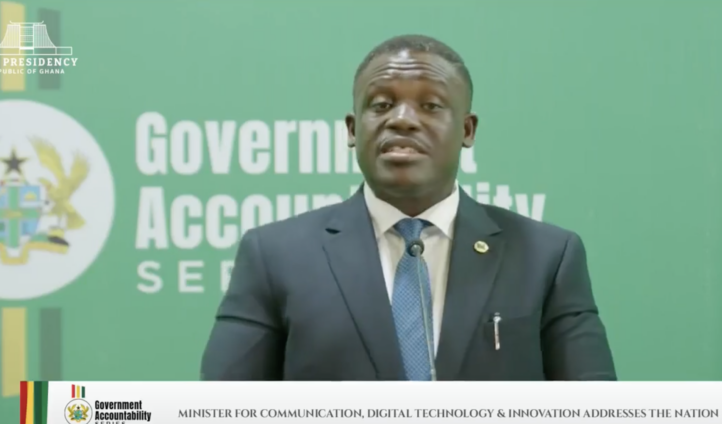
Ghana is set to complete the assignment of spectrum for 5G services and begin deployment by December 2026, Communications, Digital Technology and Innovations Minister Samuel Nartey George has announced .
The development forms part of the government’s commitments to improve the quality and reliability of telecommunications services while expanding access to faster mobile connectivity across the country .
Speaking at the Government Accountability Series at Jubilee House in Accra on Monday, September 7, Mr George said the Ministry would introduce a series of measures to improve network quality, including a road-excavation coordination framework and an Emergency Telecommunications Framework .
Operators will be required to meet upgraded network-quality standards as part of the new arrangements, with the Minister emphasising that poor network quality would no longer be overlooked .
Major private sector investment
The announcement comes as MTN Ghana has committed more than $1.1 billion over the next three years towards the expansion and improvement of its telecommunications network, including the nationwide rollout of 5G services .
Mr George disclosed that approximately $380 million is earmarked for the current year alone, to be spent on improving network coverage, deploying additional cell sites and supporting the rollout of 5G infrastructure .
The investment package includes plans to establish 800 new network sites across Ghana, with 80 sites planned for the Northern, North East, Savannah and Upper East regions . Mr George noted that this represented the highest annual build the company had undertaken in a decade, with 180 of those sites already active and carrying traffic .
Policy shift on 5G licensing
The December timeline for 5G deployment follows a significant policy shift earlier this year when the government ended the exclusive rights previously granted to Next-Gen InfraCo (NGIC) to build and operate the country’s wholesale 5G network .
The decision to open the 5G market to competition came after repeated rollout delays under the wholesale model. NGIC was granted a 10-year licence in May 2024, but the exclusive concession has now been terminated eight years before its scheduled expiry in 2034 .
The National Communications Authority (NCA) has since launched a call for applications for 5G spectrum licences, open to mobile network operators, mobile virtual network operators, wireless access providers, internet service providers, and new entrants that are 100 percent Ghanaian-owned .
Licence holders will be required to meet strict rollout and coverage obligations, including providing outdoor mobile broadband coverage to at least 70 percent of Ghana’s population by March 2027, based on the 2021 national census .
Addressing fibre cuts and network disruptions
Mr George also addressed the persistent challenge of fibre cuts, disclosing that road construction under the government’s “Big Push” programme accounts for roughly half of all road-related fibre cuts each month .
The Minister revealed that Ghana recorded nearly 4,300 fibre cuts in the first half of 2026, with the sector expected to spend more than $20 million this year repairing damaged fibre infrastructure .
He cited an incident along the Winneba-Mankessim road, where a damaged fibre cable caused a 17-hour outage, affecting data services from Winneba through to Cape Coast .
To address the problem, the government is working on a “Dig Once” policy, a joint Cabinet Memorandum between the Ministry and the Ministry of Roads and Highways that would require road construction projects to make provision for dedicated fibre chambers alongside roads .
Illegal mining, known as galamsey, accounts for about 25 percent of fibre cuts, while private developments and estate construction represent approximately 26 percent .
Reforms and customer protections
The Minister said the NCA would also launch its online licensing and payment portal, finalise the road-excavation coordination framework, and introduce cost-recovery penalties to address damage to telecommunications infrastructure .
“The rapid completion of network-quality upgrades is mandatory and non-negotiable,” Mr George stated .
He added that the NCA would prepare a framework for customer remedies and sanctions against telecommunications operators that failed to meet required service standards .
Mr George linked the ongoing reforms to rising demand, noting that national smartphone penetration had increased to 71.8 percent as of June 2026, up from 27.5 percent in 2016 .
“The work is far from finished, and I will not pretend otherwise. But the direction is unmistakable, the results are measurable, and the resolve of this Ministry is unshaken,” he said .


