



Former Environment Minister argues that Ghana has known about its environmental challenges for decades but consistently fails to sustain solutions, describing the country as stuck on a “roundabout” of policy abandonment.
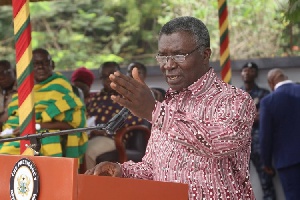
Ghana’s environmental crisis is not primarily a problem of inadequate knowledge but a political failure rooted in the inability to act on challenges the country has identified for nearly 50 years, former Environment, Science, Technology and Innovation Minister, Prof Kwabena Frimpong-Boateng, has said .
Delivering the keynote lecture at the Fourth Annual Colloquium of the Department of Political Science Education at the University of Education, Winneba, the cardiothoracic surgeon turned environmental campaigner argued that Ghana “is not at a crossroads” in its environmental management but is instead “on a roundabout” — repeatedly confronting the same problems without sustaining the solutions needed to address them .
The lecture, titled “Airs, Waters, Places — and Ghana: Politics, the Environment, and the Habit of Abandonment,” examined Ghana’s environmental challenges through the lens of governance, politics and policy continuity .
Diagnosis Is the ‘Cheap Part’
According to Prof Frimpong-Boateng, Ghana has sufficient technical knowledge to diagnose problems such as pollution, environmental degradation and the destruction of natural resources. He described diagnosis as the “cheap part” of the challenge .
“The expensive part is doing something about it,” he stressed, insisting that the failure to act cannot simply be attributed to a lack of technical knowledge .
He argued that Ghana’s challenge is rooted in what he described as the country’s “mental environment” — the attitudes and behaviours that determine what society tolerates, neglects or chooses to address. While the physical environment is often the focus of environmental discussions, the mental environment is equally important because it influences how people respond to environmental threats .
‘Rivers Do Not Vote’
Prof Frimpong-Boateng identified a fundamental mismatch between Ghana’s political cycle and the time required for environmental policies to produce results. Political leaders operate within relatively short electoral cycles, while environmental problems and their consequences develop over much longer periods .
“Environmental enforcement carries an immediate political cost for the person or institution enforcing the law, while the consequences of failing to enforce environmental regulations are often delayed and less politically visible,” he explained .
“The political cost of enforcing environmental law falls on the enforcer; the political cost of not enforcing it falls on nobody,” he said, creating a structural incentive for governments to avoid difficult environmental decisions .
He further noted that environmental benefits are often delayed and widely distributed, whereas the political costs of enforcement tend to be immediate and concentrated. “Rivers do not vote,” he said, illustrating the difficulty of translating environmental protection into immediate political rewards .
‘Minister for Consequences, Not Causes’
Prof Frimpong-Boateng also argued that Ghana’s environmental governance structure makes it difficult for the sector responsible for the environment to address the root causes of environmental degradation .
He described the Environment Ministry as essentially a “minister for consequences, not causes”, because many of the activities that damage the environment — mining, land-use planning, sanitation, energy, roads, agriculture and industry — fall under other sectors .
He stressed that treating the environment as a stand-alone sector rather than the foundation upon which other sectors depend contributes to the country’s inability to effectively manage environmental challenges. Water, for instance, should not be treated merely as an environmental issue because it is directly linked to public health .
Operation Vanguard Gains Were Not Sustained
Using Ghana’s fight against illegal mining as an example, the former minister recalled the establishment of Operation Vanguard in July 2017, which involved about 400 military and police personnel deployed to parts of the Eastern, Ashanti and Western regions .
According to him, the intervention produced measurable improvements, including a reduction in turbidity, lower water treatment costs and the recovery of some water bodies. The Pra River, for instance, began running clear, while fishermen reported improvements in fish catches .
However, Ghana failed to sustain the gains made. He described how the country subsequently developed a broader system to tackle illegal mining — an “architecture” built over about 20 months — only to abandon its conditions and mechanisms .
The measures included the establishment of 72 District Committees on Illegal Mining, training of miners in sustainable mining practices, mapping and verification of small-scale mining concessions, the development of an electronic licensing system, tracking of earth-moving equipment, alternative livelihood programmes, mercury-free gold processing initiatives, satellite and drone monitoring, and reforms to strengthen oversight of small-scale mining .
He said the system was developed between April 2017 and December 2018, but many of its components were subsequently abandoned. He described this pattern as a form of policy abandonment in which systems gradually cease to function without any formal decision being taken to repeal them .
‘Enforcement Without Alternative Is Theatre’
Prof Frimpong-Boateng further argued that enforcement alone cannot sustainably resolve environmental challenges such as illegal mining .
He said people engaged in galamsey respond to the economic realities of their lives and that enforcement without credible alternatives risks merely moving the problem elsewhere .
“Enforcement without alternative is theatre,” he said, arguing that soldiers or other security personnel deployed without accompanying economic alternatives could turn affected communities against the state. He said this was one reason previous campaigns against illegal mining had struggled to achieve lasting results .
He stressed that environmental enforcement must therefore be accompanied by practical and credible alternatives for people whose livelihoods depend on activities that are being restricted .
Call for Institutional Reforms
To address what he described as Ghana’s recurring environmental policy failures, Prof Frimpong-Boateng proposed a number of institutional reforms :
· A National Environmental Compact, negotiated across political parties and ratified by Parliament, to establish a limited number of long-term environmental commitments that successive governments would not be able to abandon administratively
· Personal liability for officials who issue permits affecting gazetted wetlands, watercourses, drainage systems and forest reserves
· An annual State of the Environment audit presented to Parliament
· A system for publicly registering seized and released mining equipment
· The creation of a statutory Environmental Restoration Fund financed from mineral royalties
Partisan Failure
In recent interviews, Prof Frimpong-Boateng has been equally critical of both major political parties. He accused the NPP and NDC of both benefiting from illegal mining activities, stating bluntly: “NPP loved it, NDC loved it. NPP went, and NDC has come; they love it. NPP, NDC are all from the same parents as far as galamsey is concerned” .
He also observed that some areas are getting worse, pointing to the district of the current Lands Minister, Emmanuel Armah-Kofi Buah, as “one of the worst areas in Ghana” for galamsey activity .
His comments add to the growing chorus of voices warning that Ghana’s environmental crisis has reached a critical juncture, with forest reserves, water bodies and farmlands under unprecedented threat from illegal mining operations .


